Investing in financial products involves risk. Losses may exceed the value of your original investment.
The Crypto Trading Starter Kit
A plain-English PDF: what to check before you trade, how orders and risk really work, and the mistakes to skip. Get it free.
Quick answer
Crypto trading jobs span market making (Wintermute, Jump, GSR), OTC desks (Cumberland, B2C2), prop trading, exchange trading teams, and DeFi-native roles. Junior trader pay starts around $80,000-$150,000 base plus performance bonus; senior market makers can clear $500,000+. Typical entry: quant or finance background, demonstrable PnL, and Python or C++ fluency.
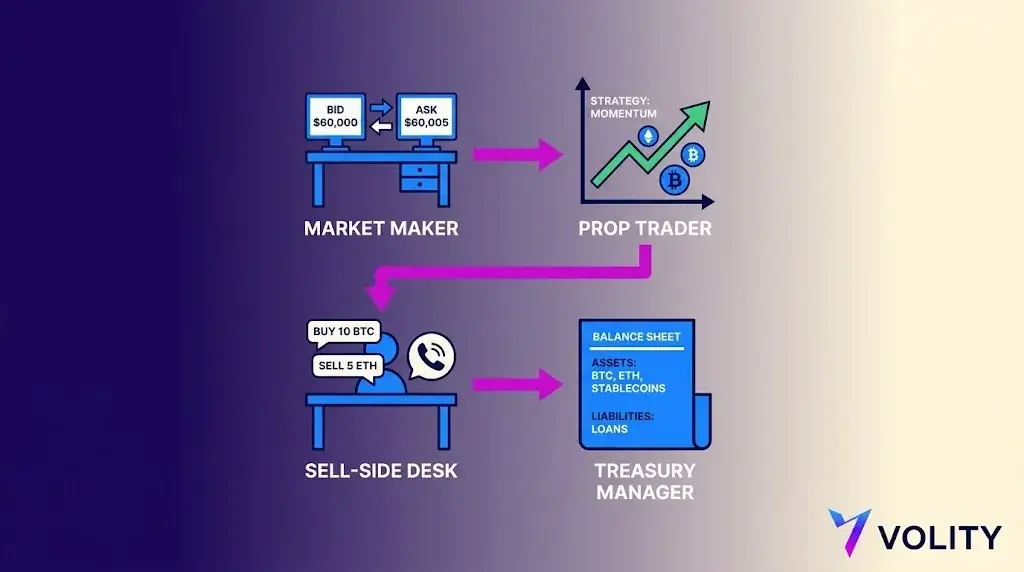
Crypto trading jobs split across four families: market making, proprietary trading, sell-side desks, and corporate treasury. Each has different skill profiles, pay bands, and entry paths. The romantic image of the lone trader getting rich on a screen does not describe how most of the seats actually work in 2026. The seats are predominantly engineering-led, risk-managed, and team-based. Here is the realistic map of the industry, the compensation ranges, and how outsiders break in.
The four families of trading seats
- Market making. Posting two-sided quotes on exchanges, capturing the spread, earning maker rebates. Inventory-neutral by design. Firms include Wintermute, Jump Trading’s crypto arm, GSR, and Cumberland (DRW).
- Proprietary trading. Firm capital, directional and statistical strategies. Includes multi-strategy crypto desks and crypto-native prop shops.
- Sell-side / OTC. Quoting and executing block trades for institutional clients. The desk warehouses risk briefly and hedges. Includes Galaxy Digital, B2C2 and bank crypto desks such as Standard Chartered.
- Corporate treasury / asset management. Running the crypto book at exchanges, miners, public companies with a treasury allocation, and tokenised-fund managers.
The roles inside each family
| Role | What they do | Typical background |
|---|---|---|
| Quant developer | Builds trading strategies and execution infra | CS/maths PhD or strong eng background, Python/C++ |
| Quant researcher | Designs the alpha; backtests; statistical work | PhD in maths/physics/stats; published research a plus |
| Trader (discretionary) | Manual or semi-systematic execution; market sense | Trading floor experience, FX or commodities pivot |
| Risk manager | Position limits, VaR, scenario tests, post-trade | Risk background from bank or hedge fund |
| Execution / operations | Settlement, custody, exchange ops | Back-office at a regulated venue or fund |
| Strategist / analyst | Macro and on-chain views; client-facing | Sell-side research or buy-side analyst experience |
Compensation: what the bands actually look like
Crypto trading compensation is bifurcated. Top firms pay at or above traditional-finance benchmarks; smaller crypto-native shops pay less in cash and more in equity or token allocations. Approximate 2026 ranges (USD, total comp) for experienced hires in major hubs (NY, London, Singapore):
- Junior quant developer (1-3 years): $180k-350k.
- Senior quant developer (5-8 years): $400k-900k.
- Quant researcher (top firms): $500k-2m+ at the high end.
- Trader (book PnL accountable): $200k base + variable bonus tied to PnL, ranging from zero to multi-million.
- Risk manager (senior): $300k-600k.
- Operations / settlement: $100k-250k.
Token allocation can dwarf cash at successful crypto-native firms during bull markets and go to zero in downturns. Treat it as optionality, not income.
What firms actually screen for
Three signals across nearly every interview process:
- Quantitative aptitude. Probability, statistics, mental math under time pressure. Brain-teasers and Bayesian puzzles are still standard.
- Coding ability. Python and at least one of C++/Rust/Go. Live coding interviews are now standard at quant-heavy firms.
- Crypto-native curiosity. Familiarity with on-chain mechanics, exchange microstructure, funding rates, MEV. You do not need to be a maximalist; you do need to demonstrate that you have read the docs.
How outsiders break in
Five paths that actually work, in rough order of likelihood:
- Pivot from traditional finance. FX, commodities, or rates desks port well into crypto sell-side and OTC roles.
- Engineering route. Backend or low-latency engineering at a fintech or HFT, then move into crypto trading infrastructure.
- Quant academic. PhD in a quantitative field, lateral hire into a research seat. The signal is published work plus a stated trading interest.
- Open-source contribution. A demonstrable track record building or contributing to open-source crypto tooling (CCXT, Hummingbot, custom indicators) gets junior interviews at crypto-native shops.
- Personal track record. A multi-year, audited PnL on a personal account with consistent risk-adjusted returns. Real, not advertised. Most firms verify with a take-home or live trading exercise.
What does not work
- YouTube credentials. A trading channel or paid Discord is not a substitute for a verifiable PnL.
- Bootcamp alone. “Crypto trading bootcamps” without an associated job pipeline rarely lead to seats.
- Influencer status. Followers do not translate to a desk role. Firms hire for risk-adjusted returns and engineering rigour.
Geographic concentration
Major hubs in 2026: New York, London, Singapore, Hong Kong, Dubai, and Chicago for HFT. Remote roles exist but are concentrated at smaller firms; major desks still prefer in-office for risk and compliance reasons.
Regulatory backdrop
MiCA in the EU, MAS licensing in Singapore and FCA registration in the UK have professionalised hiring at firms operating in those jurisdictions. Compliance has grown from an afterthought into a standing share of every trading team’s headcount, and those roles are now among the easier ones to enter from outside the industry.
Volity for active traders
For traders evaluating personal account performance before pursuing a seat, Volity offers regulated CFD exposure to 20+ cryptocurrencies, plus forex, indices, commodities, and equities, on MT4 and MT5. Trading is executed by UBK Markets Ltd, a Cyprus Investment Firm authorised by CySEC under licence 186/12. Retail leverage is capped at 1:2 on cryptoassets under ESMA. Negative balance protection applies on retail accounts.
Volity operates a trading platform and also publishes educational and analytical content about trading. The content on this page is for educational purposes only and should not be considered financial advice. Volity may benefit commercially when readers open trading accounts through links on this site.
Our content is produced and reviewed under documented editorial standards; see our comparison and review methodology.
Frequently asked questions
What roles actually exist in crypto trading?
The main clusters are trading and market making, quantitative research, engineering for low-latency and exchange systems, risk and compliance, and operations covering settlement and custody. Engineering and compliance roles outnumber discretionary trading seats.
Do I need a finance degree to break in?
For quantitative and engineering roles, demonstrable skill in mathematics, statistics and programming matters more than the subject on your degree. For compliance and operations, familiarity with the regulatory framework carries more weight.
What is the most realistic entry route?
Building something verifiable. A documented research project, a working backtest with honest cost assumptions, or contributions to open-source tooling give a hiring manager evidence, which a general application does not.