Investing in financial products involves risk. Losses may exceed the value of your original investment.
The Crypto Trading Starter Kit
A plain-English PDF: what to check before you trade, how orders and risk really work, and the mistakes to skip. Get it free.
Quick answer
To start day trading crypto, open and close positions within the day on the most liquid coins, cap risk at 0.5% to 1% of equity per trade, write your entry and exit rules down, and enforce a daily max-loss circuit breaker. Begin on a demo, journal every trade, and scale size only once your process is consistent. For the overview, see day trading crypto; for the methods, see crypto day trading strategies.
Day trading crypto means opening and closing every position inside the same 24-hour window, with no overnight risk and no funding-rate carry. The appeal is obvious: crypto trades around the clock, it is materially more volatile than equities, and a small account can take a lot of setups in a week. The reality is that most retail day traders blow up inside 90 days, almost always for the same three reasons: leverage abuse, no edge in their setup, and no journal. Our desk view in 2026 is simple. Day trading is a craft, it pays the people who treat it as one, and it punishes everyone else.
What is day trading in crypto, exactly?
A day trade opens and closes inside a single calendar day. In crypto there is no formal session close, so the working definition we use on the desk is: position held for less than 8 hours, no funding period crossed, no overnight gap risk. Inside that bucket sit three sub-styles:
- Scalping: holds of 30 seconds to 10 minutes, targeting 5-20 basis points per trade.
- Intraday momentum: holds of 30 minutes to 4 hours, targeting 1-3% per trade.
- News and event trades: opportunistic, around CPI prints, FOMC, ETF flow data, or COIN earnings.
How much capital do you actually need?
An honest floor: $5,000 of risk capital. Below that, fixed costs (spread, commission, withdrawal) consume a meaningful share of every trade. A more realistic working account is $10,000 to $25,000. At 1% risk per trade and 1:2 retail crypto leverage under ESMA, a $10,000 account risks $100 per setup and can carry roughly $2,000-$4,000 of notional comfortably. That is enough to express a thesis without forcing concentration.
When do we actually trade?
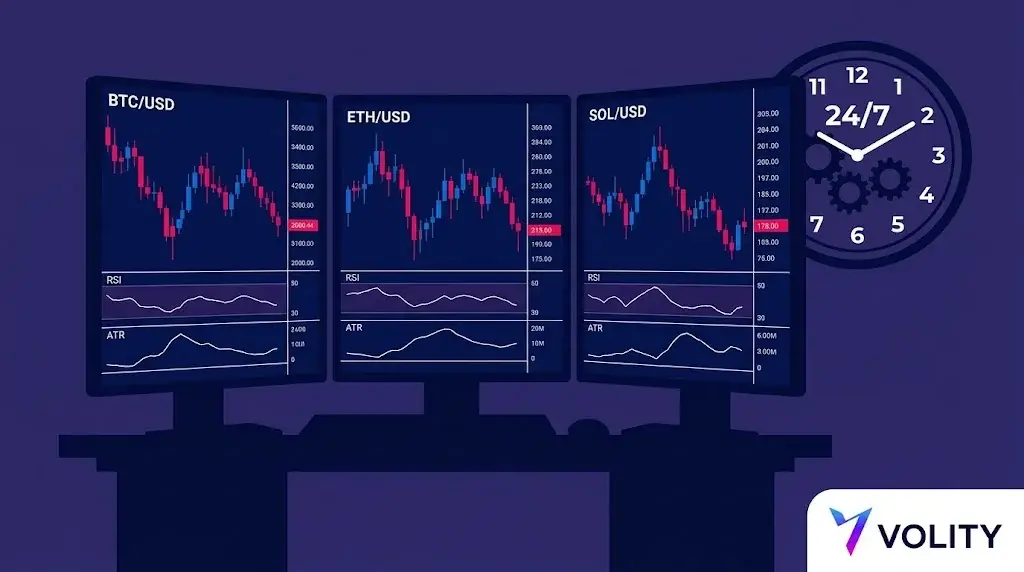
Crypto runs 24/7, but liquidity does not. The desk hours we run, in UTC:
- 00:00-03:00: Asia open. Active in JPY pairs and Asia-listed alts.
- 07:00-10:00: London open. Highest BTC/ETH spot volume of the day.
- 13:30-16:00: US open and macro-data window. CPI, NFP, FOMC all print here.
- 20:00-22:00: US close into Asia handover. Often the cleanest trend-day continuation window.
Weekend volume is a fraction of the weekday figure. Spreads widen, slippage worsens, and a single whale can move BTC 2% in a minute. We size weekends down by half or skip them entirely.
What edge are we actually looking for?
Three setups carry our flow. They are not secret, they are repeatable, and they require patience.
- Opening-range breakout. The first 30 minutes after London open define a high and low. A clean break of either, on rising volume, is the trigger.
- Failed-move reversion. Price pushes through a level, fails to hold, and snaps back inside. Stop just beyond the failure wick, target the opposite side of the range.
- Macro-reaction fade or follow. CPI prints hot, BTC drops 2% in 90 seconds, then chops. We trade the second move, not the first.
Risk controls: the non-negotiables
- 1% account risk per trade. Maximum.
- 3% daily loss cap. Hit it, close the platform, walk away.
- 5 trades per day, hard cap. Beyond 5, edge converges to randomness for almost every retail style.
- No revenge trades. After a stop-out, mandatory 15-minute pause.
- 1:2 leverage ceiling. ESMA caps retail crypto leverage at 1:2 in the EEA. We do not push past it even where rules permit.
Why most day traders lose money
The 70-80% retail-loss figure broker disclosures cite is real, and crypto sits at the higher end. We see four root causes:
- Leverage drift. Starting at 1:2, creeping to 1:5, blowing up at 1:10.
- Setup creep. Trading every chart that looks interesting instead of three high-conviction patterns.
- No journal. Without a written record of entry, stop, target, and outcome, you cannot tell luck from edge.
- Cost blindness. A 0.1% round-trip cost on 5 trades a day is 2.5% a week. The strategy has to clear that bar before it is even profitable.
Tools we actually use
- One charting platform (TradingView or MT5) with saved layouts for BTC, ETH, SOL.
- A spreadsheet journal: 8 columns, 1 row per trade. No fancier tooling needed for the first 200 trades.
- An economic calendar pinned to a second monitor.
- A funding-rate dashboard for the major perps. Funding spikes are signals, not noise.
Day trading crypto at Volity
Volity offers CFD exposure to 20+ cryptocurrencies on MT4 and MT5. Retail leverage on crypto is capped at 1:2 under ESMA. Negative balance protection applies. Eligible retail clients of UBK Markets are covered by the Cyprus Investor Compensation Fund up to EUR 20,000 per client per firm in the event of broker insolvency. Execution is by UBK Markets Ltd, a Cyprus Investment Firm authorised by CySEC under licence 186/12.
Volity operates a trading platform and also publishes educational and analytical content about trading. The content on this page is for educational purposes only and should not be considered financial advice. Volity may benefit commercially when readers open trading accounts through links on this site.
Our content is produced and reviewed under documented editorial standards; see our comparison and review methodology.