Investing in financial products involves risk. Losses may exceed the value of your original investment.
Bitcoin price morgan is a core topic for traders in 2026. The complete guide follows.
Crypto markets heat up amid bitcoin push and institutional bets
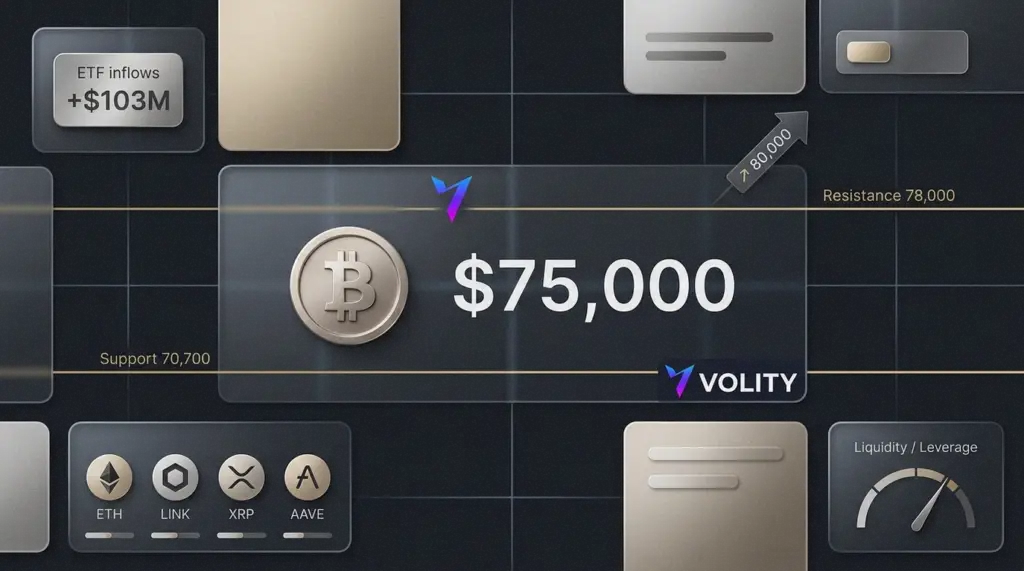
Bitcoin hovered near $75,000 into the session, and the tone felt decisively risk-on. However, the tape still carried that familiar crackle of leverage, with traders watching for forced liquidations below $70,700 and again near $78,000. Meanwhile, equity markets stayed buoyant on hopes of a calmer geopolitical backdrop, and crypto rode the same wave with less resistance than it has managed in weeks.
Still, the set-up looked binary. The next sharp move might not need fresh news, just a bout of thin liquidity at the wrong hour.
Bitcoin eyes resistance as ETF demand returns
Institutional appetite pushed back into view after Morgan Stanley’s Bitcoin ETF took in $103 million of net inflows, outpacing close rivals on the day. The market read it as more than a one-off allocation. It looked like the start of another allocator rotation, especially as spot products keep soaking up supply while traders rebuild exposure through derivatives.
On Gate.io, bitcoin traded through $75,000 and tempted breakout chasers toward the psychological $80,000 level. However, the same momentum that attracts trend followers can also tug in late leverage, and that leverage tends to leave footprints. This time, the footprints sat in two obvious places: support around $70,700, and overhead fragility near $78,000. A stumble could trigger a long squeeze, while a clean push higher could force shorts to cover into thin offers.
Meanwhile, Tether added 951 BTC to reserves, a small but pointed signal that the industry’s main settlement rail still prefers to keep some dry powder in the asset it collateralises with sentiment. In another corner of the market, BitMEX floated a proposal for a reactive “early warning” system to improve derivatives risk tooling. It will not stop liquidations, but it may change how quickly they cascade.
Altcoins stir as relative strength rotates
Elsewhere, the altcoin complex tried to wake up without turning into a full carnival. Chainlink drew attention as traders watched for a bullish moving-average crossover and a push through compressed resistance on shorter timeframes. If that break arrives, the $10 area sits as the obvious line in the sand for momentum funds. However, LINK still lives and dies by whether bitcoin can hold its own support, because correlation remains high when stress hits.
XRP attracted tactical buyers looking for a rebound toward $1.60, helped by a mix of technical support and a broader risk-on mood. Meanwhile, ETH/BTC printed its strongest reading in roughly three months, a subtle shift that matters more to portfolio managers than to headline chasers. The question is less “can ethereum pump” and more “does it keep outperforming bitcoin on days when risk assets rise”.
In DeFi, Aave pushed out of a bearish channel and flirted with a momentum turn. Pi Network tested support near $0.20. Worldcoin jumped about 12% on leveraged positioning, although the move also raised a familiar liquidity warning: fast pumps can unwind just as quickly when funding flips.
Institutional and regulatory currents shift beneath the surface
Politics also stayed close to the market. Sentinel Action Fund earmarked $8 million in support of pro-crypto Ohio Senate hopeful Jon Husted, a reminder that the industry’s lobbying has moved from defensive crouch to active investment. Meanwhile, Circle’s Jeremy Allaire landed on TIME’s annual list, which does not move charts, but does reflect stablecoins edging further into the mainstream conversation.
In Asia, South Korea’s work on tokenised bank deposits for government spending signalled something bigger than a pilot programme. It suggested a future where stablecoin-like rails emerge inside the banking system, rather than outside it. The competitive set for USDT and USDC may widen over the next cycle, even if near-term flows still favour the incumbents.
Macro calm lifts the mood, but volatility still lurks
Global risk markets took heart from talk of easing tensions in the Middle East, and crypto followed. However, calm headlines can fade quickly, while positioning can become crowded even faster. Traders remained focused on levels rather than narratives, because levels dictate liquidations, and liquidations dictate speed.
By the numbers
- Bitcoin: near $75,000, with key liquidation interest around $70,700 and $78,000.
- Morgan Stanley Bitcoin ETF: $103 million net inflows on the day.
- Tether: added 951 BTC to reserves.
- Worldcoin: up about 12% on leveraged activity.
- Crypto market cap: roughly $3.5 trillion.
Key takeaways
- Watch $70,700 in BTC. If it breaks, liquidation selling can do the rest.
- $78,000 is the pressure point. A clean move through it can force short-covering.
- ETH/BTC strength matters. Continued outperformance supports selective alt risk.
- Alt breakouts need BTC stability. LINK and XRP can run, but correlation bites fast.
- ETF flows are the spine of this rally. If they stall, the market may look brittle.
For more on this topic see our deep-dives on Bitcoin Bottom Signals: ETF Outflows and Options Expiry Explained, Bitcoin ETF Outflows: What Multi-Day Redemptions Signal for BTC, and Bitcoin Price Dips as ETF Outflows Surge and Pi Network Eyes Rally.
What our analysts watch: Three readings turn wirehouse access from announcement into a working signal. Net creations on the largest spot ETF wrappers (IBIT, FBTC, ARKB) show whether allocations are landing or only being approved.
Wirehouse rotation frequency (once a model portfolio adds BTC at a 1 to 2% weight, every quarterly rebalance becomes a buy) measures the recurring nature of the bid. Authorised participant CME futures basis tells us whether market makers are positioned for sustained creation flow or only short-term arbitrage.
When all three line up, the structural bid that comes from wirehouse adoption tends to compress drawdowns and lift floor prices over multi-quarter horizons.
Frequently asked questions
Why does Morgan Stanley wirehouse access matter for Bitcoin?
Wirehouse advisors collectively manage trillions in client assets. Once compliance clears Bitcoin spot ETFs as a recommended allocation, every rebalancing cycle channels recurring net inflows into the wrappers, which forces authorised participants to acquire underlying BTC.
The mechanism is structural rather than discretionary, and the duration is multi-quarter. The U.S.SEC publishes the issuer disclosures that compile daily flow tables.
How does spot ETF demand translate into BTC price?
Net creations require authorised participants to source underlying BTC on regulated venues. The mechanism is direct demand on spot order books rather than synthetic derivative exposure. As long as net flows remain positive, the structural bid persists. Investopedia explains the creation/redemption mechanism in detail.
What is the typical wirehouse Bitcoin allocation size?
Recommended allocations on regulated platforms typically range from 0% to 4% of total client portfolio depending on risk tolerance, with 1 to 2% being the most common for moderate-risk profiles. The aggregate effect at scale is significant even with small individual weights. The U.S. Federal Reserve publishes the household-level wealth data that contextualises the addressable size.
How should retail traders position around wirehouse flow data?
Treat sustained net inflows as a structural bid, not a tactical signal. Add to core positions during episodes of leverage flushing rather than chasing breakouts on flow headlines. Volity research uses ETF flow data alongside on-chain metrics to size BTC allocations across cycles.
Related guides
- Bitcoin explained
- Cryptocurrency trading
- Crypto trading platforms
- Best crypto investments
- Best trading platforms
Volity operates a trading platform and also publishes educational and analytical content about trading. The content on this page is for educational purposes only and should not be considered financial advice. Volity may benefit commercially when readers open trading accounts through links on this site.
Our content is produced and reviewed under documented editorial standards; see our comparison and review methodology.