Investing in financial products involves risk. Losses may exceed the value of your original investment.
Cardano midnight binance is a core topic for traders in 2026. The complete guide follows.
Crypto news digest: Midnight launches, Binance bets big on predictions
March ended with two moves that say a lot about where crypto is heading. First, Cardano’s privacy sidechain Midnight switched on its mainnet and invited builders to bring regulated privacy on-chain. Meanwhile, Binance Wallet pushed prediction markets into the app, effectively turning a wallet into a betting terminal for events and narratives.
Both stories land at an awkward moment for risk. Regulators want tighter rails, issuers want growth, and traders want volatility without the nasty surprises. The week’s theme is simple: platforms are adding features that keep users inside their ecosystems.
Midnight goes live and Cardano leans into regulated privacy
Midnight’s federated mainnet, branded the Kūkolu phase, went live at the end of March 2026. Input Output Global is running it with partners that include Google Cloud, MoneyGram, eToro and Blockdaemon. For Cardano, that matters because it brings enterprise-friendly names into the launch story, even before full decentralisation.
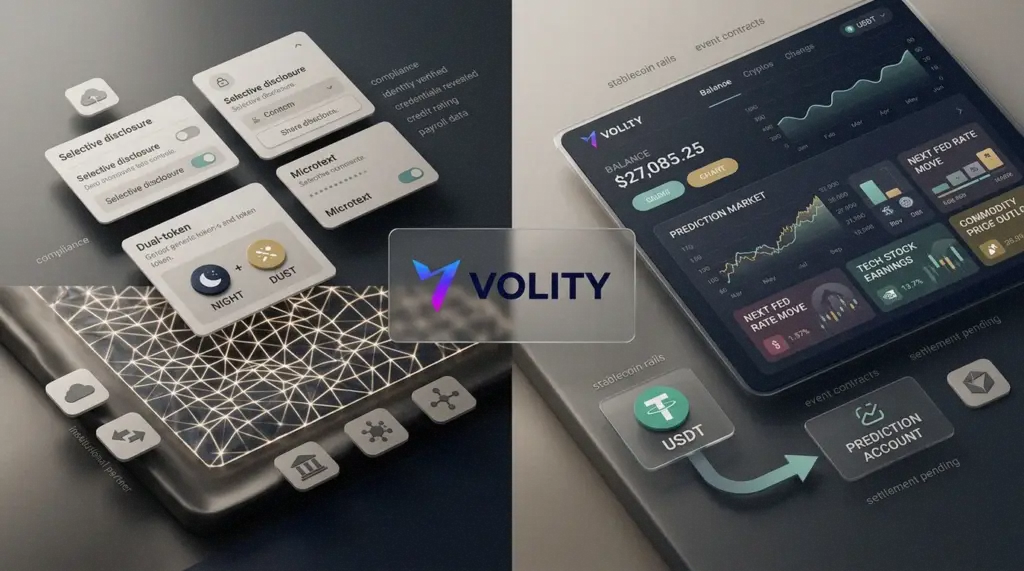
Technically, Midnight is pitched as a privacy Layer 1 for decentralised apps that cannot expose everything by default. It uses zero-knowledge proofs and selective disclosure, while shifting proof creation to the client side. As a result, sensitive information can stay off-chain, while the chain still gets the verification it needs.
- Dual token design: NIGHT handles governance and staking, while DUST is auto-generated for fees. This aims to separate transaction costs from token price swings.
- Hybrid ledger: Midnight supports public and private data in one system. Developers can choose what to reveal and to whom.
- Phased decentralisation: The network starts federated and aims to bring in stake pool operators by Q3 2026.
Charles Hoskinson called it the ecosystem’s biggest milestone and pointed to LayerZero integration for cross-chain liquidity. However, the market will judge Midnight less by slogans and more by whether it attracts apps that need compliant privacy, such as identity, credit, payroll, and institution-facing stablecoin flows.
Traders will also watch what staking participation looks like once Cardano stake pool operators are invited in. If security and usage rise together, ADA sentiment usually improves. If usage lags, the launch risks becoming another well-funded chain looking for its first killer app.
Binance Wallet brings prediction markets inside the app
Binance took a different route and went straight for attention. Its wallet now integrates third-party prediction platforms, led by Predict.fun on BNB Smart Chain. Users can take positions on sports, politics, economics and crypto events without leaving the wallet interface.
Access sits behind routine version updates, with iOS at 3.11.1 and Android at 3.11.2. Users fund a dedicated Prediction Account, which draws USDT from spot or funding balances. That is frictionless by design, and therefore it is likely to pull activity forward fast.
The timing is not subtle. Event markets have exploded in activity, and crypto wallets want to be more than storage. Meanwhile, politicians in the US keep pushing for tighter rules around insider advantages in event betting. Binance is effectively betting that demand will outrun discomfort, at least in the near term.
For BNB, the feature reads as sticky utility, not a direct fee windfall. Even so, more wallet activity tends to support chain usage narratives. Traders are already watching whether BNB can hold the psychologically important $600 area, since a clean break lower could sour sentiment quickly in a risk-off tape.
Regulation, flows and the mood music
Elsewhere, Russia is advancing proposals to curb retail access to crypto trading. In the US, lawmakers are pushing a “Mined in America Act” to reduce reliance on Chinese mining exposure. Regulators are also circling the idea of crypto exposure inside 401(k) retirement plans, which keeps compliance desks nervous.
Meanwhile, the SEC’s decision to drop the Justin Sun case, just ahead of an enforcement leadership change, is feeding speculation about priorities. However, it does not signal a softer stance across the board, and traders should treat it as case-specific until proven otherwise.
On flows, corporate Bitcoin buying reportedly collapsed week-on-week, while spot Bitcoin ETFs logged $296 million of outflows, snapping an earlier streak. The market is leaning more on macro direction and less on steady passive inflows.
Ethereum also drew attention, with Bitmine holding 4.7 million ETH, framed as a staking-heavy treasury posture. The Ethereum Foundation also staked roughly $46 million. Meanwhile, Tether’s gold token XAUt expanded onto BNB Chain as the real-world asset theme keeps creeping into more venues.
Token watch: fast charts, faster narratives
- Keeta: broke a falling wedge pattern, with $0.57 floated as a target.
- VINE: jumped 86% on Elon Musk-linked “AI Vine” chatter.
- CORE: fell 48% as volume briefly outpaced market capitalisation.
- SIREN: doubled in 24 hours and reignited the familiar DeFi-versus-pump argument.
By the numbers
- Midnight mainnet: live end-March 2026, federated phase called Kūkolu
- Decentralisation target: Q3 2026 rollout to stake pool operators
- ETF tape: $296m Bitcoin ETF outflows
- ETH treasury headline: 4.7m ETH held, framed as a staking bet
- BNB level to watch: $600
Key takeaways
- Midnight is a bet on compliant privacy, so watch developer traction, not announcements.
- Binance Wallet is chasing engagement, therefore volatility may lift around headline events.
- $600 on BNB is a mood barometer, while risk assets stay sensitive to macro scares.
- ETF outflows make the market more reflexive, so liquidity shocks can travel faster.
- Token spikes tied to narratives can reverse hard, so size positions as if exits get crowded.
Put together, Midnight and Binance’s prediction push show crypto’s next land grab. Apps want privacy without jail risk.
Wallets want time spent and taps. Meanwhile, traders want clean levels and liquid exits.
The winners will be the ones that offer all three.
For more on this topic see our deep-dives on European Banks and Stablecoins: What MiCA-Era Crypto Means for BTC, Dogecoin ETF: How It Works and What It Means for Crypto, and Algorand Price Prediction: Will ALGO Reach $1? Analysis and Outlook.
For more on this topic see our deep-dives on Crypto Selloffs and Stablecoin Surges: How Capital Rotates, BTC, ETH and XRP Outlook: Reading the Big-Three Crypto Signals, and Kyrgyzstan Gold-Backed Stablecoin USDKG: Secure Crypto Investment Trends.
What our analysts watch: Three reads turn launch-week noise into tradable signal. Developer traction on Midnight measured by deployed dApps in identity, payroll, and institutional stablecoin flows is the only durable proof that a privacy chain has product-market fit; announcement weight without app weight fades inside two quarters.
BNB price behaviour around the $600 psychological shelf is the cleanest single read on whether prediction-market integration is producing chain-utility narrative or pure novelty flow. And the regulatory backdrop on event markets matters because every retail-friendly prediction venue eventually meets jurisdictional friction.
The CoinDesk coverage of Cardano launches and Binance product rollouts tracks adoption in real time, the European Securities and Markets Authority work on crypto-asset markets under MiCA frames the EU policy backdrop for both privacy and prediction products, and the ECB Economic Bulletin primer on Layer 1 architectures covers the dual-token mechanics. Volity offers BTC, ETH, ADA, BNB, and major altcoin CFD access under CySEC oversight via UBK Markets (licence 186/12), with execution from our SLU and Cyprus entities.
Frequently asked questions
Why does Midnight separate NIGHT and DUST instead of using one token?
The split insulates fee mechanics from token-price volatility. NIGHT carries governance weight and staking economics; DUST is auto-generated for transaction fees. Developers and users transacting on Midnight do not see fee bills swing wildly with NIGHT spot price, which is the structural complaint enterprises make about single-token chains. The trade-off is added cognitive load for end users, which the wallet layer has to abstract away.
Are wallet-based prediction markets a sustainable retention feature for exchanges?
The retention is real for the first two cycles of novelty flow and uncertain after that. Prediction markets attract event-driven traffic, which spikes around elections, sports finals, and macro releases, but the same flow disperses during quiet periods. Wallets that succeed convert the prediction-market user into a derivatives or perpetuals user; wallets that do not, watch the cohort churn back to single-purpose venues.
What separates regulated privacy from anonymity in the Midnight design?
Selective disclosure. Users prove they meet a compliance condition (residency, KYC tier, accreditation) without revealing the underlying personal data, and counterparties accept the proof rather than the identity. The chain stores cryptographic verification, not the cleartext attribute. The architecture is built for use cases like institutional stablecoin settlement and on-chain payroll, where regulators need an audit trail and counterparties need confidentiality.
Should a retail trader treat ADA as a launch-window momentum trade?
The cleanest framing is to treat ADA price action through Midnight launch the same way the desk treats any infrastructure-launch token: enter only after the rollout passes its first decentralisation milestone (Q3 2026 stake-pool operator phase per Cardano roadmap), size half on launch confirmation and half on observed dApp traction, and accept that early-launch volatility frequently retraces before the structural thesis plays through.
Volity operates a trading platform and also publishes educational and analytical content about trading. The content on this page is for educational purposes only and should not be considered financial advice. Volity may benefit commercially when readers open trading accounts through links on this site.
Our content is produced and reviewed under documented editorial standards; see our comparison and review methodology.