Investing in financial products involves risk. Losses may exceed the value of your original investment.
Crypto market cap is a core topic for traders in 2026. The complete guide follows.
Crypto market tops $2.5tn as shorts get squeezed and regulators move closer
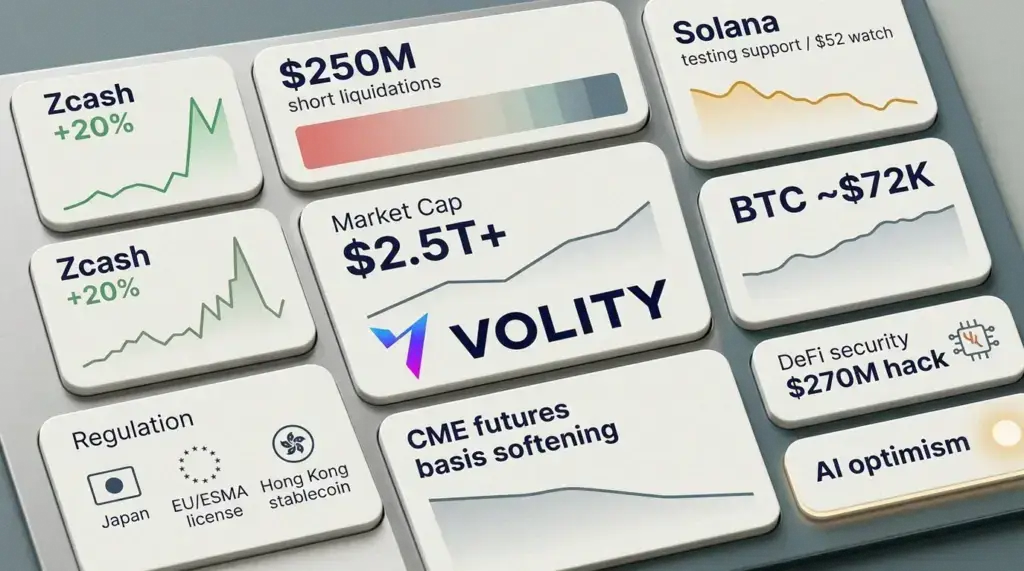
Crypto has pushed back above $2.5tn in market value today, as a sharp rally forced bears to cover. Across major venues, about $250m of short positions got liquidated, while Bitcoin traded near $72,000 after yesterday’s break higher. Meanwhile, the tone felt less like retail frenzy and more like systematic buying, with traders watching whether the move can hold through the next macro catalyst.
However, the tape under the surface looked messy. Bitcoin spot stayed firm, yet CME futures softened as basis trades unwound, a sign that some leveraged “cash and carry” money took risk off. The headline price strength came with a quieter warning: the rally may need new cash, not just forced buying, to extend.
Elsewhere, the alt market delivered the usual drama. Zcash jumped more than 20% on fresh momentum, while Solana churned below obvious technical levels, with some traders pointing to $52 as the next air pocket if support fails. Meanwhile, single name narratives did the heavy lifting, as they often do when Bitcoin pauses.
Regulators tighten the frame, but the politics remain
Policy was the other engine today, with several jurisdictions signalling that crypto is becoming less of a side show. Japan moved to reclassify cryptocurrencies as financial instruments, which matters because it pulls the market closer to the language and controls of mainstream finance. Meanwhile, in Europe, the ECB backed a plan that would make ESMA the single supervisor for major crypto firms, a step towards a more unified rulebook.
In Hong Kong, officials awarded the first stablecoin licences to HSBC and a Standard Chartered venture, a decision designed to coax institutional flows while keeping issuance inside a regulated corral. Although that looks like a local story, it will shape how Asian treasurers think about settlement rails and on chain cash management.
In the US, the picture stayed mixed. The Treasury launched a cyber threat sharing channel for crypto firms, which reads like a tacit admission that the sector is now part of critical financial plumbing. Meanwhile, the politics around the CLARITY Act stayed tense, with the SEC chair signalling readiness to implement it once Congress approves. However, Wall Street voices warned that the 2026 midterms could still scramble the timetable, and Coinbase again hinted it could shift focus abroad if the final shape disappoints.
- White House economists said stablecoin yields should not drain banks, softening a key objection.
- New York prosecutors pushed for tougher penalties on unlicensed crypto operations.
- UK investigators froze $12m tied to scams under Operation Atlantic.
DeFi takes another hit, and “circuit breakers” return to the chat
DeFi’s security premium rose again after a reported $270m hack linked to Drift Protocol, which reignited an old argument about whether open finance needs market wide “circuit breakers”. Circle pushed for tougher guardrails, and politicians will notice, especially as stablecoins try to win broader acceptance. Meanwhile, smaller infrastructure plays kept raising money, including Enhanced Labs, which disclosed a $1m round for on chain options yield tooling.
However, the market’s reaction stayed pragmatic rather than panicked. Traders have learned to treat hacks like weather, unless they threaten a core stablecoin or a major exchange.
AI and crypto: the narrative grows louder, even if the links stay fuzzy
The AI theme also fed risk appetite. Alibaba touted progress in AI video models, while Tether promoted its QVAC SDK for offline AI on consumer devices. Meanwhile, Coinbase talked up its x402 protocol shift towards usage based pricing for agentic AI payments. Yet the real point for markets is simpler: AI headlines keep investors in a “future tech” mood, which often lifts liquid crypto beta with it.
Funding numbers did their part. AlphaTON raised $43m for privacy focused infrastructure, while Anthropic and Perplexity ran through fresh growth claims that kept the broader AI complex feeling hot. Even crypto assets with thin AI links found willing buyers, at least for the day.
By the numbers
- Crypto total market value: $2.5tn+
- Short liquidations: about $250m
- Bitcoin: near $72,000
- Zcash: +20%+ session move
- Scam funds frozen in the UK: $12m
Key takeaways
- Watch the CME basis: a weaker premium can cap upside without fresh spot demand.
- Regulatory “integration” is bullish long term, yet it can turn into enforcement risk fast.
- Assume DeFi hacks keep happening; size risk around bridge and oracle exposure.
- Alt rallies look idiosyncratic; liquidity can vanish quickly if Bitcoin stalls.
- Keep one eye on the next macro print, because crypto’s new highs still trade like risk assets.
For more on this topic see our deep-dives on Bitcoin at $90K: Crypto Market Risks and Investment Strategies, Bitcoin Price at a Crossroads: Crypto Tax Deadline Explained, and Bitcoin Price Drops Sharply: Reading the Trapdoor Setup in BTC.
For more on this topic see our deep-dives on Tokenization Explained: XRP ETF Dynamics, Staking ETPs and Real-World Assets, Crypto Treasury Plays: Forward on Solana, Metaplanet on Bitcoin, and Bitcoin and Ethereum Outlook: How Regulation Shapes Crypto Prices.
What our analysts watch: The Volity desk reads any regulatory regime shift through three filters. Implementation timeline credibility (clear statutory deadline plus enforcement mandate equals durable repricing).
Cross-jurisdiction reinforcement (when two or more major regulators move the same direction, the trade has more legs). Market-structure friction (the rule may be bullish for the asset class but bearish for specific intermediaries, which matters for venue-token trades like BNB or exchange equities).
When timeline, jurisdictions, and friction read the same way, the trade has multi-quarter duration.
Frequently asked questions
Does crypto rallying on regulatory clarity always last?
Not always. The first-day rally usually overshoots on short covering, then mean-reverts as traders price the actual implementation difficulty.
The durable move comes from the second leg, weeks to months later, when the rule starts shaping institutional flow. The U.S.SEC publishes the rulemaking timelines that frame implementation pace.
Why does Hong Kong granting stablecoin licences matter globally?
Hong Kong sits at the intersection of mainland Chinese capital and global institutional money, so a regulated stablecoin issuance corridor there shapes how Asian treasurers think about settlement rails. The licences are precedent-setting for adjacent jurisdictions including Singapore and Tokyo. The FATF publishes the global standards that anchor stablecoin regulatory design.
How should traders position around a US Clarity Act timeline?
Smaller and earlier rather than larger and later. Legislative timelines slip, especially around midterm cycles, so the asymmetric trade is to build exposure at the proposal stage rather than the vote stage. The UK FCA publishes parallel regulatory frameworks that contextualise the US implementation pace.
What is the second-order trade after a major regulatory move?
The infrastructure trade. Regulated stablecoin issuers, compliant custodians, listed exchange equities with appropriate licences, and tokenised real-world asset platforms all benefit from clarity, often more than the underlying assets themselves. The BIS financial market infrastructure research covers the structural pass-through to settlement and custody markets.
Related guides
- Bitcoin explained
- Cryptocurrency trading
- Crypto trading platforms
- Best crypto investments
- Ethereum explained
Volity operates a trading platform and also publishes educational and analytical content about trading. The content on this page is for educational purposes only and should not be considered financial advice. Volity may benefit commercially when readers open trading accounts through links on this site.
Our content is produced and reviewed under documented editorial standards; see our comparison and review methodology.