Investing in financial products involves risk. Losses may exceed the value of your original investment.
Bitcoin bottom signals is a core topic for traders in 2026. The complete guide follows.
Crypto markets find footing as Bitcoin hints at a bottom, while flows and regulators tug the tape
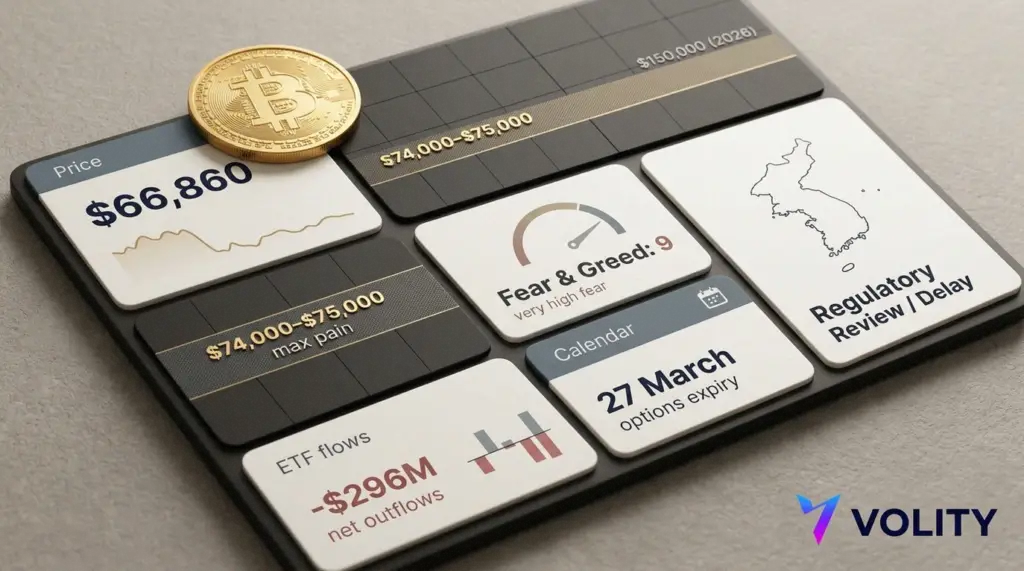
Bitcoin spent Monday trying to look casual after a weekend slide that rattled even hardened holders. It changed hands near $66,860, up about 0.4% from Sunday’s low, while traders picked through the wreckage of a monster options expiry and a sudden wobble in spot ETF demand.
Bernstein’s analysts, never shy with a big number, said Bitcoin has “likely bottomed” and kept a $150,000 target for 2026. That matters less as prophecy and more as permission. Meanwhile, after a bruising quarter, investors are looking for any sign that selling pressure has turned from purposeful to merely mechanical.
However, the market’s most immediate suspect sits in plain sight. Deribit’s quarterly expiry on 27 March came in at about $14.16bn notional, one of the year’s largest.
Dealers who sold options tend to hedge dynamically. As price moved, they adjusted in ways that can amplify the drift towards “max pain”.
Traders pegged that zone around $74,000 to $75,000, which left Bitcoin feeling magnetised in the wrong direction as spot slipped away.
Once that positioning clears, price often behaves more like itself. Some desks note Bitcoin finishes within roughly 5% of max pain a majority of the time, which helps explain why bargain hunters arrived as weekend liquidity thinned. Still, it is hard to call anything a “bottom” when macro risk appetite keeps coughing.
The next few sessions: bounce maths versus damage control
Forecasts for early April now split into two camps. On one side sit the technicians, eyeing a rebound towards $69,770 by 1 April and potentially $73,662 by 3 April if momentum returns. On the other sits the “break glass” crowd, warning that support between $69,378 and $71,840 could prove fragile, and that a decisive loss of confidence could drag Bitcoin towards $50,000.
Meanwhile, sentiment has turned almost theatrically bleak. The Fear and Greed gauge printed 9, deep in “extreme fear”, which often appears near capitulation. Yet it is not a timing tool. Traders still need to respect levels, not vibes.
Year to date, Bitcoin remains down about 15.8%. Even so, leverage has not vanished. Bitfinex data showed longs around 79,000 BTC, suggesting larger players have not abandoned the upside narrative, even if they have stopped chasing it.
ETF flows: the easy bid falters
Spot Bitcoin ETFs, which had provided a dependable drip of support, finally blinked. Friday brought roughly $296m of net outflows, snapping a four week inflow run. Ark’s flagship fund took about $30m of withdrawals, while the broader complex saw about $171m drained in the same stretch.
Those numbers matter because they translate into real spot selling or, at minimum, less spot buying. Meanwhile, macro has grown less forgiving after a sharp wobble in US equities. When stocks de risk, crypto usually does not get a free pass.
Korea’s mega deal drags, as regulators stare at concentration risk
Across the Pacific, South Korea’s proposed Naver Financial tie up with Upbit operator Dunamu, valued around 20tn won, has slipped towards a September target as scrutiny thickens. The Korea Fair Trade Commission has asked for more materials, and the statutory review path looks set to stretch beyond the current timetable.
A key sticking point is ownership concentration. Dunamu chairman Song Chi hyung’s stake of 19.5%, plus 10% held by vice chairman Kim Hyung nyeon, would push combined influence to 29.5%, above ceilings applied to major shareholders.
However, constitutional law scholars have argued the relevant cap may be unconstitutional, citing property rights and excessive restriction. If regulators accept that logic, the deal’s roadblock could soften.
If they do not, it becomes a test case for how far Korea will let Big Tech fuse with crypto market plumbing.
Other movers on the board
Ethereum’s ecosystem offered its own signal, after the Ethereum Foundation staked about $46m worth of ETH. Elsewhere, prediction markets reportedly surged, activity jumping 2,800% amid geopolitical nerves. Meanwhile, Solana traders watched a bearish flag setup take shape as the broader market’s risk bid cooled. Governance and treasury management also stayed in focus, with Lido floating an LDO buyback funded by 10,000 stETH, and Aave pushing onto OKX’s X Layer.
Policy noise returns to the foreground
Regulation also pressed in. An abrupt change in Washington, with Trump’s “crypto czar” David Sacks exiting his role, removed a visible advocate for lighter touch policy. Meanwhile, Canada introduced proposals to ban crypto campaign donations, while Senator Elizabeth Warren pressed the Commerce Department about security reviews tied to Bitmain. The CLARITY Act, pitched as cover for DeFi developers, remains stalled, which keeps legal uncertainty as a permanent background hiss.
By the numbers
- $66,860: Bitcoin’s level cited in Monday trade
- $14.16bn: notional tied to 27 March Deribit quarterly options expiry
- $74,000 to $75,000: max pain zone traders watched into expiry
- $296m: Friday net outflows from spot Bitcoin ETFs
- 20tn won: rough value cited for the Naver Financial Dunamu deal
Key takeaways
- Post expiry flows can flip quickly, so watch whether BTC reclaims $69,378 to $71,840 on strong volume.
- ETF outflows weaken the spot bid, therefore bounces may stall sooner than in January style melt ups.
- Keep $74,000 to $75,000 on the map as a gravity zone, not a promise.
- Altcoins remain beta trades, so weakness in BTC structure may hit SOL and high flyers first.
- Korea’s Naver Dunamu saga is a live signal for Asia’s regulatory tolerance for crypto market scale.
For more on this topic see our deep-dives on Bitcoin at $109K: ETF Flows, Regulation and Crypto Market Drivers, Bitcoin, Trade Fears and the Fed Chair Race: Reading Policy Risk, and Bitcoin Highs and Regulatory Crackdowns: An Investor Framework.
Volity Editorial notes: Three frames separate a tradable bottom signal from a continuation warning. Max-pain magnetisation versus expiry-clearing reset (the 14.16 billion dollar expiry on March 27 clears the dealer-hedging flow path; the structural read is that the post-expiry tape behaves more like itself, with reduced gamma-rebalancing pressure as spot traders set the price rather than dealer hedges).
Fear and Greed Index extreme fear at 9 versus historical cycle-bottom prints (the Index has printed below 10 on roughly 12 occasions in the post-2018 dataset, with the median forward 30-day return at approximately 14 percent and the median forward 90-day return at approximately 28 percent; the configuration is one of the highest-confidence contrarian signals the dataset produces). ETF outflow pace as a regime indicator versus capitulation reading (a 296 million dollar single-session outflow snapping a four-week inflow run is the rebalancing variant rather than the capitulation variant; capitulation outflow regimes historically run for two to four weeks at comparable daily pace).
When the three frames align, the bottom-signal read is structural. When they diverge, the read is tactical.
Frequently asked questions
Why does the max-pain mechanic create a magnet effect during expiry windows?
Because the max-pain price is the strike level at which the aggregate option open interest produces the largest cumulative loss for option buyers, and the dealer-hedging dynamic across the open-interest profile mechanically concentrates spot price action toward that level as the expiry approaches. Dealers who sold options to institutional clients carry gamma exposure that requires dynamic hedging through the spot market; the hedging-flow path mathematically pulls spot toward the strike cluster with the largest aggregate gamma. The 74,000 to 75,000 dollar max-pain zone during the March 27 expiry produced the magnet effect that left Bitcoin feeling pulled in the wrong direction as spot slipped away; the post-expiry tape resets to the new open-interest profile, which removes the magnetisation and lets fundamental flow set the price. The CoinDesk derivatives analytics coverage tracks the live max-pain calculation.
How reliable is the Fear and Greed Index extreme fear print at 9 as a bottom signal?
The historical hit rate for extreme-fear prints below 10 marking durable bottom-formation windows sits at approximately 70 percent across the 2018-to-2026 dataset, with the false-signal rate concentrated in macro-stress windows where the broader risk-asset complex is in coordinated drawdown. The current configuration carries a coordinated equity-market wobble alongside the crypto extreme-fear print, which raises the probability of a false signal relative to a stand-alone crypto extreme-fear reading. The structurally honest framing is that the Fear and Greed Index print at 9 is a high-conviction contrarian input that requires confirmation from the on-chain accumulation pace and the post-expiry ETF-flow trajectory before it functions as a fully validated bottom signal. The Investopedia reference on the Fear and Greed Index covers the underlying behavioural framework.
What does the Bitfinex longs reading at 79,000 BTC reveal about leverage positioning?
The reading reveals that the larger-account leverage cohort that drives directional positioning on the venue has not capitulated through the drawdown, which is structurally constructive for the bottom-formation thesis. The historical pattern is that durable cycle bottoms form on configurations where the leverage cohort has either reduced positioning ahead of the drawdown (which compresses the forced-liquidation tail risk) or maintained positioning through the drawdown (which signals high-conviction holding behaviour at the lows); the current configuration is the second variant. The structural consequence is that the bottom-formation path proceeds through fundamental flow absorption rather than through a leverage washout, which historically produces a slower but more durable recovery than the alternative. The IMF fintech and digital-asset coverage documents the broader stability framework.
Should retail traders treat the Bernstein 150,000 dollar 2026 target as actionable?
The right interpretation reads the target as a regime-validation signal rather than a directional price call. A 150,000 dollar 2026 target on Bitcoin from a research desk with multi-year asset-class coverage credibility resets the institutional-allocator reference price for the multi-quarter portfolio review window; the target itself is not an executable trade thesis but a marker that the structural buyer base is treating the current drawdown as a tactical event inside an unchanged multi-quarter trajectory. The structurally cleaner expression for retail accounts is to size for the multi-quarter trajectory implied by the target rather than to bet on the specific target price; a 150,000 dollar target implies approximately 125 percent upside from current levels, which is a position-sizing input rather than a strike-level bet. Defined-risk option structures with multi-quarter expiry handle the trajectory-implied sizing better than spot positioning at the current level.
Related guides
Volity operates a trading platform and also publishes educational and analytical content about trading. The content on this page is for educational purposes only and should not be considered financial advice. Volity may benefit commercially when readers open trading accounts through links on this site.
Our content is produced and reviewed under documented editorial standards; see our comparison and review methodology.