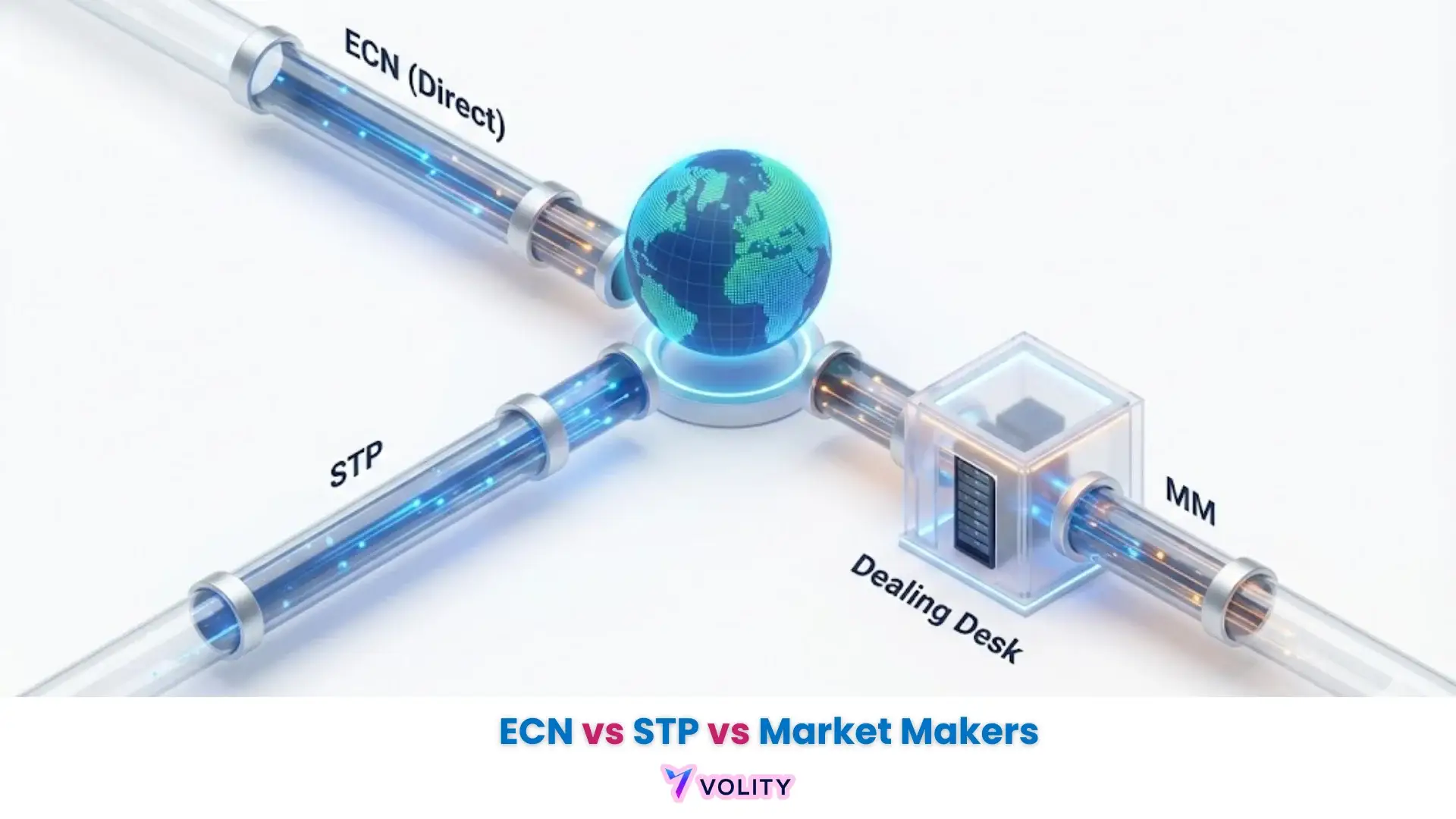
The foreign exchange (Forex) market is the largest financial market globally, with trillions exchanged daily. Navigating this complex environment requires a clear understanding of the entities facilitating trades, primarily the brokers. Three main broker models dominate the landscape: Electronic Communication Network (ECN), Straight Through Processing (STP), and Market Maker.
Each model offers distinct advantages and disadvantages concerning spreads, execution speed, transparency, and potential conflicts of interest. Making an informed choice among these models is essential for optimizing your trading experience and protecting your capital.
While understanding ECN, STP and Market Makers is important, applying that knowledge is where the real growth happens. Create Your Free Forex Trading Account to practice with a free demo account and put your strategy to the test.
Non-Dealing Desk (NDD) Models: ECN and STP Brokers
Non-Dealing Desk (NDD) brokers operate without an internal dealing desk, meaning they do not take the opposite side of client trades. Instead, they route client orders directly to liquidity providers. This fundamental difference enhances transparency and minimizes potential conflicts of interest between the broker and the trader.
NDD brokers primarily generate revenue through commissions or by marking up spreads.
What is a non-dealing desk?
A Non-Dealing Desk (NDD) broker directly passes client orders to the interbank market or liquidity providers, avoiding internal processing. This contrasts sharply with a Dealing Desk (DD) broker, which processes orders internally and acts as the counterparty to client trades.
The core principle of NDD is that the broker does not intervene in the order flow, aiming for faster execution and tighter spreads.
What is an ECN broker?
An ECN broker uses an Electronic Communication Network to connect participants in the Forex market directly. This includes banks, hedge funds, and individual traders. ECNs aggregate prices from multiple liquidity providers (Tier 1 banks and financial institutions), offering the tightest possible bid/ask spreads.
How do ECN brokers make money?
Traders get Direct Market Access (DMA), placing orders directly into the interbank market. ECN brokers typically offer tighter spreads but charge a commission per trade, appealing to high-volume traders, according to AvaTrade and Vantage Markets. Price aggregation makes sure traders receive the best available price from the various liquidity sources.
Order execution is generally fast and anonymous, with no re-quotes.
What is an STP broker?
An STP broker (Straight Through Processing) routes client orders directly to their chosen liquidity providers, such as banks or other financial institutions. Unlike ECNs, STP brokers typically work with a smaller pool of liquidity providers.
How do STP brokers make money?
The STP broker adds a small markup to the bid/ask spread they receive from their liquidity providers, which constitutes their profit. A bridge solution is the technology that connects the broker’s trading platform to these liquidity providers, making sure seamless and automated order routing.
This model results in fast and reliable order execution without a dealing desk, reducing the likelihood of re-quotes.
Ready to Elevate Your Trading?
You have the information. Now, get the platform. Join thousands of successful traders who use Volity for its powerful tools, fast execution, and dedicated support.
Create Your Account in Under 3 MinutesDealing Desk (DD) Model: Market Maker Brokers
The Dealing Desk (DD) model represents a different approach to Forex brokerage, primarily employed by Market Maker brokers. In this model, the broker creates an internal market for its clients, often acting as the counterparty to their trades. This means that when a client buys, the Market Maker sells, and vice versa.
This operational structure has significant implications for pricing, execution, and the potential for conflicts of interest.
What is a Dealing Desk (DD) Broker?
A Dealing Desk (DD) broker (also known as a Market Maker) manages client orders internally. Instead of passing orders directly to the interbank market, the broker takes the opposite side of the trade, creating an internal market. This model contrasts with a Non-Dealing Desk (NDD) broker, which routes all orders to external liquidity providers.
The DD broker essentially “makes the market” for its clients, setting its own bid and ask prices.
What is a Market Maker broker?
A Market Maker broker provides liquidity by consistently quoting both buy and sell prices. They profit primarily from the spread (the difference between the bid and ask price) they set for their clients.
How do Market Maker brokers make money?
Market Makers profit from the spread and sometimes from client losses, leading to potential conflicts of interest, as noted by Tools for Brokers and ePlanetBrokers. They manage their risk by offsetting client orders internally or hedging with larger liquidity providers if their exposure becomes too high.
This internal management allows them to offer fixed spreads, which can be attractive to some traders.
The A-Book/B-Book Dynamic: An Insider Look
Market Maker brokers often manage client orders using an A-Book/B-Book model. In the A-Book strategy, the broker passes client orders directly to external liquidity providers (similar to an STP model). This is typically for larger, more consistently profitable traders.
Conversely, the B-Book strategy involves the broker internalizing client orders, taking the opposite side of the trade. This is often used for smaller retail traders, where the broker profits from the aggregated losses of these clients.
Some Market Makers use a Virtual Dealer Plugin for platforms like MT4 to automate B-Book operations, including re-quotes and slippage, to manage risk and profit effectively. This dynamic addresses the common concern about Market Makers potentially trading against their clients.
What is the Role of Spread and Re-quotes in Market Making?
Market Makers typically offer either fixed or variable spreads. Fixed spreads remain constant regardless of market volatility, providing predictable trading costs. However, Market Makers may introduce re-quotes during periods of high volatility or rapid price movements. A re-quote occurs when the broker cannot execute an order at the requested price and offers a new price.
This can be frustrating for traders, as it delays execution and can lead to missed opportunities or unfavorable entries. Re-quotes are a common feature of Market Maker brokers due to their dealing desk operations, as many users on Babypips Forums have pointed out.
Key Differences in Trading Experience: Spreads, Execution & Risks
The choice between ECN, STP, and Market Maker brokers significantly impacts a trader’s daily experience. Key differences manifest in trading costs, the speed and reliability of order processing, and the inherent risks associated with each model. Understanding these distinctions is crucial for aligning a broker with individual trading strategies.
Which broker type has the tightest spreads?
Spreads are the difference between the bid and ask price of a currency pair, representing a trading cost. ECN brokers generally offer the tightest raw spreads, often starting from 0.0 pips, but they charge a commission per lot traded.
STP brokers offer variable spreads that are slightly wider than raw ECN spreads, as they include a markup for their service, but typically charge no separate commission.
Market Maker brokers can offer either fixed or variable spreads, which are generally wider than NDD brokers, and typically do not charge commissions.
The typical fees for each broker type vary, with ECN having commissions plus tight spreads, STP having slightly wider spreads with no commission, and Market Makers having wider spreads with no commission.
What is order execution?
Order execution refers to how quickly and at what price a trade is completed. In ECN and STP models, orders are typically executed almost instantly at the best available market price, due to direct routing to liquidity providers.
This high execution speed is vital for strategies like scalping or high-frequency trading, where even milliseconds can affect profitability.
Latency, the delay between an order being placed and executed, is minimized in NDD environments due to robust server infrastructure and direct connections. Market Makers, by contrast, may introduce re-quotes, which can delay execution and result in less favorable prices, impacting trading outcomes.
What is slippage?
Slippage occurs when an order is executed at a price different from the requested price. This typically happens in fast-moving markets or during periods of high volatility when the market price changes rapidly between the time an order is placed and executed. Slippage can occur with any broker type but is more common with NDD brokers in volatile conditions.
What are re-quotes?
Re-quotes, as discussed, are primarily associated with Market Maker brokers. They happen when a broker cannot fill an order at the requested price and offers a new price. Traders then have the option to accept or reject the new price.
Do Market Makers trade against you?
The perception that Market Maker brokers trade against their clients is a common concern among traders. While Market Makers profit from client losses when taking the opposite side of trades (B-Book model), their primary business model relies on the aggregated volume and the spread.
Reputable Market Makers manage their risk exposures carefully and do not actively seek to manipulate individual client trades. However, the inherent conflict of interest in their model means that when a client wins, the broker loses on that specific trade, which is a key differentiator from NDD brokers.
How does leverage work with different broker types?
Leverage allows traders to control a larger position with a smaller amount of capital. All broker types offer leverage, but the specific ratios and margin requirements can vary. Regulations often dictate maximum leverage levels, such as 1:30 in Europe or higher ratios (e.g., 1:500) offered by offshore brokers. There are generally no significant differences in how leverage fundamentally works across ECN, STP, or Market Maker models, but minimum margin requirements for certain account types, especially true ECN, might be higher.
ECN vs STP vs Market Maker: A Comprehensive Comparison Table
Choosing the right Forex broker model depends heavily on individual trading preferences, capital, and risk tolerance. This comprehensive table highlights the key characteristics and differences between ECN, STP, and Market Maker brokers, providing a quick reference for comparison.
| Feature | ECN Broker | STP Broker | Market Maker Broker |
| Order Execution | Direct to interbank | Direct to LPs | Internalized (Dealing Desk) |
| Spreads | Raw, tightest (0.0 pips) | Variable, slightly wider | Fixed or Variable, wider |
| Commissions | Yes, per trade | Generally no | Generally no |
| Conflict of Interest | None | None | Potential |
| Re-quotes | Rare/None | Rare/None | Common |
| Slippage | Possible (volatility) | Possible (volatility) | Less common (internal pricing) |
| Liquidity | Multiple LPs, deep | Multiple LPs | Broker’s own |
| Ideal Trader | Scalpers, HFT, large volume | All types, balanced | Beginners, predictable costs |
| Min. Deposit | Often $1,000+ | $100-$500+ | $10-$200+ |
| Regulation Focus | Crucial | Crucial | Crucial |
| Pricing Transparency | High | High | Moderate (internal control) |
| Trading Style | Aggressive, fast | Flexible | Swing, position |
How to Choose the Right Broker Model for Your Trading Style?
Selecting a Forex broker is a critical decision that should align with your specific trading strategy, capital, and risk appetite. There is no universally “best” broker model; instead, the ideal choice is the one that best suits your individual needs. This section guides you through the key considerations for making an informed decision.
How much capital do I need for an ECN account?
Assessing your trading strategy and capital is the first step. ECN accounts often require significantly higher minimum deposits, frequently starting from $1,000 or more, compared to STP or Market Maker accounts, according to B2Broker and TSG Brokers.
If you are a beginner with limited capital or prefer long-term, less frequent trades, an STP or Market Maker might be more accessible. Scalpers and high-frequency traders, who demand tight spreads and rapid execution, typically benefit most from ECN or STP brokers.
Swing traders and those with a position trading strategy might find fixed spreads from Market Makers appealing for predictable costs.
What is a regulated broker?
The importance of regulation cannot be overstated. A regulated broker is overseen by a financial authority, providing a layer of security and transparency. Regulation by top-tier authorities (e. g. , FCA, CySEC, ASIC) is crucial for making sure broker transparency and client fund security across all models, as highlighted by AvaTrade and ePlanetBrokers.
When choosing, ask about their regulatory licenses, how client funds are segregated, and their execution policy. This due diligence helps protect your investments and makes sure fair trading practices.
What is a trading platform? Can I use expert advisors (EAs) with all broker types?
The trading platform is your primary interface with the market. Popular platforms like MetaTrader 4 (MT4) and MetaTrader 5 (MT5) are widely offered by all broker types. These platforms provide charting tools, technical indicators, and the ability to use Expert Advisors (EAs) for automated trading.
Most brokers support EAs, but the execution environment (ECN, STP, or Market Maker) can impact an EA’s performance, especially for strategies sensitive to slippage or re-quotes. make sure your chosen platform offers the tools and compatibility required for your trading approach.
How does a hybrid model work?
A hybrid broker model combines elements of both Dealing Desk and Non-Dealing Desk operations. These brokers might internalize some client orders (B-Book) while sending others directly to liquidity providers (A-Book), often depending on the client’s profitability or trade size.
This approach allows brokers greater flexibility in managing risk and offering competitive conditions to various client segments. For traders, a hybrid model can sometimes offer a balance of tighter spreads and lower minimum deposits.
Turn Knowledge into Profit
You've done the reading, now it's time to act. The best way to learn is by doing. Open a free, no-risk demo account and practice your strategy with virtual funds today.
Open a Free Demo AccountBeyond the Models: Common User Challenges & Red Flags
Traders often face practical and psychological challenges that go beyond understanding ECN, STP, and Market Maker models. Recognizing these issues can help prevent frustration and unexpected losses.
1. Perception vs Reality of Market Makers
- Common concern: “Why do Market Makers get a bad rap?”
- Market Makers profit when clients lose, creating an inherent conflict of interest.
- Reputable Market Makers operate within regulations, but the perception of trading against clients can erode trust.
- Understanding the A-Book/B-Book dynamic helps clarify how orders are managed and revenue is generated.
2. Frequent Re-Quotes
- Typical complaint: “I keep getting re-quotes, is this a Market Maker problem?”
- Re-quotes are a hallmark of Dealing Desk operations.
- Can disrupt strategies, especially for scalpers, and create frustration.
- Takeaway: Consistent re-quotes indicate your broker may be operating as a Market Maker.
3. Verifying True ECN/STP Brokers
- Key question: “How do I know if a broker is really ECN/STP and not a disguised Market Maker?”
- True ECN brokers typically:
- Charge commissions
- Offer raw spreads reflecting interbank pricing
- Require higher minimum deposits
- Red flags for disguised Market Makers:
- Fixed spreads
- Very low minimum deposits
- Frequent re-quotes
- Tip: Review the broker’s execution policy in legal documents.
- Presence of a Virtual Dealer Plugin often signals B-Book operations.
4. Hidden Costs Beyond Spreads & Commissions
- Traders often overlook additional expenses:
- Swap rates (overnight financing)
- Inactivity fees
- Deposit/withdrawal fees
- Latency impact on execution for high-frequency strategies
- Execution policy details:
- Handling of slippage
- Order types
- Other factors affecting trading costs
- Advice: Read these policies carefully to avoid unexpected expenses.
Key Takeaways
- ECN Brokers: Provide direct market access with the tightest spreads but charge commissions on trades.
- STP Brokers: Route orders to liquidity providers, offering variable spreads with a small markup.
- Market Maker Brokers: Internalize orders, act as the counterparty, and profit from spreads and sometimes client losses, which may create conflicts of interest.
- Regulation Matters: Choosing brokers regulated by top-tier authorities ensures transparency, fund security, and fair trading practices.
- Broker Selection Factors: Consider your trading strategy, available capital, and risk tolerance when choosing the appropriate broker model.
Frequently Asked Questions (FAQ)
References
- Understanding ECN, STP, and Market Maker Models
- ECN vs STP: Differences, Pros & Cons, and Which to Choose?
- STP vs ECN Forex Brokers: What’s The Difference? – B2Broker
- Broker Challenge “NDD/STP” vs. True “ECN” and “Mkt Mkr” broker talk
- What Market Maker, STP and ECN brokers really are – Forex Brokers