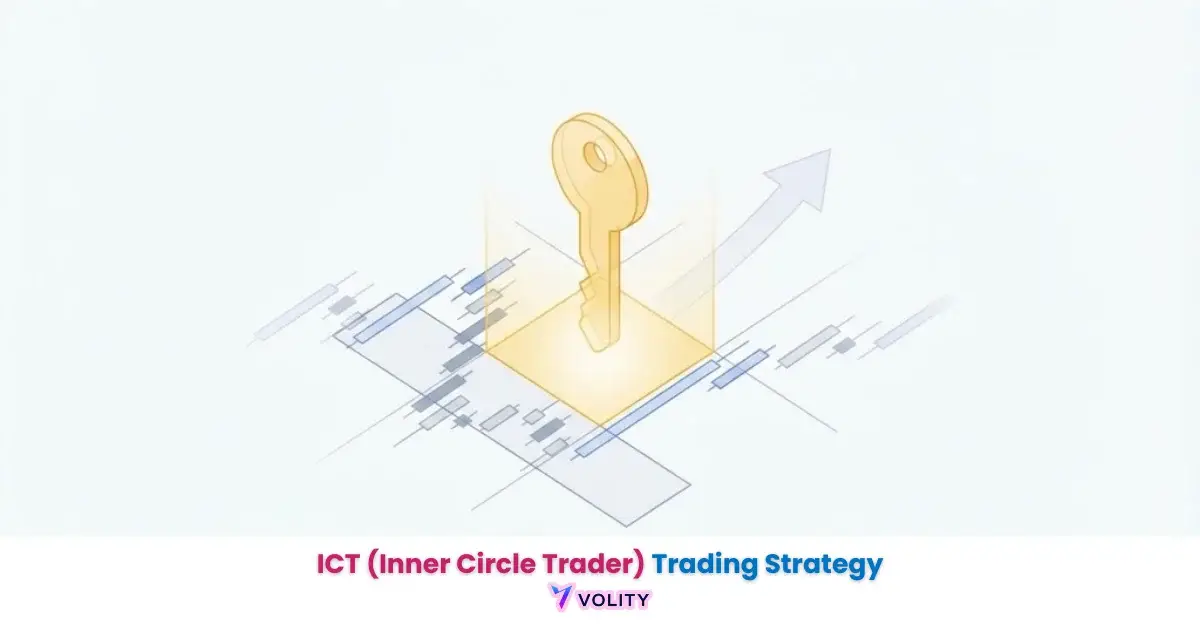
It aims to decipher how “smart money” influences market movements, providing a framework for traders to identify high-probability setups by recognizing specific patterns and time-based opportunities.
While understanding Inner Circle Trader is important, applying that knowledge is where the real growth happens. Create Your Free Forex Trading Account to practice with a free demo account and put your strategy to the test.
What Is ICT(Inner Circle Trader) Trading?
ICT (Inner Circle Trader) is a price action trading methodology created by Michael J. Huddleston, who has over 20 years of experience in the markets and authored the ‘Market Maker Series’. This approach aims to analyze market movements based on institutional footprints. It moves away from traditional retail indicators, which often lag or provide misleading signals.
The core theory introduces the Interbank Price Delivery Algorithm (IPDA), a conceptual model suggesting that market prices are not random but are algorithmically delivered to balance buy-side and sell-side liquidity. ICT theory suggests this algorithm drives market prices, rather than simple supply and demand dynamics. This framework helps traders anticipate price movements by understanding the underlying institutional order flow.
Key Concepts & Terminology
Understanding ICT trading requires familiarity with its specific jargon. These terms define crucial market structures and zones where institutional activity becomes evident. The methodology employs precise definitions to identify trend continuations or reversals.
Key market structure concepts include:
- BOS (Break of Structure): A break above a previous swing high in an uptrend or below a previous swing low in a downtrend, confirming the continuation of the current trend.
- CHOCH (Change of Character): An initial sign of a potential trend reversal, indicated by price breaking a minor swing point against the prevailing trend.
- MSS (Market Structure Shift): A more significant break of structure that strongly suggests a trend reversal.
Important trading zones include:
- Fair Value Gaps (FVG): Price imbalances on the chart, where three consecutive candles show a gap between the high of the first candle and the low of the third candle (or vice-versa). The market often returns to fill these gaps.
- Order Blocks (OB): Specific candles or groups of candles representing areas where institutional orders were placed, often serving as strong support or resistance levels.
- Liquidity Pools (Buy-side/Sell-side): Areas on the chart where a concentration of stop-loss orders and pending orders (buy stops/sell stops) accumulate. Institutions often target these pools to fill their large orders.
Ready to Elevate Your Trading?
You have the information. Now, get the platform. Join thousands of successful traders who use Volity for its powerful tools, fast execution, and dedicated support.
Create Your Account in Under 3 MinutesThe Power of Three (AMD) Model
The Power of Three (AMD) model describes a three-stage market cycle institutions often utilize. This model helps traders identify high-probability institutional setups by recognizing the distinct phases of price action. It simplifies complex market movements into predictable stages.
The three phases are:
- Accumulation: The initial stage where institutions quietly accumulate or distribute positions. Price often consolidates within a tight range, gathering orders without significant directional movement.
- Manipulation (The “Judas Swing”): A false move designed to trap retail traders and sweep liquidity. Price moves aggressively in the opposite direction of the true intended move, triggering stop losses and creating false signals. This move is also known as a “Judas Swing.”
- Distribution: The true directional move, following the manipulation phase. Price moves strongly in the direction that institutions intended, often leveraging the liquidity gathered during the manipulation phase. A common risk management rule for this model suggests a 1:2 Risk-to-Reward Ratio.
The “Silver Bullet” Strategy
The “Silver Bullet” strategy is a specific, time-based setup within the ICT methodology that targets high-volatility windows. This strategy focuses on specific hourly ranges when market movements are typically more pronounced, offering clearer setups. It relies on the market’s tendency to create liquidity sweeps and Fair Value Gaps during these specific times.
The strategy identifies two primary time windows:
- 10:00 AM – 11:00 AM ET (New York Time): This window occurs during the New York trading session, often seeing significant volume and volatile moves as European and US markets overlap.
- 03:00 AM – 04:00 AM ET (New York Time): This window occurs during the London Open, another period characterized by increased market activity and liquidity.
A typical Silver Bullet setup involves price making a liquidity sweep (manipulation) and then forming a Fair Value Gap (FVG) within these specific windows. Traders look to enter trades based on the market’s reaction to these elements, expecting a strong directional move.
How an ICT Trade Plays Out?
Understanding how an ICT trade unfolds helps clarify the methodology. These simulations illustrate both successful applications and common pitfalls, providing practical context for the concepts discussed. They highlight the importance of patience and adherence to the strategy’s rules.
Scenario A (Success): The “Judas Swing” Capture
- Identification of Accumulation: A trader observes price consolidating for several hours, indicating potential accumulation during the Asian session.
- Manipulation Lower: As the London session opens, price manipulates lower, sweeping previous sell-side liquidity. This move triggers stop-loss orders for early buyers.
- MSS and FVG Formation: Price then sharply reverses, breaking market structure (MSS) to the upside and leaving a clear Fair Value Gap (FVG). This signals the end of the manipulation and the beginning of distribution.
- Entry and Outcome: The user enters a Long position at the mitigation of the FVG, targeting previous buy-side liquidity. The trade successfully hits its target, achieving a +2R profit.
Scenario B (Failure): The “Chop” Trap
- Missed Window/Ignored Caveats: A trader attempts to apply the Silver Bullet strategy outside its designated time windows or ignores low volume conditions.
- IPDA Enters Consolidation: The market enters a choppy, consolidating phase, where the Interbank Price Delivery Algorithm delivers price without clear directional bias. Price bounces within a narrow range without breaking significant market structure.
- Stop Loss Triggered: Without a clear manipulation or distribution phase, the trader’s entry based on a perceived FVG leads to a quick reversal. The trade triggers its stop loss, resulting in a loss. This scenario emphasizes the criticality of timing and confirming market conditions.
Risks and Criticisms of ICT
The ICT trading methodology, while comprehensive, carries inherent risks and faces certain criticisms. Understanding these aspects provides a balanced perspective on its application. Trading financial markets always involves capital risk.
- Subjectivity: A primary criticism revolves around the subjectivity of identifying certain patterns. Concepts like Order Blocks and Fair Value Gaps can appear differently to various traders, leading to inconsistent interpretations compared to rigid mechanical systems. This subjectivity can make the learning curve steep for beginners.
- Learning Curve: The methodology involves extensive terminology and conceptual frameworks, requiring significant time and effort to master. Beginners often struggle with the complexity of integrating multiple concepts (BOS, MSS, FVG, OB, AMD) simultaneously.
- Anecdotal Win Rates: Claims regarding high profitability or specific win rates (e.g., “70% win rate”) are often shared within community forums. These figures are generally anecdotal and not backed by audited statistical studies. Traders should approach such claims with caution and conduct their own rigorous backtesting and forward testing to verify potential profitability.
- No Universal Proof: The underlying Interbank Price Delivery Algorithm (IPDA) is a theoretical model proposed by Michael J. Huddleston. There is no universally recognized or scientifically proven financial algorithm that dictates all market movements as suggested by the IPDA theory. This framework serves as a conceptual lens for analysis rather than a scientifically proven market mechanism.
Key Takeaways
- ICT trading focuses on institutional footprints and the theoretical Interbank Price Delivery Algorithm (IPDA).
- Key concepts include Market Structure Shifts (MSS), Fair Value Gaps (FVG), and Order Blocks.
- The Power of Three (AMD) model outlines Accumulation, Manipulation, and Distribution phases.
- The Silver Bullet strategy targets specific high-volume trading windows: 10:00 AM – 11:00 AM ET and 03:00 AM – 04:00 AM ET.
- The methodology is highly subjective and requires extensive backtesting due to its complex nature.
Bottom Line
The ICT trading strategy offers a sophisticated, price action-based methodology centered on understanding institutional market behavior. While the approach demands a significant learning commitment due to its unique terminology and subjective pattern recognition, it provides a comprehensive alternative to traditional indicator-based trading. Traders must exercise caution, conducting thorough backtesting and understanding the theoretical nature of its underlying algorithms, as with any trading approach.
Turn Knowledge into Profit
You've done the reading, now it's time to act. The best way to learn is by doing. Open a free, no-risk demo account and practice your strategy with virtual funds today.
Open a Free Demo Account