Investing in financial products involves risk. Losses may exceed the value of your original investment.
Top trades oil is a core topic for traders in 2026. The complete guide follows.
Top 5 trades to watch: momentum fires up amid oil tensions and tech resilience
Oil is back in charge of the tape. Traders woke to fresh anxiety around the Strait of Hormuz, and crude immediately started behaving like a headline asset. The market did not panic, however. Instead, it rotated, hedged, and carried on.
Energy led early, while gold caught a classic safety bid. Meanwhile, long Treasuries firmed, and that combination told a simple story: investors want protection, but they are not abandoning risk. Today’s best set-ups sit in the overlap between momentum and defensible catalysts.
The S&P 500 has also gained a thicker skin this earnings season. Forward growth expectations still hover near 17%, even with geopolitics in the background. That matters, because dip-buying only works when profit expectations do not crack.
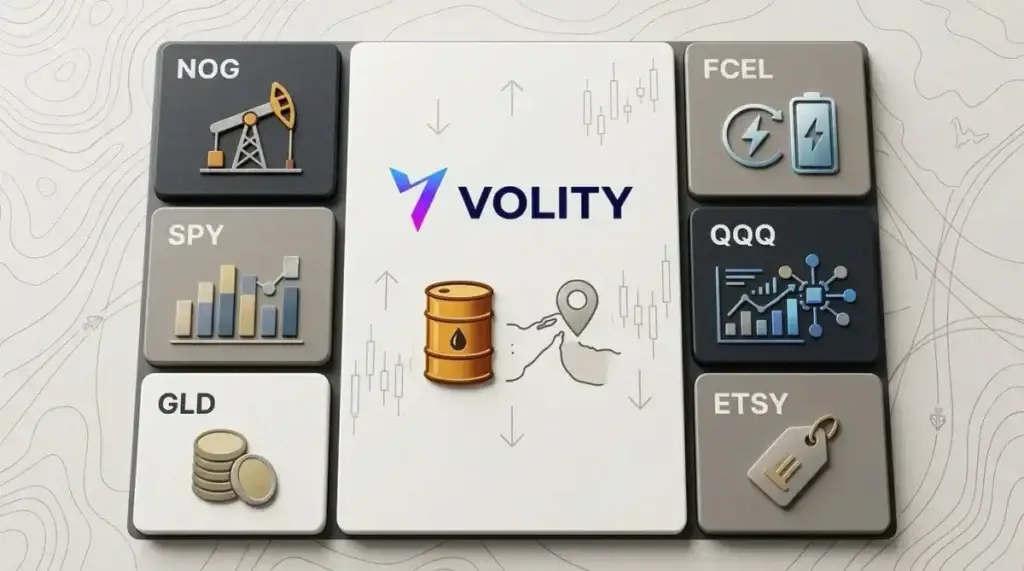
1) Northern Oil and Gas (NOG): energy momentum pure play
NOG is a straightforward way to express the “oil up, cash flows up” trade without needing a thesis about refining margins or petrochemicals. When the energy complex catches a bid, upstream names often move first, and NOG tends to trade with that urgency.
Post-earnings price action has stayed constructive, and the broader group has confirmation behind it. Meanwhile, defence and industrial names have also seen interest, reinforcing the geopolitical basket.
Consider NOG as a buy-the-dip momentum candidate if volume supports the rebound. However, keep one eye on rate-sensitive cross-currents, because higher yields can compress multiples even when crude rallies.
2) FuelCell Energy (FCEL): AI-powered clean energy surge
FCEL sits in the most volatile corner of the “AI needs power” narrative. The stock can behave like a sentiment seismograph, and that makes it useful for traders, if not always comfortable for investors.
Recent results helped. The company’s fiscal Q1 2026 print showed an EPS of -$0.52 versus -$0.68 expected, which kept the squeeze alive. However, the market remembers prior stumbles, including a fiscal Q3 2025 miss, so it will not grant a long leash.
This works best as an oversold bounce or trend day vehicle, not a set-and-forget position. Position size matters more than being “right”.
3) SPDR S&P 500 ETF (SPY) and Invesco QQQ (QQQ): index dips look buyable
Single-stock risk rises fast in headline markets, so index exposure has extra appeal. Meanwhile, Big Tech continues to supply the market’s spine, with AAPL, MSFT and NVDA still shaping flows.
Year to date, the S&P 500 is up about 9.75% and the Nasdaq is up about 15%. QQQ has held its broader uptrend, even when AI-related nerves flare. Traders have also leaned on moving-average support to frame risk.
Options can express this view cleanly, especially for intraday swings. However, keep an eye on any sudden spike in oil, because it can hit breadth and force risk reduction.
Gold jumped about 1.59% as the market priced the possibility of longer-lasting friction in energy corridors. The move made sense alongside a bid in long bonds, with TLT climbing as investors rebalanced towards safety.
GLD works as portfolio armour when valuations feel stretched and headlines arrive faster than analysts can update spreadsheets. It can pair well with risk-on exposure elsewhere, rather than replacing it.
5) Etsy (ETSY): earnings beat momentum
ETSY has enjoyed a cleaner post-earnings narrative than many consumer names. Buyers showed up after the company delivered better signals on active buyer trends, and that supported a continuation move.
Meanwhile, other discretionary pockets face fresh doubts as oil rises, because higher fuel costs can squeeze travel and shipping-sensitive businesses. That contrast can help ETSY stand out in relative strength screens.
Watch volume for signs of real sponsorship. If the stock fades on light trade, the move may be more about positioning than conviction.
By the numbers
- Oil: pricing pressure rebuilding, with talk of a push towards $100 a barrel if tensions persist.
- Energy sector: up about +1% on the session’s early leadership.
- Gold: about +1.59% as a risk hedge.
- S&P 500: about +9.75% YTD, supported by earnings resilience.
- Nasdaq: about +15% YTD, with mega-cap tech still setting the tone.
Key takeaways
- Prefer theme-aligned momentum in energy and selective clean tech, but tighten risk controls.
- Use SPY and QQQ to reduce single-name headline risk when geopolitics drives intraday swings.
- Keep GLD as a hedge if oil headlines intensify and correlations start to break.
- In FCEL, trade the volatility, do not marry it.
- In ETSY, treat volume as the truth serum for any continuation move.
For more on this topic see our deep-dives on Enterprise AI Software Stocks: Why Productivity Plays Compete With Crypto, Occidental Petroleum (OXY) Options: Support Levels and Put Strategies, and NVIDIA Stock Analysis: Price Drivers and Buy/Sell Framework.
What our analysts watch: Three lenses convert an oil-driven session into a sized basket. The energy upstream-versus-downstream read (when crude rallies on supply-risk headlines, upstream names typically lead while refining and petrochemical names lag, because the marginal barrel price feeds revenue faster than it feeds margin compression).
The gold-Treasury correlation read (gold up alongside long-duration Treasuries firming is the classic safety-bid stack that confirms the protection thesis; gold up while long bonds sell off is a different regime that signals dollar-debasement positioning rather than geopolitical hedging). The breadth-protection check (when the S&P 500 holds while energy and gold lead, the regime is constructive for theme-aligned momentum; when breadth narrows sharply with the index propped only by mega-cap tech, the protection trade should expand rather than the momentum trade).
The IMF commodities research covers the macro framework that anchors crude shock analysis, the Bank of England monetary policy documents the real-economy transmission, and the World Gold Council reference on safe-haven assets frames the cross-asset rotation template. Volity offers oil, gold, equity index, and bond CFD execution under CySEC oversight via UBK Markets (licence 186/12), with entities in Saint Lucia and Cyprus.
Frequently asked questions
Why does upstream energy typically lead refining and petrochemicals on a supply-shock day?
Because the upstream producer captures the price increase on the next barrel of production immediately, while refining margins are bounded by retail fuel prices that adjust on a delay and petrochemical names face feedstock-cost pressure that compresses near-term margin. The structural read is that NOG-style upstream exposure is the cleanest expression of the oil-up trade on day one of a shock, while refining and integrated names are the second-leg trade once the crack-spread response is visible in inventory data. Sizing the basket toward upstream on the headline day and rotating into the integrateds once the spread response prints is the disciplined sequence rather than buying the whole sector at once.
How should traders read gold up alongside long-bond strength versus gold up with bonds selling off?
The two regimes price different concerns and call for different position sizes. Gold up with long bonds firming is the geopolitical or growth-shock regime that confirms a flight-to-quality bid; the right tactic is to use gold as a cross-asset hedge inside a risk-on book and to watch the dollar index for confirmation of the safety bid. Gold up with long bonds selling off is the dollar-debasement or fiscal-concern regime; the right tactic is a heavier gold weighting (often paired with miners or silver) because the regime tends to extend rather than mean-revert. Mismatching the regime to the position sizing is the most common error in the oil-tension playbook.
Does the FCEL volatility profile fit the oil-tensions safe-haven framework or sit outside it?
It sits outside the safe-haven framework but inside the AI-power thematic that often co-trends on oil-up days because the energy buildout narrative tightens. The right framing is that FCEL is a sentiment seismograph for the AI-power thesis; it can move with the safe-haven complex on a single session but it is not a hedge. The disciplined position size is small enough to absorb a 10 to 20 percent intraday range without disrupting the broader basket. Treating FCEL as a trend-day vehicle rather than a set-and-forget position aligns the position size with the actual volatility profile.
What does the 17 percent forward earnings growth expectation tell traders about dip-buying durability?
It tells traders that the dip-buying playbook has fundamental support beyond price-action conditioning. Dip-buying works when the forward profit path remains intact; the historical pattern is that drawdowns inside a regime of rising forward earnings expectations are absorbed within two to four weeks, while drawdowns inside a regime of falling forward earnings expectations extend into multi-month corrections. The disciplined response to an oil-driven dip is to verify whether the headline event compresses the forward growth path (typical for a sustained oil-supply shock above 100 dollars per barrel) or whether it just reprices the discount rate (typical for a contained geopolitical event); the two regimes carry meaningfully different position-sizing prescriptions.
Related guides
- Gold trading platform
- Indices trading platforms
- Foreign exchange market explained
- Swing trading platforms
- Risk management
Volity operates a trading platform and also publishes educational and analytical content about trading. The content on this page is for educational purposes only and should not be considered financial advice. Volity may benefit commercially when readers open trading accounts through links on this site.
Our content is produced and reviewed under documented editorial standards; see our comparison and review methodology.
New to the metal? Start with our guide to trading gold.