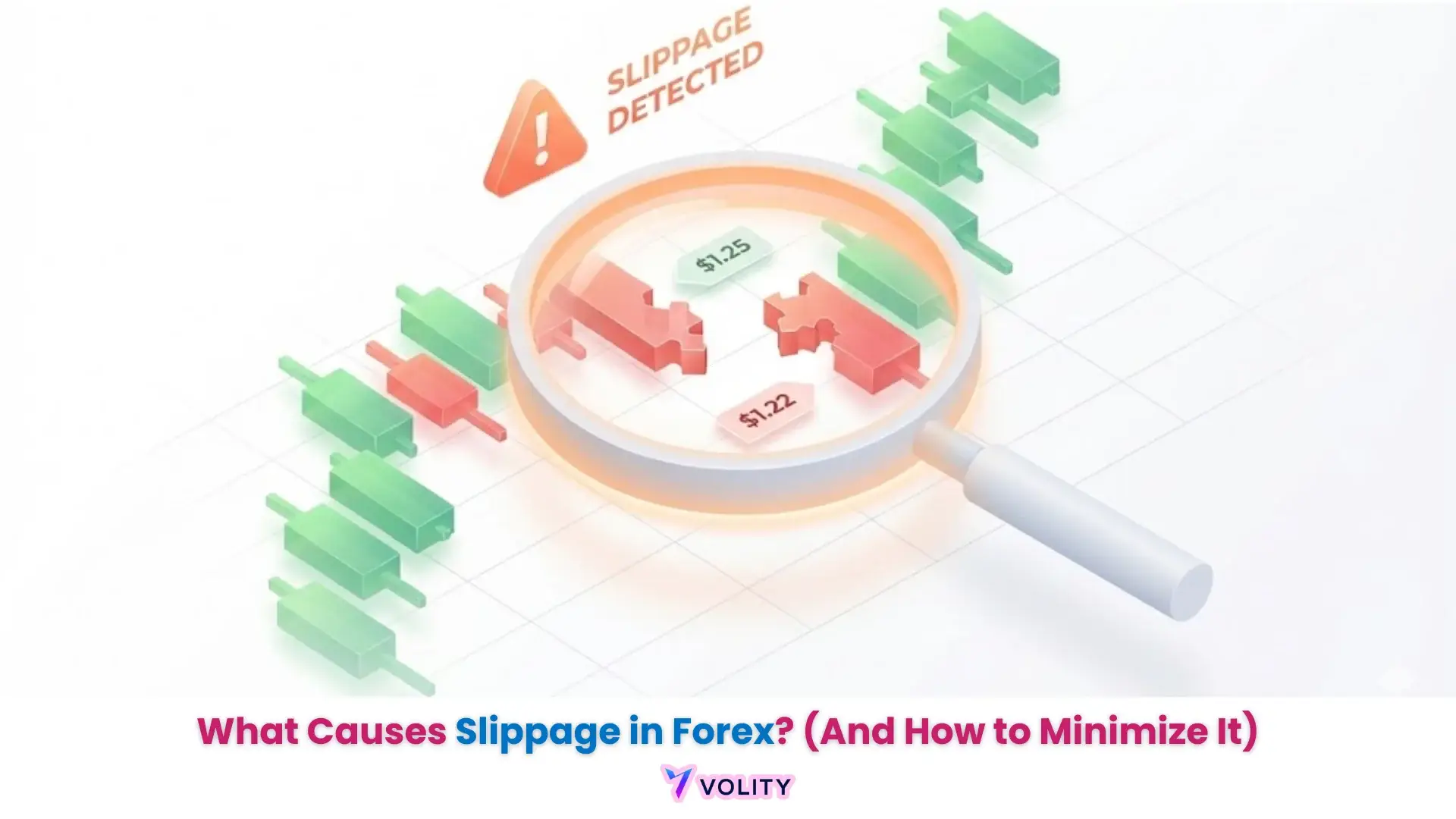
Forex slippage is the unexpected difference between a trade’s expected and actual execution price, often caused by high market volatility, low liquidity, or major news events. It can significantly impact profitability, making understanding its dynamics crucial for traders. This guide explores the causes of slippage, from order types to technical factors, and provides actionable strategies to minimize its negative effects and improve trade execution.
While understanding What Causes Forex Slippage is important, applying that knowledge is where the real growth happens. Create Your Free Forex Trading Account to practice with a free demo account and put your strategy to the test.
Forex Slippage: Definition & Types
Slippage represents a fundamental challenge in dynamic financial markets, particularly in forex. It highlights the gap between a trader’s expectation and the market’s reality during order execution. Grasping its definition and the distinct types of slippage is the first step toward effective management.
Slippage is the difference between the expected price of a trade and the price at which the trade is actually executed. This phenomenon occurs when a market order cannot be filled at the requested price due to rapid price changes or insufficient liquidity. Instead, the order is executed at the next available price in the market. This discrepancy can happen when placing new trades, closing existing positions, or when stop-loss orders are triggered.
For instance, if a trader places a buy order for EUR/USD at 1.1050, but the market moves quickly, the order might be filled at 1.1052. The 2-pip difference represents slippage. This deviation is a common occurrence in fast-moving markets, especially around major news announcements.
The Two Faces of Price Discrepancy
Slippage can manifest in two forms: positive and negative. Negative slippage occurs when the execution price is worse than the expected price. For a buy order, this means a higher price, and for a sell order, a lower price. This type of slippage directly reduces potential profits or increases losses for the trader.
For example, if a stop-loss order is set at 1.2000 but executes at 1.1995, it’s negative slippage. Negative slippage can significantly erode profits, especially for high-frequency traders or scalpers.
Positive slippage, conversely, happens when the execution price is better than the expected price. For a buy order, this means a lower price, and for a sell order, a higher price. While less common, positive slippage is advantageous to the trader, improving the profitability of the trade. For example, a take-profit order set at 1.2100 might execute at 1.2105, resulting in an extra 5 pips of profit. Both types are a direct result of market conditions rather than broker intent.
| Feature | Positive Slippage | Negative Slippage |
| Impact | Favorable for trader | Unfavorable for trader |
| Buy Order | Executed at lower price | Executed at higher price |
| Sell Order | Executed at higher price | Executed at lower price |
| Result | Increased profit or reduced loss | Reduced profit or increased loss |
| Frequency | Less common, often with limit orders | More common, often with market orders |
Market Dynamics & Execution Causes
Understanding the root causes of slippage is crucial for developing mitigation strategies. Slippage most often occurs during periods of high volatility, when market orders are used, or when large orders are placed.
These conditions create an environment where the market moves too quickly for orders to be filled at their initial requested price.
The Speed Factor
High market volatility is a leading cause of slippage. When prices fluctuate rapidly, the time between a trader placing an order and the broker executing it can see significant price shifts. This speed prevents the order from being filled at the desired price.
During periods of extreme volatility, the bid-ask spread can widen dramatically, further exacerbating slippage.
For example, a sudden news release or a major economic announcement can trigger a surge in trading volume and price movement. In such an environment, the price displayed on a trader’s screen might no longer be available by the time the order reaches the liquidity provider.
The order then gets filled at the next best available price, which could be several pips away.
The Depth of the Market
Liquidity refers to the ease with which an asset can be bought or sold without affecting its price. In forex, low liquidity means there are fewer buyers and sellers in the market at a given price level. When liquidity is scarce, there are larger gaps between available bid and ask prices.
If a trader places an order for a certain amount, and there isn’t enough opposing volume at the requested price, the order must be filled across multiple price levels or at a significantly different price.
This situation is common in exotic currency pairs or during off-peak trading hours when major financial centers are closed. A large order placed in a low-liquidity market can consume all available opposing orders at one price, forcing the remaining portion of the order to be filled at a less favorable price, leading to slippage.
Sudden Shocks
Major news events and economic announcements are significant triggers for sudden market volatility and subsequent slippage. High-impact news, such as interest rate decisions, Non-Farm Payroll (NFP) reports, or geopolitical developments, can cause immediate and drastic price movements.
These events often lead to a rush of traders entering or exiting positions, overwhelming the market’s capacity to process orders smoothly.
The sudden influx of orders and rapid price changes mean that the market price can “gap” over several pips, making it impossible to execute orders at intermediate prices. Even unexpected economic data releases, like a surprise inflation report, can create these conditions, leading to significant price discrepancies for traders.
Ready to Elevate Your Trading?
You have the information. Now, get the platform. Join thousands of successful traders who use Volity for its powerful tools, fast execution, and dedicated support.
Create Your Account in Under 3 MinutesOrder Types, Broker Execution & Technical Factors
Beyond market dynamics, the type of order used, a broker’s execution model, and underlying technical infrastructure play critical roles in the occurrence of slippage. Traders must understand these elements to gain better control over their trade outcomes.
Market vs. Limit
The choice of order type significantly influences a trade’s susceptibility to slippage. Market orders instruct the broker to execute a trade immediately at the best available price. While they guarantee execution, they do not guarantee a specific price, making them highly prone to slippage during volatile conditions.
This is because the market price can shift between the time the order is placed and when it is filled.
In contrast, limit orders instruct the broker to execute a trade only at a specified price or better. This guarantees the execution price, but it does not guarantee execution. If the market price never reaches the specified limit, the order will not be filled.
Using limit orders instead of market orders is a primary way to control slippage, as it guarantees a maximum or minimum execution price.
Stop-loss orders are designed to limit potential losses, but they become market orders once triggered. This means they are also susceptible to slippage, especially in fast-moving markets. Many traders experience their stop loss being skipped entirely during a news release, which is normal under extreme volatility and gapping.
| Order Type | Price Guarantee | Execution Guarantee | Slippage Risk | Primary Use |
| Market | No | Yes | High | Immediate entry/exit |
| Limit | Yes | No | Low | Specific entry/exit price, positive slippage |
| Stop Loss | No | Yes (upon trigger) | High | Loss prevention, becomes market order |
Broker Execution Models & Liquidity Providers
A broker’s execution model and its network of liquidity providers directly impact the frequency and severity of slippage. Brokers operate using various models, such as Straight Through Processing (STP), Electronic Communication Network (ECN), or Market Maker.
ECN and STP brokers typically route orders directly to a pool of liquidity providers, aiming for the best available price. Market Makers, on the other hand, often act as the counterparty to trades.
The quality and depth of a broker’s liquidity pool are paramount. A broker with access to numerous, reputable liquidity providers can often fill orders more efficiently and at better prices, potentially reducing slippage. Conversely, a broker with limited liquidity sources may struggle to find matching orders quickly, leading to greater price discrepancies.
While not all slippage is the broker’s fault, some brokers indeed offer superior execution speed and lower slippage due to their robust infrastructure and liquidity relationships.
Latency, VPS, and Connectivity
Technical factors, particularly latency, play a significant but often overlooked role in forex slippage. Latency refers to the delay in data transmission between a trader’s computer, the broker’s server, and the liquidity providers. Even milliseconds of delay can be critical in fast-moving markets.
High latency means that by the time an order travels from the trader to the broker and then to the market, the price may have already changed.
To mitigate latency, many serious forex traders, especially those engaged in algorithmic trading, use a Virtual Private Server (VPS). A VPS is a remote server located geographically close to the broker’s servers, drastically reducing the network delay. This allows for faster order execution and can significantly reduce the chances of slippage.
Additionally, a stable internet connection and a reliable trading platform are essential. Any instability or connectivity issues can introduce delays, increasing the risk of orders being filled at unfavorable prices.
How to Trade Forex Slippage
Developing strategies to minimize forex slippage is crucial for consistent trading results. Proactive risk management involves implementing specific techniques and tools to gain better control over trade execution and protect against unexpected price movements.
These strategies enable traders to adapt to volatile market conditions rather than simply reacting to them.
Employing Smart Order Types
The strategic use of order types is a primary defense against slippage. Traders should prioritize limit orders over market orders, especially when entering or exiting positions during potentially volatile periods.
Limit orders guarantee the desired price, ensuring no negative slippage, though they carry the risk of non-execution if the market doesn’t reach the specified level.
For stop-loss orders, traders can consider using “guaranteed stop-loss orders” if offered by their broker. These orders protect against gapping and extreme slippage by guaranteeing execution at the specified price, even if the market gaps past it. However, guaranteed stop losses often come with a slightly wider spread or a small premium.
Carefully placing stop losses, away from obvious price levels where many other stops might be clustered, can also reduce the chance of being caught in a cascade of orders.
Strategic Trading Around News Releases
Trading around major news events requires a strategic approach to minimize slippage risk. One effective strategy is to avoid trading during high-impact news releases altogether. The extreme volatility and unpredictable price movements make precise execution nearly impossible.
If trading is unavoidable, consider using pending orders (like limit orders) placed away from the current market price, allowing the initial volatility to subside.
Alternatively, some traders choose to scale down their position sizing significantly during news events. This reduces exposure to potential negative slippage. Monitoring economic calendars and understanding the potential impact of upcoming data releases is a fundamental practice for implementing these strategies.
Optimizing Your Technical Setup
A robust technical setup is a silent guardian against slippage. Ensuring a reliable internet connection is paramount; a stable, high-speed connection minimizes data transmission delays. Regularly updating your trading platform and operating system helps maintain system stability and responsiveness. Outdated software can introduce bugs or slow down execution.
For serious traders, especially those using automated strategies, investing in a Virtual Private Server (VPS) is a highly recommended optimization. A VPS reduces latency by hosting your trading platform close to the broker’s servers. This can shave off crucial milliseconds in order execution, significantly reducing slippage, particularly during rapid market movements.
Adapting to Algorithmic Trading Environments
Few guides acknowledge the significant role of algorithmic trading in exacerbating slippage. Modern forex markets are heavily influenced by high-frequency trading (HFT) algorithms that execute trades in microseconds. These algorithms can quickly consume liquidity at specific price levels or even create “flash crashes” that lead to rapid price gaps.
Understanding this dynamic can help traders anticipate and mitigate slippage.
For instance, large institutional orders, often broken down into smaller “iceberg orders” by algorithms, can influence liquidity. Traders can adapt by avoiding overly aggressive market orders, especially for larger position sizes.
Spreading out large orders into smaller chunks over time, or using algorithms that adapt to real-time market depth, can help minimize the impact of these high-speed market participants and reduce the likelihood of significant slippage.
Turn Knowledge into Profit
You've done the reading, now it's time to act. The best way to learn is by doing. Open a free, no-risk demo account and practice your strategy with virtual funds today.
Open a Free Demo AccountCommon Challenges & Misconceptions
Slippage often leads to frustration and confusion, especially for less experienced traders. Addressing common pain points and misconceptions helps clarify the nature of this market phenomenon and fosters better trading decisions.
Why Did My Stop Loss Get Skipped Entirely?
- A common and frustrating experience for traders is when their stop-loss order appears to be “skipped” entirely, executing at a price significantly worse than expected.
- This often happens during periods of extreme market volatility, typically around major news announcements, when the market experiences a gapping effect.
- A price gap occurs when the market literally jumps from one price level to another without any trades occurring in between.
Since a stop-loss order converts into a market order once triggered, if the market gaps over the stop-loss price, the order will be filled at the next available price* after the gap.
- This is not a malfunction of the stop loss but a natural consequence of market mechanics in a gapping environment.
- While frustrating, it’s a legitimate market condition, not an error or malicious act.
Is My Broker Scamming Me With High Slippage?
Many traders, after experiencing significant negative slippage, wonder if their broker is intentionally “scamming” them. While it’s crucial to choose a reputable and regulated broker, most instances of slippage are due to legitimate market conditions rather than malicious practices. As discussed, high volatility and low liquidity are the primary drivers.
However, a broker’s execution quality can vary. Some brokers may have slower execution speeds or less favorable relationships with liquidity providers, leading to more frequent or severe slippage. It is essential to research a broker’s execution policies, read reviews, and even test their services on a demo account.
Consistently high or unusual slippage, especially during normal market conditions, might warrant further investigation or a switch to a different broker.
The Psychological Toll of Unexpected Slippage
While most resources focus on technical solutions, we recognize the critical psychological impact of unexpected slippage. Experiencing significant negative slippage can be incredibly frustrating and emotionally taxing. It can lead to feelings of unfairness, anger, and a loss of confidence in one’s trading strategy.
This emotional distress can, in turn, lead to poor decision-making, such as revenge trading, over-leveraging, or abandoning a well-tested system.
Maintaining discipline and emotional control is paramount. Traders should acknowledge that slippage is an inherent part of trading volatile markets and incorporate it into their risk management. Accepting that not every trade will execute perfectly can help manage expectations.
Focusing on long-term probabilities and adhering to a predefined trading plan, even after experiencing slippage, is vital for psychological resilience.
Slippage vs. Spread: A Key Distinction
While both slippage and spread represent costs associated with trading in the forex market, they are distinct concepts driven by different market dynamics. Understanding this difference is fundamental for accurate cost calculation and risk assessment.
The bid-ask spread is a fixed or variable cost charged by the broker, reflecting the difference between the highest price a buyer is willing to pay (bid) and the lowest price a seller is willing to accept (ask).
Slippage, conversely, is an unexpected deviation from the expected execution price, primarily caused by market volatility and liquidity.
| Feature | Slippage | Spread |
| Definition | Diff. between expected & actual price | Diff. between bid & ask price |
| Nature | Unexpected price deviation | Broker’s fixed/variable cost |
| Cause | Volatility, low liquidity, news events | Broker’s profit, market supply/demand |
| Predictable? | No, highly unpredictable | Yes, generally known beforehand |
| Impact | Can be positive or negative | Always a cost (negative) |
| Control | Mitigated by order types, VPS | Chosen by broker, varies by asset |
Key Takeaways
- Forex slippage is the discrepancy between expected and executed prices, driven by volatility, low liquidity, and news events.
- Proactive strategies like using limit orders, avoiding high-impact news, and optimizing technical setups (e.g., VPS) can significantly minimize negative slippage.
- Understanding broker execution models and technical factors like latency is crucial for better trade control and execution quality.
- Distinguishing legitimate market conditions from potential broker issues helps manage the psychological impact of unexpected price discrepancies.
- Mastering slippage management allows traders to navigate the forex market with greater confidence and improve overall trading performance.