The foreign exchange market operates with high leverage and liquidity that amplifies both profits and losses. Price gaps between sessions, especially on weekends when the market is closed, can exceed protective stop-loss levels. Geopolitical events, central bank interventions, and macroeconomic data releases can cause violent price movements without warning. The decentralized nature of the forex market means spreads and execution quality vary significantly between brokers. Capital at risk in all leveraged trading environments.
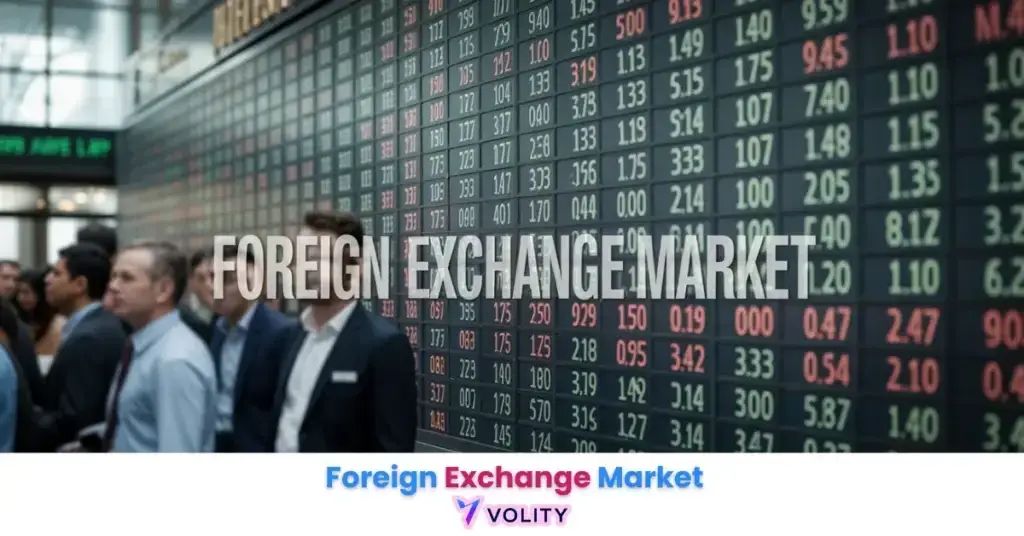
The foreign exchange market (Forex) is a decentralized global network for the trading of currencies, facilitating international trade and investment. It operates as the largest financial market on Earth, with daily turnover reaching a record $9.6 trillion in 2026. This over-the-counter (OTC) system links central banks, commercial institutions, and retail traders in a continuous 24-hour cycle across London, New York, Tokyo, and Singapore hubs.
Foreign exchange market functions as the backbone of global liquidity and international capital flows. This arena allows governments, corporations, and investors to exchange currency values to facilitate trade and manage macroeconomic risk. It serves as the most accurate real-time barometer of a nation’s economic health in 2026.
The 2026 economic landscape requires a deep understanding of the structural shifts within the interbank and retail tiers. Investors utilize the market’s 24-hour cycle to capitalize on interest rate differentials and geopolitical developments across major financial hubs.
While understanding Foreign Exchange Market is important, applying that knowledge is where the real growth happens. Create Your Free Forex Trading Account to practice with a free demo account and put your strategy to the test.
What is the foreign exchange market and why is it essential?
The foreign exchange market is the global decentralized system for buying and selling currencies to facilitate international trade, investment, and speculation. Unlike stock exchanges that operate from centralized trading floors, forex exists as a decentralized over-the-counter (OTC) network where banks, brokers, and institutions connect electronically to negotiate currency transactions bilaterally. This distributed structure ensures continuous 24-hour trading across global financial centers.
The role in global trade is fundamental to modern commerce. A Japanese automobile manufacturer exporting cars to the United States must convert yen revenue into dollars to pay suppliers at home. An American airline purchasing Airbus aircraft from Europe must convert dollars into euros to settle the invoice. These cross-border transactions, billions daily, occur exclusively through the foreign exchange market. Without this market, international trade would grind to a halt.
Market scale reflects the forex market’s dominance over all other financial arenas. Global FX daily turnover reached $9.6 trillion in 2025, a 28% increase from the $7.5 trillion reported in 2022, according to the BIS Triennial Survey (2025). By comparison, the entire global stock market capitalization is roughly $100 trillion, but daily equity trading totals only $200-300 billion. The forex market dwarfs every other financial market in terms of daily activity, making it the most liquid arena on Earth.
The Evolution of Market Scale
Currency market growth indicates a significant surge in hedging demand and institutional volatility participation in 2026. The 2025 BIS Survey reveals a shift from spot-dominant trading (where immediate currency conversion occurs) toward outright forwards and options (where future delivery dates and price insurance matter more). This shift reflects institutional demand for more complex hedging strategies as geopolitical and economic volatility has risen.
The rise of “Other Financial Institutions”, primarily hedge funds and automated algorithmic traders, now represents 50% of market participants compared to just 30% a decade ago. These sophisticated players trade currency volatility, interest rate spreads, and carry strategies (holding high-yielding currencies while shorting low-yielding ones), adding complexity to price dynamics that traditional technical analysis may miss.
Ready to Elevate Your Trading?
You have the information. Now, get the platform. Join thousands of successful traders who use Volity for its powerful tools, fast execution, and dedicated support.
Create Your Account in Under 3 MinutesHow does the foreign exchange market actually operate?
Currency pairs represent the fundamental unit of exchange where one national tender is priced against another in a continuous ratio. The EUR/USD pair, for example, expresses how many US dollars are needed to purchase one euro. When EUR/USD trades at 1.0850, it means one euro costs exactly 1.0850 dollars. The first currency in the pair (EUR) is the “base currency” and the second (USD) is the “quote currency.”
The base currency defines the reference, while the quote currency defines the price. In EUR/USD at 1.0850, the euro is the base (the “thing” being measured) and the dollar is the quote (the “measure”). If you want to buy euros, you buy the EUR/USD pair. If you want to sell euros, you sell the pair. This framework applies across all currency pairs worldwide, from major pairs like EUR/USD and GBP/USD to exotic pairs like USD/THB (Thai Baht).
The concept of the “Pip” measures the smallest price movement in the market. For most major currency pairs, a pip represents the fourth decimal place. EUR/USD moving from 1.0850 to 1.0851 is a one-pip move. A single pip on standard (100,000 unit) lot equals $10 in profit or loss. For exotic pairs or those with two decimal places (like USD/JPY), pip values differ, requiring traders to calculate carefully.
Standardized sizes determine position magnitude and required margin. A Micro lot is 1,000 units of the base currency (each pip = $0.10). A Mini lot is 10,000 units (each pip = $1). A Standard lot is 100,000 units (each pip = $10). Retailers choose lot sizes based on their account size and risk tolerance. Spot transactions now account for $3.0 trillion per day, representing 31% of the total global currency turnover, according to the Bank for International Settlements (2025).
Who are the largest participants in the 2026 forex market?
Institutional participants determines the liquidity and pricing accuracy of the global interbank market through electronic matching systems. Understanding the hierarchical structure reveals how different participant types influence price discovery and market volatility.
Central Banks occupy the apex of market influence, wielding policy rates that set the direction of entire currency blocks. The Federal Reserve’s interest rate decisions move USD pairs instantly; the European Central Bank’s announcements drive EUR dynamics. When the Bank of Japan intervenes to weaken the yen, institutional traders front-run the intervention, creating sharp directional moves. Tier-1 Banks (JPMorgan, Citi, Deutsche Bank) function as primary dealers connecting central banks to the broader market.
Corporations hedge cross-border risk constantly. A multinational corporation with revenue in euros and expenses in yen executes thousands of forex transactions monthly to lock in currency exposure. A Japanese automotive corporation purchased $500 million USD to hedge against yen weakness in April 2026, causing a temporary 40-pip spike in the pair. Past performance is not indicative of future results. These corporate flows often overwhelm retail trading volume locally.
Retail Traders access the market through brokerages and electronic communication networks (ECNs), but retail activity represents less than 5% of total turnover. When a retail trader places a $10,000 buy order on EUR/USD, their execution may be internalized by their broker (the broker takes the other side) rather than reaching the interbank market. This structure means retail traders often oppose the direction that institutional flows are moving, a structural disadvantage.
The Most-Traded Currencies and Regional Hubs in 2026
Market distribution benchmarks identifies the dominance of the US Dollar and the concentration of trading activity within specific global financial centers. The following table shows the 2026 market structure:
| Rank | Currency / Hub | Market Share (2025) | 2026 Key Trend |
| 1 | US Dollar (USD) | 89.2% | Resilient Dominance |
| 2 | Euro (EUR) | 28.9% | Slight Decline |
| 3 | United Kingdom | 37.8% | Largest Global Hub |
| 4 | United States | 19.0% | Steady Participation |
| 5 | Singapore | 11.0% | Fastest Growing Hub |
Source: BIS Triennial Central Bank Survey 2025.
The US Dollar dominance remains absolute at 89.2%, meaning the dollar appears on one side of nearly 9 out of every 10 forex transactions globally. This dominance reflects the dollar’s status as the world’s primary reserve currency held by central banks. The Euro ranks second at 28.9%, but its share has declined slightly as the Eurozone’s economic growth has lagged the United States.
London remains the largest global hub, accounting for 37.8% of total global daily turnover. The concentration reflects London’s historical importance as a financial center and its timezone position bridging Asian and American sessions. New York follows at 19.0%, driven by major banks and the influence of US economic data releases. Singapore represents the fastest-growing hub at 11.0%, reflecting Asia-Pacific economic growth and rising algorithmic trading infrastructure.
What drives currency exchange rates in 2026?
Interest rate differentials indicates the primary flow of global capital as investors seek higher-yielding assets across stable economies. When US interest rates rise to 5.5% while euro rates remain at 4.0%, investors shift capital into dollar-denominated assets, increasing demand for dollars and driving EUR/USD lower. This mechanism operates continuously, any shift in relative interest rate expectations triggers immediate currency repricing.
Central Bank Policy sets the foundation for interest rate differentials. The 2026 FOMC “Dot Plot” (showing Federal Reserve officials’ interest rate projections) and ECB guidance create forward expectations that traders immediately price into currency values. When the Fed signals “higher for longer” interest rates, the dollar strengthens. When the ECB signals easing, the euro weakens. These central bank communications often move markets more than actual rate decisions because traders position ahead of anticipated changes.
Inflation and Purchasing Power drive long-term currency trends. Higher inflation in one country erodes that currency’s purchasing power relative to others. When US inflation rises to 4% while Eurozone inflation remains at 2%, the dollar weakens gradually as investors shift toward euros to preserve purchasing power. National CPI data releases trigger immediate currency re-pricing within minutes, creating sharp moves that technical traders exploit.
Political Stability and Risk Appetite determine “Safe Haven” flows. During geopolitical crises, investors flee emerging market currencies and seek refuge in the USD, CHF (Swiss Franc), and JPY (Japanese Yen). These three currencies are considered “safe havens” because they’re backed by stable, wealthy nations. During the 2022 Russia-Ukraine crisis, EUR/USD dropped 300+ pips as investors rotated into dollars.
Risk management protocols represents the most critical factor for retail survival in the high-leverage environment of the foreign exchange market. Understanding spreads, leverage, and session timing is essential before deploying capital.
Understanding Spreads and Commissions reveals the cost of market participation. The “spread” is the difference between the bid (selling) price and the ask (buying) price. When EUR/USD shows a bid of 1.08500 and an ask of 1.08502, the 2-pip spread is the broker’s profit margin. During major news events (interest rate announcements, employment data), spreads widen dramatically to 20+ pips as institutional dealers reduce risk. Trading during high-spread periods increases the cost of doing business significantly.
Leverage and Margin show why forex is both accessible and dangerous. With 1:30 leverage, a $1,000 account can control $30,000 of currency exposure. This amplifies profits but also amplifies losses. A 100-pip move profits $300 on a standard lot (normally requiring $10,000 margin). However, a 100-pip loss wipes out the entire account. Many brokers offer 1:100 leverage or higher, creating situations where a 100-pip move causes catastrophic loss. Proper position sizing, risking only 1-2% of account per trade, is the only defense against leverage-induced account destruction.
The 24/5 Cycle requires managing positions across Tokyo, London, and New York sessions continuously. The Asian (Tokyo) session runs roughly 22:00-07:00 GMT. The European (London) session runs 07:00-16:00 GMT. The North American (New York) session runs 12:00-21:00 GMT. The 8-hour overlap between London and New York (12:00-16:00 GMT) produces the highest volume and tightest spreads. Trading during Asian hours against the trend set by London/New York creates headwinds.
Turn Knowledge into Profit
You have done the reading, now it is time to act. The best way to learn is by doing. Open a free, no-risk demo account and practice your strategy with virtual funds today.
Open a Free Demo AccountKey Takeaways
- Foreign exchange market is the world’s largest financial arena, facilitating a record $9.6 trillion in daily turnover as of 2026.
- Market decentralization ensures that currencies trade over-the-counter (OTC) 24 hours a day, five days a week, across global hubs.
- US Dollar dominance remains absolute, with the USD featuring on one side of 89.2% of all global currency transactions in 2026.
- Interest rate differentials act as the primary driver of medium-term capital flows between national economies and their respective currencies.
- Institutional participants, including tier-1 banks and hedge funds, provide the vast majority of the market’s $3.0 trillion in daily spot liquidity.
- Risk management is essential for retail traders, as leverage can magnify both profits and losses in the highly volatile FX ecosystem.
Frequently Asked Questions
This article contains references to foreign exchange market operations, currency trading, and Volity, a regulated CFD trading platform. This content is produced for educational purposes only and does not constitute financial advice or a recommendation to buy or sell any currency. Always verify current geopolitical conditions and central bank policies before trading. Some links in this article may be affiliate links.