Investing in financial products involves risk. Losses may exceed the value of your original investment.
Gold rewards traders who match a strategy to its character. XAU/USD trends hard during macro stress, ranges tightly in quiet weeks, and gaps on central-bank headlines. The five strategies below cover those conditions. Each one names the setup, the entry, and the risk rule, so you can test it on a demo account before you risk capital.
1. Trend following on XAU/USD
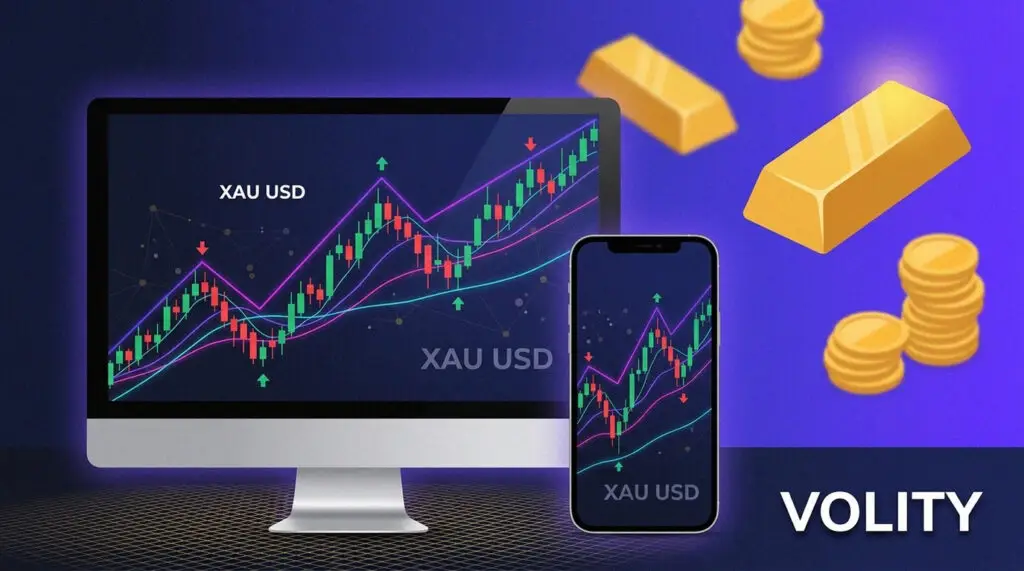
Gold spends long stretches in strong directional moves, which makes trend following its most reliable strategy. Trade in the direction of the 50 and 200 EMA on the 4-hour chart: only long when price holds above both, only short when it sits below. Enter on a pullback to the 20 EMA rather than chasing the breakout, and trail the stop under each higher low. The strength of a gold trend is why a golden cross (50 EMA crossing above the 200) is one of the most-watched signals in the metal.
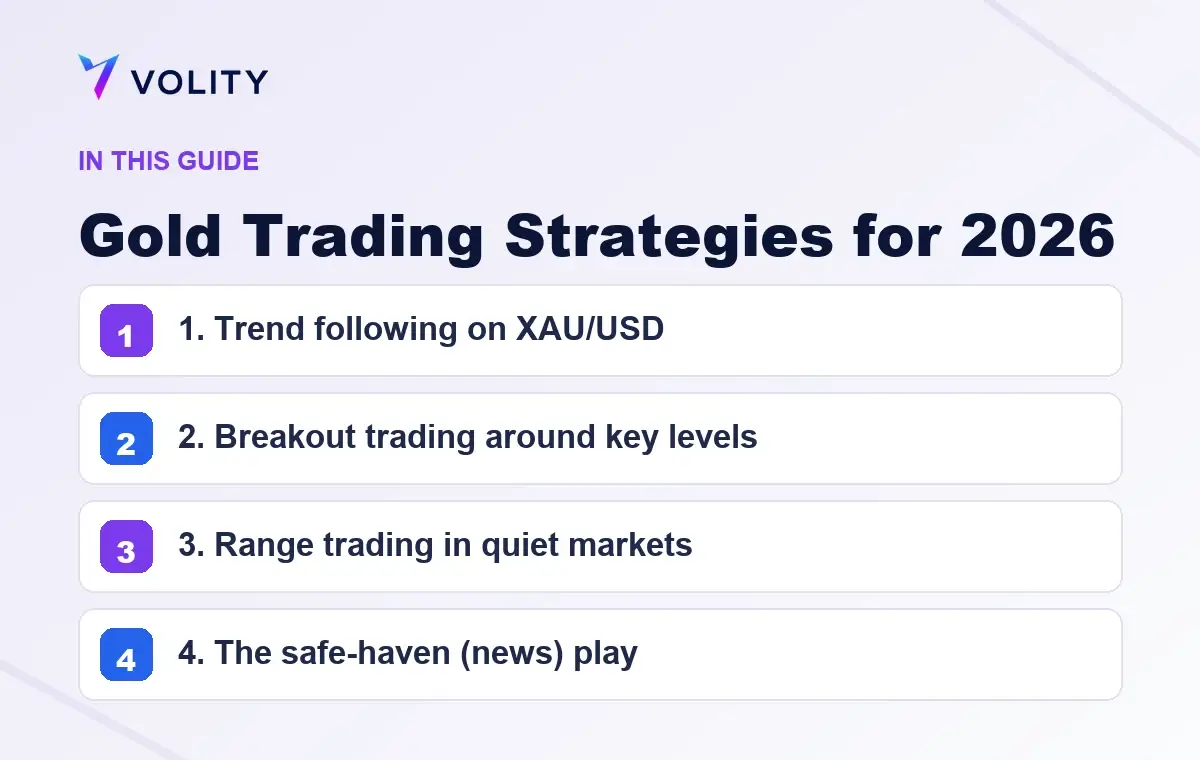
2. Breakout trading around key levels
Gold respects round numbers and prior swing highs. Mark the obvious levels, then wait for a clean break on rising volume rather than a wick. Buy-stop above resistance, sell-stop below support, with the stop on the other side of the level. Breakouts work best in the London and New York sessions, when liquidity is deepest. Tight spreads matter here because a wide spread eats the first part of the move; check the cost on your platform before you trade the open.
3. Range trading in quiet markets
When no macro catalyst is driving the market, gold oscillates between support and resistance. Fade the edges: buy near support with a stop just below it, sell near resistance with a stop just above. Confirm with RSI (oversold at support, overbought at resistance) and take profit at the opposite boundary. The moment price breaks the range on volume, the range trade is over and the breakout trade begins.
4. The safe-haven (news) play
Gold is the market’s stress hedge. Geopolitical shocks, surprise inflation prints, and dovish central-bank turns send capital into the metal. You do not need to predict the news; you need a plan for it. Trade the reaction, not the headline: let the first spike print, then enter on the first pullback in the direction of the move, with a wider stop to survive the volatility. Holding a position overnight through these events means watching swap costs, which is where a swap-free account earns its keep.
5. Golden cross / death cross momentum
The 50 EMA crossing the 200 EMA is a slow but high-conviction signal on the daily chart. A golden cross flags a regime shift to bullish momentum; a death cross, bearish. Use it as a directional filter, not a standalone trigger: take only longs after a golden cross, only shorts after a death cross, and time the actual entry with one of the strategies above. Full mechanics are in our golden cross vs death cross guide.
After a big run, timing matters as much as method. Our checklist on whether it is a good time to buy gold covers staged entries, position size and what history shows after past peaks.
Risk management for gold specifically
Gold moves fast, so position sizing is the strategy that keeps the other five alive. Risk a fixed small percentage per trade, size the position from the stop distance (not the other way round), and account for gold’s higher volatility by giving the stop room. Leverage amplifies both sides; understand exactly how it works before you raise it, covered in using leverage in gold trading.
Run these on the right platform
Every strategy here depends on three things from your broker: tight XAU/USD spreads, fast execution through news, and clean charting. Volity gives you all three, with MetaTrader 4/5 and a proprietary platform, swap-free options, and gold alongside forex, stocks and crypto in one account. Compare it against the field in our best gold trading platform breakdown, then open a free account and put a strategy on a demo first.
Quick answer: The most effective gold trading strategies in 2026 are trend following on XAU/USD, breakout trading around key levels, range trading in quiet markets, the safe-haven news play, and golden-cross momentum. Each fits a specific market condition, and all five depend on tight spreads, fast execution and disciplined risk management. Match the strategy to the condition rather than forcing one approach on every market.
Want the basics first? Read our complete gold trading guide.
Sources
This guide draws on the following public sources.
- U.S. Energy Information Administration – EIA natural gas storage, production and price series
- Silver Institute – Silver supply and demand fundamentals
- SPDR Gold Shares – SPDR Gold Shares (GLD) official fund information
- LBMA – LBMA precious metal benchmark prices
- U.S. Energy Information Administration – EIA spot prices for WTI and Brent crude
- U.S. Energy Information Administration – EIA weekly natural gas storage and price report
- World Gold Council – Gold ETF holdings and fund flow data
- Silver Institute – World Silver Survey, annual supply and demand
- World Gold Council – Gold Demand Trends, quarterly demand and supply data