Crypto daily: mergers, miners, quantum fears and a new data war
Crypto prices look sleepy. The tape beneath them does not.
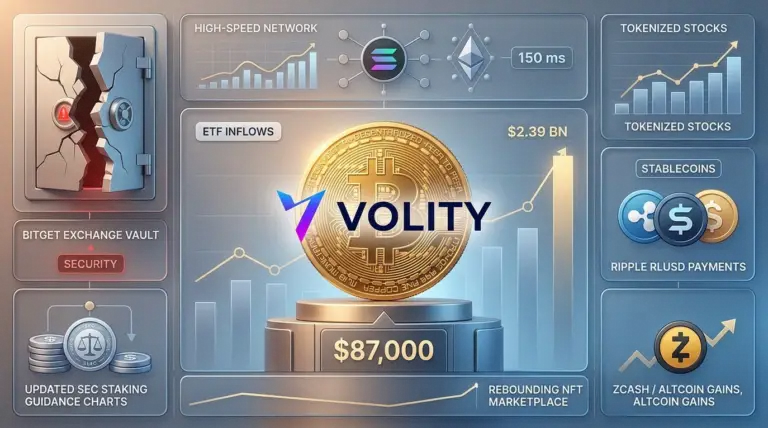
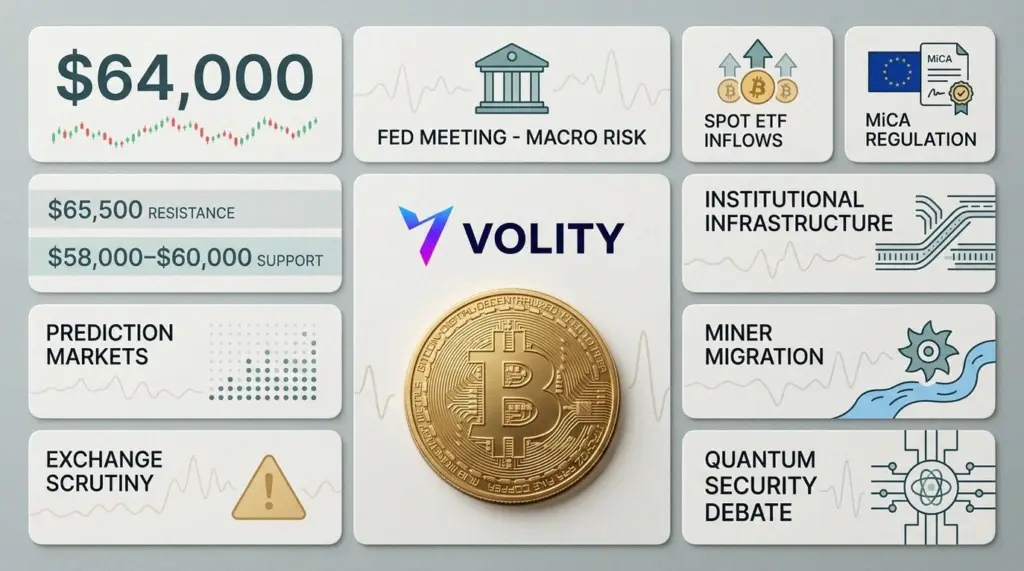
Bitcoin is hovering just above $64,000, while the total crypto market value sits near $2.28 trillion. Traders now face a familiar question before the Federal Reserve’s July 28-29 meeting: break higher, or bleed lower first?
For BTC, the map looks clean. Buyers are defending the $58,000-$60,000 zone. Sellers keep leaning on $63,800-$65,500. Until one side breaks, the market remains trapped in a corridor with expensive noise.
However, the news flow is moving faster than spot prices. Banks are inching onchain. Miners are shifting toward hydropower. Regulators are squeezing weak venues. Meanwhile, exchanges are racing into prediction markets, where the real prize may be user data.
Macro: bitcoin waits for the Fed
ETF flows have turned slightly positive after a bruising stretch of outflows. Still, conviction looks thin. That matters because crypto now trades like a rate-sensitive risk asset when macro stress rises.
If the Fed sounds patient, BTC could retest the upper band near $65,500. If policy makers lean hawkish, traders may quickly look back toward $60,000. Leverage should matter more than slogans this week.
- BTC: near $64,000
- Market value: about $2.28 trillion
- Support: $58,000-$60,000
- Resistance: $63,800-$65,500
- Fed meeting: July 28-29
Banks: payments move from pilots to plumbing
South Korea’s largest bank is plugging cross-border payments into Kinexys. That is not a meme-coin headline, but it may matter more.
The appeal is obvious. Banks want faster settlement, lower correspondent costs and less dependence on ageing payment chains. Asian lenders, in particular, have moved past laboratory language. They want systems that work on Monday morning.
For investors, the signal points toward infrastructure rather than splashy tokens. Custody, compliance tooling, settlement networks and tokenisation rails could benefit first. In this cycle, the picks and shovels may again beat the gold rush.
Meanwhile, Wise has failed to secure a U.S. bank charter from the Office of the Comptroller of the Currency. It is now looking toward the GENIUS Act as another route. The line between fintech, banking and crypto payments keeps smudging.
Europe: mica turns compliance into an M&A trigger
Europe’s MiCA regime is moving from legal theory to boardroom arithmetic. Smaller crypto firms now face a blunt calculation: comply, sell, or shrink.
Better-capitalised exchanges, brokers and custodians can use that pressure. They may buy firms with licences, good technology or local client books. However, weaker balance sheets will limit sellers’ bargaining power.
Over the next 12-24 months, MiCA could create a quiet consolidation wave. Scarce licences will carry value. So will custody platforms that can satisfy bank-grade controls. Distressed but compliant firms may become the sector’s live prey.
Venues: lmax, htx and bitmart show three kinds of risk
LMAX is preparing a possible $5 billion Nasdaq listing while also exploring a sale. Morgan Stanley is advising. The venue sits between foreign exchange and crypto, which makes it a useful mood gauge for institutional demand.
A U.S. listing would give public investors another bridge into digital-asset market structure. Still, valuation will depend on volumes, spreads and the durability of institutional crypto trading.
Elsewhere, Justin Sun’s HTX has landed on the European Union sanctions list over alleged Russia ties. That raises the cost of European counterparty exposure. It also reminds traders that liquidity now fragments by jurisdiction, not just by venue.
BitMart has paused trading after its BMX token fell more than 60%. Exchange tokens can look like cheap equity in good times. In stress, they can become a liability spiral. Confidence falls, the token drops, and the platform looks weaker.
Prediction markets: exchanges chase the data
Robinhood is exploring a deal with Crypto.com as prediction markets attract heavier traffic. Coinbase is also reshuffling senior ranks as it pushes into stocks and event contracts. Traditional exchanges are now circling platforms such as Polymarket and Kalshi.
The product story sounds simple: give users stocks, crypto, perpetuals and event markets in one place. However, the business story is sharper. Venues want order flow, behavioural signals and pricing data.
That means trading apps are becoming information machines. The best venues will not merely match orders. They will price attention, route flow and sell intelligence back into the market.
Regulators will not ignore that shift. Political contracts and macro betting can quickly resemble shadow gambling. The next fight may centre on where financial speculation ends and wagering begins.
Security: the cheapest attack still wears a headset
Binance is now testing employees every month with simulated phishing attacks. That sounds routine in banking. In crypto, it still marks progress.
Hackers do not need quantum computers when a rushed employee clicks a bad link. Human error remains cheap for attackers and ruinous for exchanges.
North Korean-linked groups are also using fake Zoom interviews and partnership calls. Victims may share screens, install “test tools” or expose wallet data. The theatre changes. The trick stays old.
- Keep wallet extensions closed during calls.
- Use separate devices for meetings and signing.
- Treat sudden job offers as security events.
- Never install call-related tools from strangers.
Mining: hydropower changes the cost curve
Bitcoin mining’s total power use has risen 38%, yet its energy mix is changing. Hydropower has overtaken gas as the largest source.
That shift is not just green branding. Miners follow cheap power wherever they can secure it. Dams, seasonal surpluses and stranded generation can improve margins when hashprice weakens.
Hydro-heavy miners may gain a structural edge in downturns. Meanwhile, cleaner energy data could soften political pressure in some regions. Grid-balancing and demand-response projects may also find fresher demand from miners.
Layer 1s: xrp gets rwas, cardano raises quantum risk
XRP Ledger has added about $2.6 billion in value as real-world asset inflows ranked strongly among major chains. Tokenised treasuries, credit and trade finance remain among crypto’s few durable growth stories.
The reason is plain. Institutions can understand yield, settlement and audit trails. They do not need a cartoon mascot to justify tokenised collateral.
Meanwhile, Cardano founder Charles Hoskinson has again warned that quantum computing could threaten Bitcoin’s cryptography. The timing remains disputed. Still, large chains cannot dodge the issue forever.
Post-quantum migration will be messy if markets wait too long. Old wallets, lost keys and slow governance could turn a technical upgrade into a market event. Long-term holders should treat cryptographic resilience as real due diligence.
Defi: uniswap builds a cleaner lane
Uniswap has launched Permissioned Pools for compliant onchain trading. These pools use approved participants and rule-based liquidity. In practice, they give institutions an automated market maker without the full chaos of open DeFi.
The move could split liquidity into two markets. One side will stay open, fast and harder to police. The other will look cleaner, slower and more bankable.
If tokenised securities keep growing, compliant pools may capture the institutional flow. Rival DEXs will then face a choice: copy the model or surrender that market.
Stablecoins: gasless does not mean free
USDT0 is being marketed as an unwrapped dollar inside the StableChain ecosystem, where fees are paid in USDT. The pitch is tidy. Users think in dollars, so they should pay in dollars.
Still, traders should ask who guarantees convertibility. They should also ask how exits work during stress. Bridges and stablecoin rails often look smooth until everybody wants the door.
Gasless transfers deserve the same scepticism. Someone pays the bill. It may appear as wider swap spreads, relayer economics, token inflation or MEV extraction. Free is often just hidden.
Key takeaways
- Respect BTC’s $58,000-$65,500 range until volume breaks it.
- Watch MiCA licences as acquisition assets in Europe.
- Treat sanctioned or offshore venues as liquidity and counterparty risks.
- Expect prediction markets to bring both growth and regulatory heat.
- Prefer infrastructure stories with revenue over tokens with slogans.
For now, crypto is not short of stories. It is short of confirmation. Until the Fed and spot flows settle the argument, discipline beats romance.
Related coverage on Volity
- How to Avoid Crypto Scams: A Beginner Safety Checklist
- How to Choose a Trading Platform: A 10-Point Checklist
- Demo vs Live Trading Account: A 7-Step Checklist Before You Go Live
- How to Size a Trade: Position Sizing and Risk Per Trade for Beginners
- Risk-Reward Ratio Explained: How to Set It and Why It Matters
- ETF vs Index Fund: The Difference and Which to Pick