Crypto traders have two screens open today. One shows Bitcoin failing again near $60,000. The other shows Washington and Brussels rewriting the rule book. Neither screen offers much comfort.
Bitcoin, Ethereum and XRP are not breaking down. However, they are not attracting enough fresh conviction either. Meanwhile, ETF flows, whale positioning and regulatory deadlines now matter as much as chart patterns.
Bitcoin meets the $60,000 wall
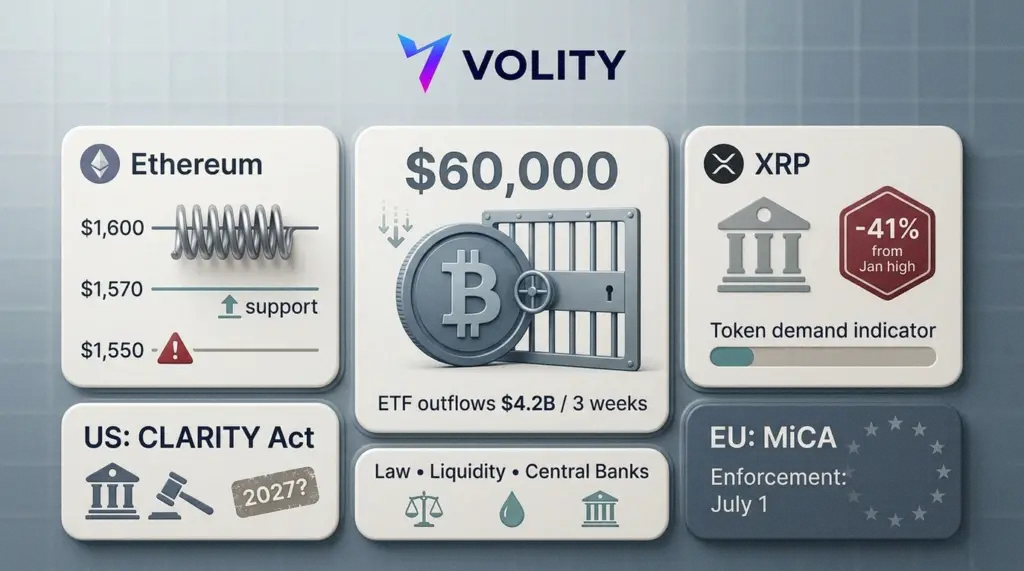
Bitcoin is pressing into the $60,000 area again, but the bid looks tired. Spot Bitcoin ETFs have seen about $4.2 billion of outflows over three weeks. Roughly $1.67 billion left in the latest week alone.
That matters because ETFs provided the cleanest institutional demand story this cycle. Sustained redemptions make each failed breakout feel heavier.
Exchange flows add another awkward signal. About 550,000 BTC reportedly moved into large deposit addresses, including Binance and OKX, as price retested $60,000. Traders usually read that as rising sell intent, not quiet accumulation.
Still, this does not look like panic. Derivatives positioning remains controlled, while ETF selling looks more like rebalancing than forced liquidation. However, the market needs a fresh buyer soon.
The macro backdrop is not helping. If the Federal Reserve revives a rate-hike bias, high-duration risk assets will struggle. In that world, Bitcoin trades less like digital gold and more like an expensive growth stock.
Ethereum coils below resistance
Ethereum is stuck in the mid-$1,500s, with $1,600 acting as the line traders keep circling. ETH has steadied near $1,570, where larger wallets appear to be testing support.
For now, whales are absorbing supply rather than chasing price. That gives the market a base, but not a breakout.
A clean move through $1,600 could pull sidelined altcoin capital back in quickly. Meanwhile, a break below $1,550 would change the tone. Large holders often defend levels until they suddenly do not.
Ethereum’s long-term story still has working parts. Layer-2 usage continues, fees remain manageable and developers have not left. However, short-term traders care less about architecture today. They care about whether risk appetite survives the next policy headline.
Xrp has a ripple problem
XRP has the strangest split in the market. Ripple keeps winning bank-facing business. Yet XRP holders keep asking a blunt question: where is the token demand?
Ripple has announced ten major bank deals in 2026, including names such as Deutsche Bank, JPMorgan and Mastercard. However, XRP remains about 41% below its January peak near $2.42.
The reason is uncomfortable. Most of these deals use Ripple’s software, settlement tools or fiat rails. They do not require meaningful XRP usage.
That distinction now dominates the trade. Ripple the company can grow while XRP the token drifts. Bank partnership headlines deserve a colder read than they often receive.
There are still pockets of demand. XRP trades near $1, while ETF interest and on-chain activity have improved. Yet newer pilots, including tokenised Treasury settlement experiments, lean heavily on RLUSD and other infrastructure pieces.
For traders, the lesson is simple. Do not buy XRP because a bank logo appeared in a press release. Buy it only if flows, liquidity and structure support the trade.
Clarity act moves onto the clock
In Washington, the CLARITY Act has become the quiet catalyst. The bill would push many tokens into a new category of “digital commodities”. That could ease pressure from securities-style oversight.
Exchanges would gain a clearer listing framework. Issuers would also get a less foggy path for token launches. However, clarity always creates winners and losers.
The bill may also block a retail US central bank digital currency. That would leave more room for regulated stablecoins, bank tokens and private settlement networks.
The timing now matters. If Congress fails to pass CLARITY by roughly August, the next practical opening may slip to 2027. Prediction markets place passage odds in the low 40% range, which says plenty about confidence in Congress.
XRP, Solana-linked assets and exchange tokens all care about the result. A commodity classification could lift a stubborn overhang. A delay would keep legal fog hanging over another trading cycle.
Europe turns mica from paper to pavement
Across the Atlantic, MiCA is moving from policy document to market plumbing. The transitional period ends on July 1, bringing full enforcement for EU-facing exchanges, stablecoin issuers and crypto service providers.
European venues must meet tougher licensing and disclosure standards. Meanwhile, regulators have signalled that penalties will not be ornamental.
That creates risk for weaker platforms. However, it also opens a lane for compliant exchanges. Coinbase, OKX and other regulated operators are already courting users who may leave smaller venues.
Volume rarely disappears. It migrates. MiCA could push European liquidity toward fewer, cleaner and more heavily watched platforms.
By the numbers
- $60,000 – Bitcoin’s current battleground level.
- $4.2 billion – estimated spot Bitcoin ETF outflows over three weeks.
- $1,600 – Ethereum’s near-term resistance line.
- 41% – XRP’s drop from its January peak near $2.42.
- July 1 – end of MiCA’s transitional period in Europe.
Memecoins get more expensive to misunderstand
While majors wait on regulators, the speculative fringe keeps building sharper machines. New memecoin launchpads now shape how retail traders enter viral tokens.
Two mechanics need attention. First, creator fees route part of each buy or sell back to teams or treasuries. That can fund promotion, but it also taxes active traders.
Second, bonding curves move prices before deep exchange liquidity exists. Early buyers can win fast. However, late buyers may pay inflated prices before a proper secondary market forms.
On Solana, traders call this grind “the trenches”. The phrase fits. Fees, insiders, thin liquidity and social momentum can all hit within minutes.
Before entry, know the fee, the curve and the exit route. Otherwise, the trade is not speculative. It is uninformed.
Infrastructure risk stays visible
Platform risk also remains stubbornly alive. Recent sequencer outages on layer-2 networks such as Base show that cheap and fast can still mean fragile.
Bridge and wallet exploits continue to drain funds across chains. Meanwhile, rushed restarts and partial refund plans rarely make users whole quickly.
Older derivatives venues face their own pressure. Leadership changes at firms such as BitMEX show how legacy crypto platforms must adapt to heavier scrutiny and deeper institutional competition.
Leverage makes these risks worse. A venue outage during a fast move can turn a manageable trade into a liquidation notice.
Trading the tape
- Respect Bitcoin’s range. A daily close above $60,000 with volume matters. Repeated failures favour tighter stops.
- Watch Ethereum’s corridor. Hold $1,550 and ETH can bounce. Lose it, and sellers gain control.
- Separate Ripple from XRP. Bank deals help the company. They do not automatically create token demand.
- Track the calendar. CLARITY and MiCA can move sentiment faster than most chart signals.
- Audit memecoin mechanics. Fees, curves and liquidity plans decide whether you can exit cleanly.
This is not a clean risk-on tape. Nor is it outright fear. It is a market waiting for law, liquidity and central banks to pick a direction. Until then, the best trade may be smaller, cleaner and less emotional.
Related coverage on Volity
- How to Avoid Crypto Scams: A Beginner Safety Checklist
- How to Choose a Trading Platform: A 10-Point Checklist
- Demo vs Live Trading Account: A 7-Step Checklist Before You Go Live
- How to Size a Trade: Position Sizing and Risk Per Trade for Beginners
- Risk-Reward Ratio Explained: How to Set It and Why It Matters
- ETF vs Index Fund: The Difference and Which to Pick