Investing in financial products involves risk. Losses may exceed the value of your original investment.
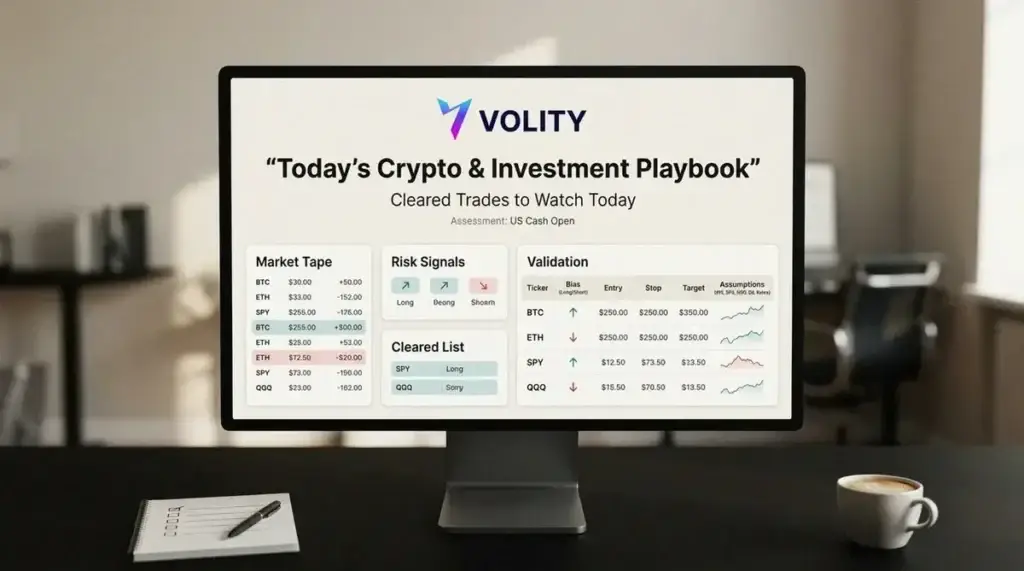
Cleared trades are the foundation of the active-trader playbook in 2026. Where a trade idea is a directional view, a cleared trade is a documented position with explicit entry, stop, target, and regime assumptions. The discipline turns a trade book from a stream of opinions into a portfolio of falsifiable hypotheses, and that distinction is what separates compounding accounts from churn accounts over rolling 50-trade samples.
The market backdrop for 2026 makes process discipline more important, not less. Volatility regimes shift quickly with macro headlines, ETF flows distort intraday liquidity in single names, and AI-driven retail order flow has compressed reaction windows from minutes to seconds. The trader who can name the regime variables underwriting each position (VIX range, SPX level, real yields, oil, dollar index) is the one who can recognise when the regime breaks and re-validate the position before it drifts into a loss.
The anatomy of a cleared trade
A cleared trade carries five fields at minimum. The ticker and direction (long, short, or pairs). The entry, expressed as a level or a conditional zone. The stop, expressed in price terms with the invalidation logic stated explicitly. The target, with explicit risk-reward (most desks insist on a minimum of 1:2). And the regime stack: the volatility, rates, currency, and commodity reads that must hold for the thesis to remain valid.
The fifth field is what most retail journals omit, and it is the one that actually drives the post-mortem. A trade stopped out under a regime that broke after entry is not the same as a trade stopped out under a regime that held; the first is a market change, the second is a thesis error, and the corrective action is different.
Re-validation cadence
Cleared trades require a documented re-validation cadence keyed to the holding horizon. Intraday and 1-to-5-day tactical trades demand a daily check against the regime stack. Swing positions held 1-to-4 weeks tolerate a weekly re-validation. Position trades on 1-to-6-month horizons can re-validate monthly, since the regime variables underwriting them (typically rate cycles or earnings cycles) move on a slower clock.
The cadence matters because trade-book drift accumulates invisibly. Five long-tech positions cleared individually under a benign regime become a concentrated factor bet during a Nasdaq-led rally, and the desk that does not run a correlation-cluster scan does not see the cluster until volatility prints. The discipline is to make the cluster visible at portfolio level before the regime breaks, not after.
For more on this topic see our deep-dives on TSMC Stock Surges on AI Chip Demand as Retail Earnings Loom, XRP, NFTs, RLUSD Stablecoin and VC Bets: Crypto Market Pulse, and QQQ Momentum and Tech: How Gold and Bitcoin Shape Risk Sentiment.
What our analysts watch: Three reads anchor the cleared-trade discipline on the desk. The first is the regime-variable consistency check; trades cleared under a VIX range of 15 to 20 should be flagged for re-validation when VIX prints outside that band, since the implicit volatility assumption underwriting the position has changed.
The second is the correlation-cluster scan, where trades cleared individually become a concentrated bet when the desk holds five long-tech positions during a Nasdaq-led rally; the cleared-trade framework makes the cluster visible at portfolio level rather than letting it accumulate invisibly. The third is the post-mortem cadence, where cleared trades that are stopped out are reviewed against their original thesis to distinguish thesis errors from execution errors, since only the latter are correctable through process changes.
The ESMA investor protection investor education resources cover the process and documentation discipline, the Financial Conduct Authority conduct-of-business rules frame the risk-management and record-keeping standards professional desks operate under, and the ECB Economic Bulletin reference on trade journals and post-mortems covers the practical implementation.
Volity offers FX, indices, equity, and crypto CFD execution under CySEC oversight via UBK Markets (licence 186/12).
Frequently asked questions
What separates a cleared trade from a trade idea?
Three criteria. A trade idea is a directional view on a ticker. A cleared trade adds a documented entry, a stop that defines invalidation in price terms, a target with explicit risk-reward, and a stated regime assumption (the broader market conditions under which the trade is valid). Every cleared trade can be falsified by a clear set of facts; trade ideas often cannot, which is why they aggregate as opinion rather than process.
How often should the cleared-trade list be re-validated?
Daily for short-term tactical trades (intraday or 1 to 5 day horizons), weekly for swing trades (1 to 4 weeks), and monthly for position trades (1 to 6 months). The re-validation cadence matches the half-life of the regime assumption underwriting the position, since longer-horizon trades typically involve regime variables that move slower than near-term variables.
Why does the cleared-trade framework specifically help retail accounts?
Retail accounts most often lose money through aggregate position drift: positions accumulate without explicit thesis, get held past invalidation, or are compounded after the original setup is gone. The cleared-trade discipline forces every open position to have a documented thesis and invalidation level, which converts the aggregate decision (trim or hold or add) into a series of explicit, falsifiable decisions. The process beats intuition over rolling 50-trade samples.
What is the most common failure mode of the cleared-trade discipline?
Thesis drift. The original cleared trade was bought on a chart-pattern thesis; the trader holds it through invalidation by switching to a fundamental thesis that was not part of the original clearance. The fix is to require that any post-entry thesis change be re-cleared as a new position with a fresh invalidation level, which makes the drift visible and forces an explicit decision rather than an implicit one.
Volity operates a trading platform and also publishes educational and analytical content about trading. The content on this page is for educational purposes only and should not be considered financial advice. Volity may benefit commercially when readers open trading accounts through links on this site.
Our content is produced and reviewed under documented editorial standards; see our comparison and review methodology.