Crypto market shifts as Washington, stablecoins and ETF flows set the pace
Crypto began the week with its usual swagger, but the tape looked less carefree underneath.
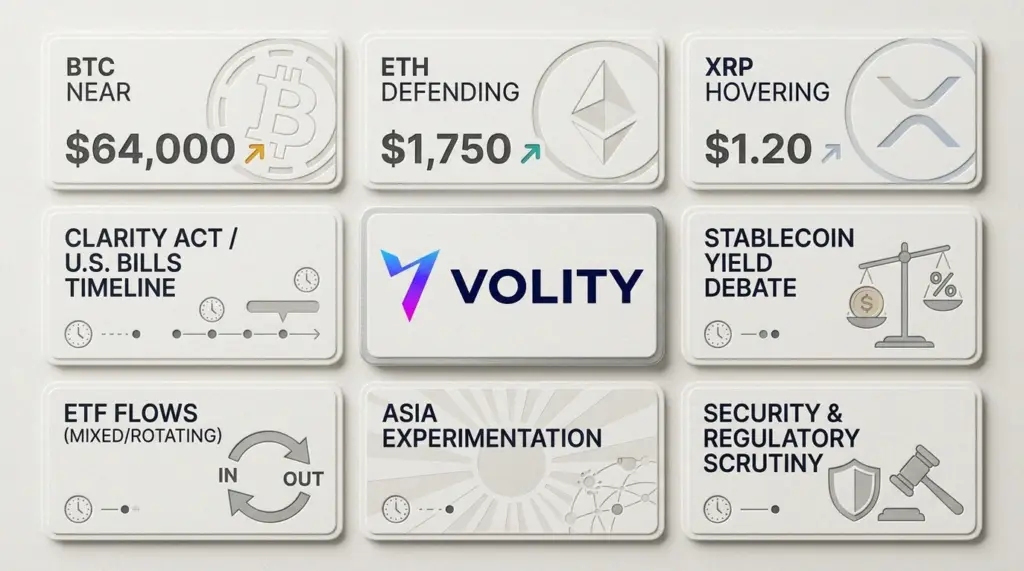
Bitcoin tried to climb back towards $64,000. Ethereum held above $1,750 after a sharp rebound. Meanwhile, XRP flirted with $1.20, a level traders now treat like a tripwire.
Yet price action is only half the story. Policy, stablecoin rules and fund flows are now driving the market as much as charts. That matters because crypto is no longer trading as one big risk bucket. Instead, capital is moving between themes with much colder discipline.
So, the market’s question has changed. Investors are not asking whether crypto is alive. They are asking which corner gets regulated, funded and trusted first.
Policy returns to centre stage
Washington has moved back into the middle of the crypto trade.
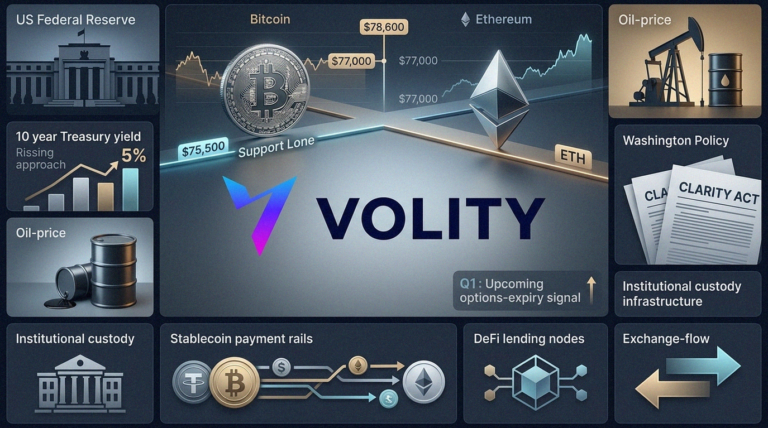
The Digital Asset Market Clarity Act, known as the CLARITY Act, remains the key item. Industry groups want the Senate to move faster, after the bill slipped from a July 4 target. The next visible pressure point is Aug. 7.
That delay matters. The bill is not just a tidy exercise in legal labelling. It could shape how the United States classifies tokens, divides power between regulators and taxes digital asset activity.
Meanwhile, lawmakers have introduced more crypto bills covering mining, staking and tax treatment. The market is no longer dealing with one narrow reform. It is watching a broader rewrite of the rulebook.
For traders, this changes the rhythm. A committee calendar can now move Coinbase, exchange tokens and stablecoin-linked names. Likewise, a single definition can change the valuation of an entire subsector.
Crypto used to sell itself as a market outside politics. However, the next rally may need a Senate timetable.
Stablecoins leave the plumbing
Stablecoins used to sit quietly in the background, like pipes under a trading floor. Now they are the argument.
The hottest fight is over yield. Banks and crypto firms are fighting over whether stablecoins should pay interest-like returns. The number attached to that fight is huge, with some market estimates framing it as a $6 trillion contest.
The outcome matters for one simple reason. If stablecoins can pay yield, they stop being mere payment tokens. They become savings products, money-market rivals and balance-sheet threats.
Bankers understand that. Crypto firms do too. The debate is less about technology than deposits.
Asia is also moving quickly. South Korea’s KT has entered the won stablecoin race through a token factory initiative. In addition, local consortium members have completed a won-based digital currency pilot on Kaia.
Those projects show how tokenised money is leaving the conference stage. It is moving into infrastructure tests, bank partnerships and domestic payment experiments.
Still, not every geopolitical stablecoin story is working. Russia’s sanctions-resistant stablecoin push appears to be losing traction. That is a useful warning. Demand can start with politics, but adoption still needs liquidity, trust and daily use.
Bitcoin recovers, but funds send mixed signals
Bitcoin’s rebound has improved the mood, but the ETF tape remains untidy.
After June’s bruising selloff, buyers have returned in spots. BTC has pushed back towards the $64,000 area. However, outflow pressure in U.S.-listed bitcoin funds has not fully disappeared.
That split tells traders something important. Institutions are not abandoning crypto wholesale. Instead, they are reallocating inside the sector.
Some capital is leaving bitcoin products. Meanwhile, selected altcoin funds are attracting fresh money. That is not the same as a broad bull market. It is a rotation trade.
In practice, bitcoin still sets the weather. Yet it no longer owns every narrative. Ethereum treasuries, XRP regulation, stablecoin policy and tokenised payments are all competing for capital.
Total crypto market value remains in the low-$2 trillion range. Even modest fund flows can bend sentiment quickly. This market is large enough to matter, but still thin enough to lurch.
By the numbers
- $64,000 – the area bitcoin is trying to reclaim after June’s weakness.
- $1,750 – a key near-term level for Ethereum after its recent rally.
- $1.20 – the XRP resistance zone drawing heavy trader attention.
- Aug. 7 – the next pressure point for the CLARITY Act debate.
- Low-$2 trillion – the rough range for total crypto market value.
Ethereum holds a cleaner momentum trade
Ethereum has become one of the tidier trades on the board.
ETH recently held above $1,750 after a 12 per cent rally. Around early July, it traded near $1,732, with a seven-day gain of about 12.5 per cent.
That matters because Ethereum’s story now has several buyers. There are ETF watchers, treasury buyers, staking investors and tokenisation believers. Together, they create a broader demand stack than the old “gas fees are rising” argument.
Corporate treasury interest also adds weight. Tom Lee’s Bitmine has pushed deeper into ETH exposure, with its Ethereum treasury described at 5.74 million tokens. That number puts the strategy firmly in institutional spectacle territory.
Meanwhile, bitcoin’s corporate treasury trade is shifting too. Strategy sold 3,588 BTC to fund Digital Credit dividends. The sale does not break the bitcoin treasury thesis. However, it reminds investors that balance-sheet crypto can also become financing fuel.
So, the treasury story is maturing. Companies are not only buying tokens for upside. They are using them as collateral, reserves, signalling devices and funding tools.
XRP tests resistance and regulation
XRP is another pocket of heavy interest.
The token is trading below $1.20, where traders see both resistance and opportunity. Meanwhile, ETF-related inflow hopes have added fuel to the move.
Ripple’s MiCA authorisation in Europe has also helped sentiment. The approval broadens its licensed footprint across the European Economic Area. For investors, that gives XRP a cleaner regulatory narrative than many rivals.
Still, the chart has not given the all-clear. Regulatory progress can attract buyers, but resistance can trap late entries. The $1.20 zone matters more than usual.
If XRP breaks cleanly, momentum funds may chase. If it fails, the same traders may sell quickly. That is the kind of setup that can turn a quiet afternoon into a very noisy candle.
Security risk keeps biting
The bullish stories come with the usual crypto footnotes, and some of them are expensive.
Security incidents remain a drag on trust. Recent issues include attacks on Summer.fi and a wallet-draining flaw called Ill Bloom. SecondFi has also said it will not reopen after a Cardano wallet breach.
These episodes rarely stop a whole bull move. However, they shape where cautious capital goes. Larger investors may prefer regulated exchanges, listed funds or custodial products when on-chain risk rises.
Speculation is another pressure point. Polymarket activity remains strong, while regulators and local authorities keep tightening scrutiny. South Korea has opened a hearing process in its Polymarket gambling review.
That matters because prediction markets sit in a legal grey zone in many places. They also attract fast money, which can vanish once compliance pressure rises.
Key takeaways
- Bitcoin needs ETF confirmation. A move above $64,000 looks stronger if fund flows stop leaking.
- Ethereum has the cleaner momentum setup. Treasury demand and ETF expectations support the trade.
- XRP is a breakout-or-rejection watch. The $1.20 area may decide the next leg.
- Stablecoin yield is a major policy risk. Banks are treating it as a deposit fight.
- Security headlines still matter. Hacks may push cautious money towards listed products.
For now, crypto is not trading on one grand story. It is trading on several smaller ones, each with its own clock.
Washington has one clock. ETF desks have another. Stablecoin builders, treasury buyers and momentum traders are all watching theirs. The winner will be the story that brings real, sticky capital first.
Related coverage on Volity
- How to Avoid Crypto Scams: A Beginner Safety Checklist
- How to Choose a Trading Platform: A 10-Point Checklist
- Demo vs Live Trading Account: A 7-Step Checklist Before You Go Live
- How to Size a Trade: Position Sizing and Risk Per Trade for Beginners
- Risk-Reward Ratio Explained: How to Set It and Why It Matters
- ETF vs Index Fund: The Difference and Which to Pick