Investing in financial products involves risk. Losses may exceed the value of your original investment.
You can invest in Nvidia in three main ways: buy the shares through a share-dealing account, get indirect exposure through an ETF that holds Nvidia, or trade the price with CFDs. Nvidia trades under the ticker NVDA, is listed on the Nasdaq in the United States and is priced in US dollars, so if you are investing from the UK the exchange rate matters as much as the share price itself.
This guide is educational and it is not investment advice. It covers how to invest in Nvidia by each route, how to read the Nvidia stock price and its chart, how UK access and currency work, and how to weigh long-range forecasts without leaning on invented targets.
How can you invest in Nvidia?
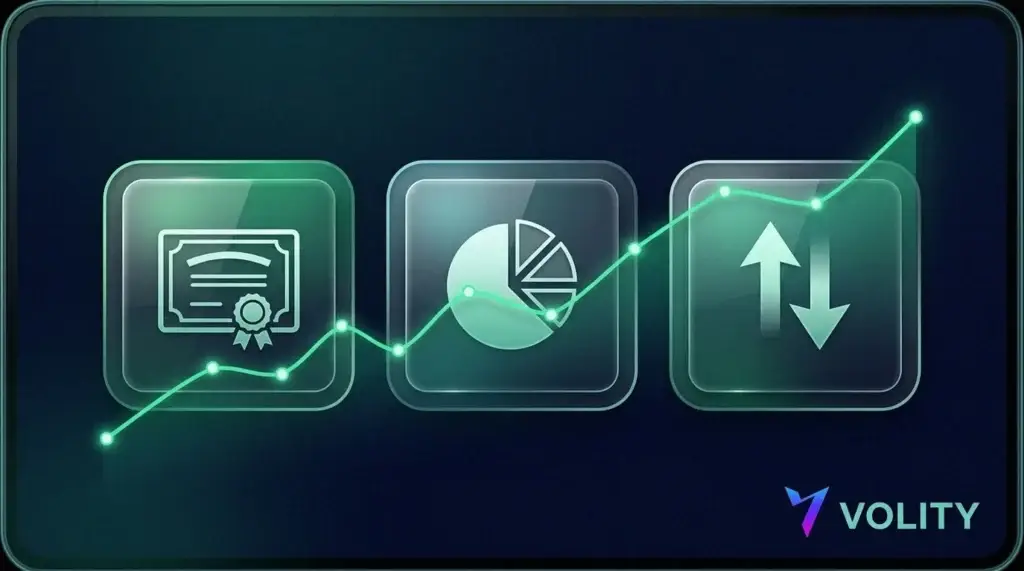
Nvidia designs the graphics and AI chips at the centre of the data-centre and artificial-intelligence boom, which is how it grew into one of the most valuable companies in the world. You can follow the company’s own numbers through its investor relations pages. The right way in depends on one question: do you want to own the company for the long term, or trade its price movements actively? The table below sets out the three routes.
| Route | What you get | Best for |
| Buy NVDA shares | Direct ownership of Nvidia stock | Long-term investors who want to hold the company |
| Buy an ETF holding Nvidia | Indirect, diversified exposure | Those who want AI and tech exposure with less single-stock risk |
| Trade Nvidia CFDs | A position on the price, long or short | Active traders using shorter timeframes |
Owning shares and holding an ETF are both about ownership over time. Trading CFDs is about taking a position on the price, up or down, over shorter horizons. The rest of this guide takes each route in turn.
How do you buy Nvidia stock in the UK?
Buying Nvidia in the UK is straightforward because it is a large, widely held US-listed company that most platforms offering access to US shares carry. You open and verify a share-dealing account that offers US stocks, add funds, search for the ticker NVDA and place your order. For anyone learning how to buy Nvidia stock for beginners, the detail that trips people up is currency: NVDA trades in US dollars, so your platform either converts your pounds at the point of trade or holds a dollar balance, and that conversion carries a small cost.
Because the shares are dollar-denominated, the Nvidia share price you see in the UK is usually shown converted into pounds, and that sterling figure moves with the exchange rate as well as with the stock. Many platforms also offer fractional shares, so you do not need the price of a whole share to start; you can put in a set amount of money instead. If you later sell at a profit, gains above the annual allowance can be subject to UK Capital Gains Tax.
The steps to buy the shares themselves are much the same at any platform that lists US stocks. A general walkthrough of how to buy Nvidia stock covers order types in more detail, but the process comes down to five steps.
- Open a share-dealing account that offers US-listed shares, and complete the identity checks.
- Add funds, and check how the platform converts your pounds into dollars.
- Search for the ticker NVDA and open an order ticket.
- Choose a whole number of shares or a fractional amount, then place a market or limit order.
- Keep a record of what you paid, since it sets your cost basis for tax later.
How do you get Nvidia exposure through ETFs?
If you like Nvidia’s story but would rather not bet on a single company, an ETF gives you a diversified way in. Nvidia is a heavyweight in the broad US indices and in technology and semiconductor funds, so a fund tracking a major US index or the chip sector will hold Nvidia alongside its peers. You get exposure to the theme, artificial intelligence and advanced computing, while spreading single-stock risk across many names. ETFs trade through the same share-dealing account as individual shares.
How do you trade Nvidia with CFDs?
The third route is trading rather than owning. An Nvidia CFD tracks the share price and lets you take a position in either direction, going long if you expect it to rise and short if you expect it to fall, without owning the underlying stock. This is the active-trading approach, and it is where Volity fits. You can trade NVDA as a contract for difference on the Volity platform, size positions to your plan, and practise on a free demo first. Opening a Volity account is free, you can fund from as little as $1, and you can start trading from $1. Equity CFDs use leverage, available up to 1:500 depending on the instrument, and because leverage magnifies losses as much as gains you should check every cost on the charges and fees page and size each trade from your own risk. Execution is CySEC-regulated under UBK Markets, licence 186/12, and you can trade NVDA alongside forex, indices and commodities from one Volity markets account.
Because CFDs are leveraged, the FCA classes them as high-risk investments and requires clear risk warnings. A CFD position can lose money as fast as it can make it, so trade with a stop and only with money you can afford to lose.
What is the Nvidia stock price and how do you read the chart?
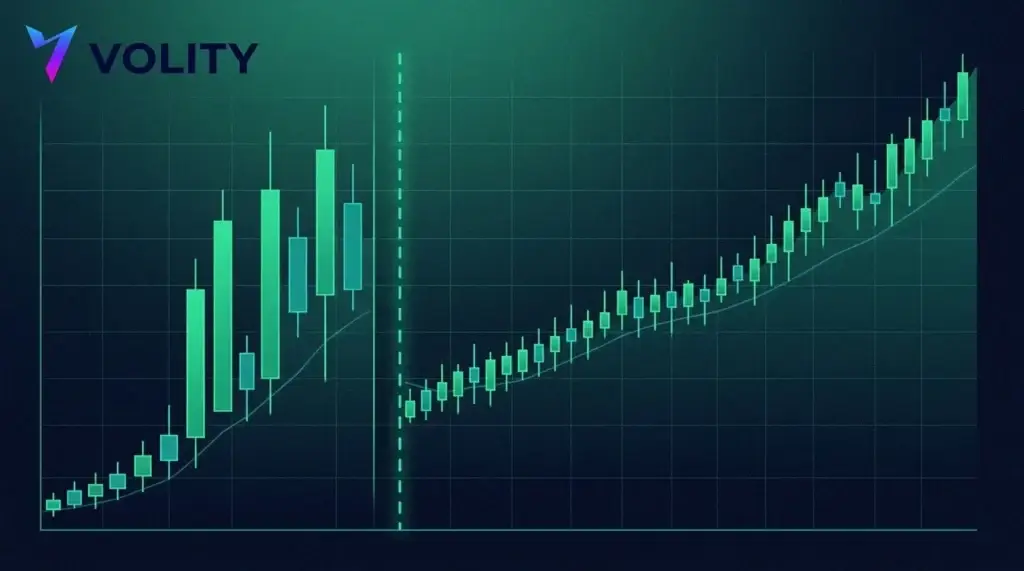
The Nvidia stock price is quoted in US dollars on the Nasdaq and updates continuously through US market hours. Any live Nvidia stock price chart, whether on your trading platform or a financial data site, shows the current level plus history across different timeframes. One historical detail is worth knowing: Nvidia carried out a ten-for-one stock split in 2024, which multiplied the share count and divided the per-share price by ten without changing the company’s overall value, so charts that reach back before then can look very different from today’s per-share numbers.
To work out what a holding is worth you do not need a special Nvidia stock calculator. The maths is the number of shares multiplied by the current price. So the answer to how much 5 shares of Nvidia are worth is five times the latest share price, converted into pounds if you are in the UK. Because the price moves constantly, use the live quote rather than a figure from an old article.
What are Nvidia stock price predictions for 2027, 2030 and 2040?
Searches for an Nvidia stock price prediction 2030, an Nvidia stock forecast 2040 or a general Nvidia stock prediction are hugely popular, and this is where honesty matters. No one can reliably predict a single stock’s price years or decades ahead. Analyst targets exist and they vary enormously between the optimists and the pessimists, which tells you how uncertain the whole exercise is. This guide will not invent a number, because a fabricated target is worse than no target at all.
What you can do instead is understand the drivers. Nvidia’s long-term value rests on continued demand for AI and data-centre chips, its ability to defend high profit margins, the pace of competition from rival chipmakers and from customers designing their own silicon, and the state of the wider economy. Weighing those forces is far more useful than trusting a precise figure for 2030 or 2040, and it is what serious investors actually do. Our Nvidia stock analysis works through the current buy, hold or sell case in that spirit.
Is it too late to invest in Nvidia?
Whether it is too late to buy Nvidia stock is the question everyone asks after a big run, and there is no advice-free way to answer it for you. What counts is the future rather than the past move: whether the price you pay today looks reasonable against what the business can earn, and how the position fits your own goals and risk tolerance. A strong company can still be a poor purchase at the wrong price, and a fallen one can be a good purchase at the right price. Rather than trying to time a single stock perfectly, many investors focus on position size, diversification and a plan they can hold to, whether they buy the shares, hold an ETF or trade the price.
Frequently asked questions
Five shares of Nvidia are worth five times the current NVDA share price. Because the stock trades in US dollars and the price changes throughout the day, multiply the live quote by five and convert to pounds if you need the sterling figure. There is no fixed amount, so always use the latest price rather than an old one.
Yes. UK investors can buy Nvidia through any share-dealing platform that offers US-listed shares. You will trade in US dollars, so expect a small currency conversion cost, and many platforms let you buy fractional shares so you can start with a set amount of money rather than the price of a whole share.
Is Nvidia a good investment for beginners?
Nvidia is a large, well-known company, but single-stock investing carries concentration risk and the share price can be volatile. Many beginners start with diversified funds and treat individual stocks like Nvidia as a smaller part of a broader mix. Whether it suits you depends on your goals and risk tolerance, and this is not advice.
Did Nvidia stock split?
Yes. Nvidia completed a ten-for-one stock split in 2024, giving shareholders ten shares for each one they held and dividing the per-share price accordingly. A split changes the share count and the per-share price, but not the total value of your holding or of the company.