Total Return measures an investment’s full performance, combining capital gains with income like dividends and interest. It offers a comprehensive view of profitability, essential for comparing investments and assessing long-term wealth growth. This guide explains the total return formula, provides clear examples, and highlights its importance for all investors.
While understanding Total Return is important, applying that knowledge is where the real growth happens. Create Your Free Forex Trading Account to practice with a free demo account and put your strategy to the test.
What is Total Return?
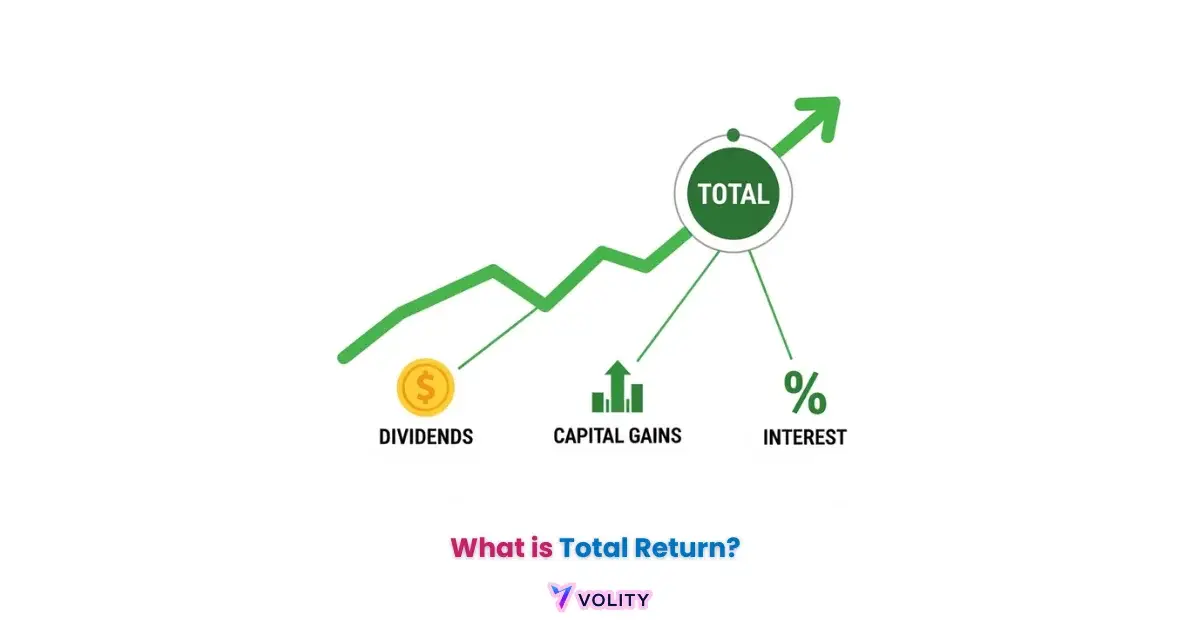
Total Return quantifies the overall performance of an investment by taking into account both capital gains and income generated. It provides investors with a comprehensive view of how an investment has performed over a specific period, including dividends, interest, and any change in the investment’s value.
When evaluating total return, investors consider two main components: capital gains (or losses), which is the increase or decrease in the investment’s value, and income generated, such as dividends from stocks or interest from bonds. Capital gains occur when a security’s price rises, while losses reduce total return. Reinvested income compounds and can significantly boost overall performance.
Total return analysis helps investors assess the overall profitability of an investment. It enables them to compare different investments and make informed decisions based on their individual goals and risk tolerance. It’s particularly relevant when weighing the differences between investing vs trading, as total return favors longer holding periods where compounding works in your favor.
Long-term investors find total return especially important for better portfolio allocation, diversification, and risk management, focusing on wealth growth.
Total Return Examples
Total Return is often expressed as a percentage. For example, if an investment has a total return of 10% over one year, it means the investment gained 10% in value, including any income earned from the investment, such as dividends or interest payments.
As another example, imagine an investor put $1,000 into a stock that pays a 2% dividend annually. After one year, the stock rose by $100 (10%) and paid $20 in dividends. Together, this gives a total return of 12%.
Total return accounts for both increased investment value and income generated, providing a more accurate measure of performance than price appreciation alone. This distinction matters whether you’re focused on positional trading over weeks and months or building a long-term portfolio. Even fractional shares generate total return through the same combination of price movement and dividend income.
Ready to Elevate Your Trading?
You have the information. Now, get the platform. Join thousands of successful traders who use Volity for its powerful tools, fast execution, and dedicated support.
Create Your Account in Under 3 MinutesCalculating Total Return for Stocks
To calculate total return when analyzing performance, consider these steps. First, determine the capital appreciation by subtracting the purchase price from the sale price. Next, add up all dividends received during the holding period. Finally, combine the capital appreciation and dividends to find the total return.
This process is a useful comparison tool for any trading style. Whether you’re a day trader evaluating short-term gains or a long-term investor tracking annual performance, total return gives you the complete picture.
Total Return Formula Explained
To calculate Total Return, use the following formula:
Total Return = ((Ending Value – Beginning Value) + Dividends or Interest) ÷ Beginning Value
For example, you invested $10,000 in a stock at the beginning of the year. At the end of the year, the stock increased in value to $12,000, and you received $400 in dividends.
Using the formula:
Total Return = (($12,000 – $10,000) + $400) ÷ $10,000
= ($2,000 + $400) ÷ $10,000
= $2,400 ÷ $10,000
= 0.24
Therefore, the Total Return on your investment would be 24%. This takes into account both the capital appreciation of the stock and the dividends received.
These calculations are relevant whether you’re buying individual shares, exploring derivative trading, or holding positions across asset classes like precious metals or energy markets.
Turn Knowledge into Profit
You've done the reading, now it's time to act. The best way to learn is by doing. Open a free, no-risk demo account and practice your strategy with virtual funds today.
Open a Free Demo AccountWhy Total Return Matters for Traders
Total return is not just a metric for long-term investors. Active traders also benefit from understanding it. For instance, a swing trader who holds dividend-paying stocks for several weeks may earn income on top of their capital gains — boosting overall returns beyond what price charts alone would suggest.
It also plays a role in evaluating broader economic indicators and market conditions. During periods of tight monetary policy, income components like dividends and bond interest become a larger share of total return as capital appreciation slows.
Understanding total return helps develop a genuine trading edge, accounting for all sources of profit, not just price movement. If you’re still building your foundation in the markets, our guide on how to become a trader is a great place to start.
Bottom Line
Total Return is a fundamental metric for any investor or trader, providing a holistic view of investment performance by combining capital gains with all forms of income. Unlike simple price appreciation, it accounts for dividends, interest, and reinvested earnings, offering a more accurate assessment of true profitability. Understanding and calculating total return is essential for making informed decisions, comparing diverse investments, and effectively managing a portfolio for long-term wealth growth.
Key Takeaways
- Total Return measures an investment’s complete performance, including both capital gains and income.
- It provides a more accurate picture of profitability than just looking at price changes alone.
- The formula for Total Return accounts for beginning value, ending value, and any dividends or interest received.
- Understanding Total Return is crucial for comparing investments, making informed decisions, and managing risk effectively.