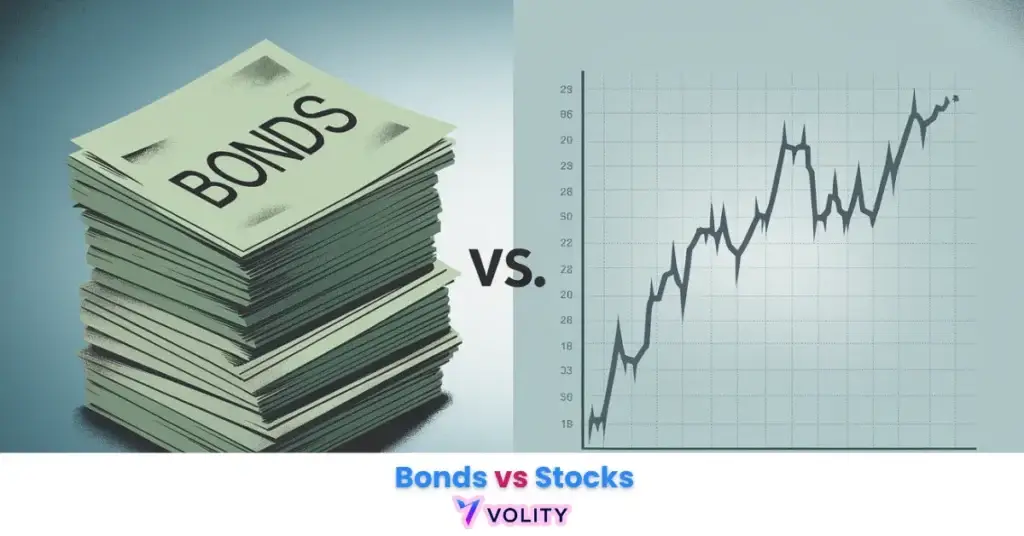
Bonds and stocks represent distinct asset classes with different risk-return profiles that can move together during inflationary periods, violating the traditional diversification assumption. Long-term government bonds can be as volatile as stocks if interest rates move sharply in a short period, causing significant capital losses in bond funds. Rising interest rates create direct losses for existing bond holders through price depreciation. The 60/40 portfolio model failed during 2022 when both stocks and bonds declined simultaneously. Past performance is not indicative of future results. Capital at risk.
Bonds and stocks represent the two primary pillars of asset allocation, offering distinct paths to wealth accumulation through debt and equity. While stocks provide ownership and high growth potential, bonds function as loans that offer fixed income and capital preservation. In 2026, the traditional 60/40 model is being re-evaluated as investors navigate a high-interest-rate environment where bonds once again provide competitive yields against equity returns.
Bonds vs stocks comparison functions as the primary framework for determining an investor’s long-term risk profile. This choice identifies whether a portfolio prioritizes aggressive capital appreciation or conservative income generation. It serves as the starting point for every strategic asset allocation plan in 2026.
The 2026 financial landscape requires a nuanced understanding of how inflation impacts both asset classes differently. While stocks can act as an inflation hedge through rising corporate earnings, bonds often suffer unless they are specifically structured as inflation-protected securities.
While understanding Bonds vs Stocks is important, applying that knowledge is where the real growth happens. Create Your Free Forex Trading Account to practice with a free demo account and put your strategy to the test.
What is the fundamental difference between bonds and stocks?
The primary difference between bonds and stocks identifies the distinction between being a lender (debt) and an owner (equity) of a corporation or government.
Stocks represent direct ownership in a company: you buy shares and become part-owner of the business, entitled to its profits through dividends and capital appreciation. Bonds are debt instruments: you lend money to a government or corporation, receiving fixed interest payments in return plus repayment of your principal at maturity. The financial hierarchy places bonds above stocks: in bankruptcy, bondholders (senior creditors) receive payment before common stockholders (the last to receive anything).
The payment Priority explains the risk-return trade-off: bondholders collect interest regardless of company performance, creating certainty; stockholders collect dividends only when profits are strong, creating uncertainty but unlimited upside potential. Return Mechanisms differ fundamentally: stocks generate returns through capital gains (price appreciation) and dividends, while bonds generate returns through fixed interest payments (coupon) only.
Data from an SEC Investor Guide confirms that in a corporate liquidation, bondholders are classified as “senior creditors,” while common stockholders are the last to receive any remaining assets (SEC Investor Guide, 2025).
Understanding the Capital Stack
The capital stack is the hierarchical structure of a company’s financing that determines the order of repayment and risk for investors. Senior Debt (Bonds) sits at the top, receiving priority in any payout scenario. Common Equity (Stocks) sits at the bottom, receiving only what remains after all creditors are paid. The risk-return trade-off across the stack is mathematically inverse: safer debt requires lower promised returns; riskier equity demands higher potential returns to compensate investors.
Ready to Elevate Your Trading?
You have the information. Now, get the platform. Join thousands of successful traders who use Volity for its powerful tools, fast execution, and dedicated support.
Create Your Account in Under 3 MinutesRisk vs. Reward: Comparing Historical Performance
Historical stock and bond returns confirm that equities consistently deliver higher long-term growth at the cost of significantly greater price volatility.
Over the last century, US stocks have outperformed US bonds in 68% of rolling 1-year periods and 91% of rolling 20-year periods (Vanguard Historical Data, 2026). The average annual return for stocks hovers around 10% (with 15-18% standard deviation), while bonds average 4-5% annually (with 5-7% standard deviation). Drawdown analysis reveals bonds’ power: during the 2008 financial crisis, stocks fell 55% while bonds posted positive returns. During the 2020 pandemic crash, stocks recovered in weeks; bonds protected capital during the uncertainty.
Stocks Investing for Beginners teaches that the “Volatility Gap” between these asset classes matters more than absolute returns, bonds smooth portfolio returns, reducing the psychological pain of equity crashes.
How interest rates impact the bonds vs stocks relationship
Interest rate fluctuations are the primary driver of the inverse relationship between bond prices and the relative valuation of growth stocks.
Rising interest rates hurt bond prices directly: a 10-year bond paying 3% becomes worthless when new 10-year bonds pay 5%, so the old bond’s price must fall to match the new yield. The same rate increase damages growth stocks through Discounted Cash Flow (DCF) impact: when the discount rate rises, future cash flows are valued lower today, crushing the price-to-earnings multiples of unprofitable companies dependent on future growth.
The 2026 “Yield Trap” manifests as follows: when 10-year Treasury yields hit 5%, conservative investors abandon stocks and lock in the guaranteed return. Bond Price Sensitivity intensifies: the concept of “Duration” measures how much a bond’s price falls when rates rise, a 10-year bond with 8-10 years of duration loses 1% in value for every 1% rise in interest rates.
Real trading example: An investor rotated 20% of their tech holdings into 10-year bonds in early 2026 as yields hit 5%. The bond position provided a guaranteed 5% return, while the Nasdaq 100 experienced a 12% drawdown due to tightening credit conditions, resulting in significant capital preservation. Past performance is not indicative of future results.
Should a beginner buy stocks or bonds in 2026?
Asset allocation benchmarks identifies the ideal balance of stocks and bonds based on an investor’s age and risk tolerance.
| Profile | Stock Allocation | Bond Allocation | Primary Goal |
| Aggressive (Age 25) | 90% | 10% | Maximum Growth |
| Balanced (Age 45) | 60% | 40% | Risk-Adjusted Return |
| Conservative (Age 65) | 30% | 70% | Capital Preservation |
| Income Seeker | 20% | 80% | Passive Cash Flow |
| 2026 Inflation Model | 50% | 50% | Real Wealth Growth |
Sources: Data compiled from Charles Schwab and Fidelity Investment Guidelines (2026).
The 2026 Correlation Shift: When diversification fails
Positive correlation events indicate that high inflation can cause both stocks and bonds to decline simultaneously, challenging the traditional 60/40 model.
Analysis of the 2022 and early 2026 correlation spikes reveals that bonds failed as a “safe haven” during inflation-driven rate hikes. Both asset classes fell together: stocks crashed from elevated valuations while bonds crashed from rising rates. The traditional 60/40 portfolio returned -16% in 2022, proving that diversification breaks during inflationary regimes. Role of “Alternatives” (Gold, Real Estate) in a modern 2026 portfolio has exploded: investors need true negative correlation, not just different asset classes.
Portfolio Rebalancing becomes critical in a correlation-shift environment: rebalancing forces you to sell winners and buy losers, improving returns even when both asset classes decline.
Turn Knowledge into Profit
You have done the reading, now it is time to act. The best way to learn is by doing. Open a free, no-risk demo account and practice your strategy with virtual funds today.
Open a Free Demo AccountHow to Invest: ETFs vs. Individual Securities
Exchange Traded Funds represent the most efficient and liquid vehicle for gaining broad exposure to both stock and bond markets.
Using “Total Stock Market” ETFs like VTI or “Total Bond Market” ETFs like BND provides diversification across hundreds of securities with minimal fees (0.05% annually). The benefit of professional management in corporate bond funds lies in credit research: bond funds employ analysts who evaluate default risk, something individual investors cannot replicate. Individual bond picking requires deep knowledge: you must understand yield curves, credit ratings, and interest rate forecasts.
What Are Bonds explains bond mechanics; Equity Trading describes stock execution, both can be accomplished through low-cost ETFs.
Key Takeaways
- Stocks provide equity ownership in a company, offering high long-term growth potential through capital gains and dividends.
- Bonds function as a loan to a government or corporation, providing fixed interest payments and a return of principal at maturity.
- Risk-return profiles differ significantly, with stocks carrying higher volatility and bonds offering relative stability and income.
- Interest rate changes typically move bond prices in the opposite direction, while also impacting the valuation of growth-oriented stocks.
- Portfolio diversification relies on the historical low correlation between stocks and bonds to reduce overall investment risk.
- Allocation strategies must be adjusted based on an investor’s age, with younger investors typically favoring a higher percentage of stocks.
Frequently Asked Questions
This article contains references to bonds vs stocks and Volity, a regulated CFD trading platform. This content is produced for educational purposes only and does not constitute financial advice or a recommendation to buy or sell any financial instrument. Always verify current regulatory status and platform details before using any trading service. Some links in this article may be affiliate links.