Discount brokers in the Eurozone offer access to leveraged trading products and global markets that carry substantial execution risk and operational dependencies. While MiFID II protections mandate segregated accounts and €20,000 compensation coverage, a broker’s default or regulatory action can still disrupt access to your capital. Currency conversion, wider spreads during volatile markets, and stock lending programs introduce additional risk layers. Past performance is not indicative of future results. Capital at risk.
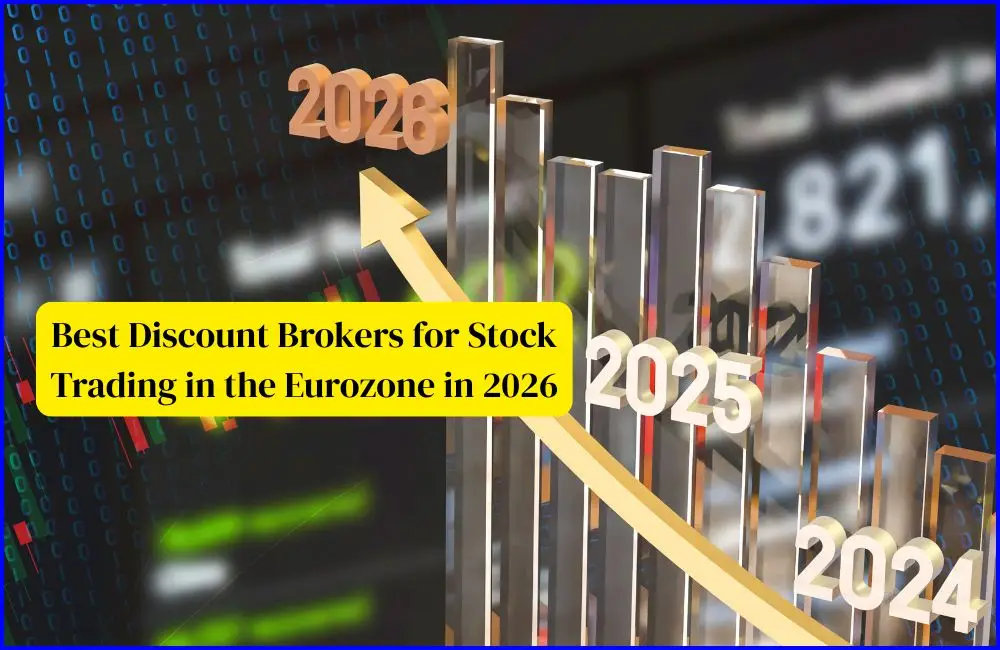
Best discount brokers for stock trading in the eurozone are regulated entities that utilize electronic execution to lower the cost of retail participation. These firms operate under the unified European securities framework, providing passported services across all member states. Competition among low-cost providers has pushed headline commissions on a mid-sized European equity trade down to a few euros.
While understanding Eurozone Discount Brokers is important, applying that knowledge is where the real growth happens. Create Your Free Forex Trading Account to practice with a free demo account and put your strategy to the test.
Best discount brokers for stock trading in the eurozone function as the primary gateway for cost-conscious investors seeking global market exposure. These platforms focus on high-volume execution and digital-first service models to maintain their low-fee structures. They serve as a critical tool for building long-term wealth within the Eurozone’s unified financial market in 2026.
The 2026 Eurozone brokerage landscape is defined by the convergence of traditional discount models and mobile-native neobrokers. Investors utilize these platforms to access not only local indices like the DAX and CAC 40 but also US equities and a vast array of UCITS-compliant ETFs.
What defines a “discount broker” in the Eurozone context?
A Eurozone discount broker is a MiFID II-regulated financial institution that provides self-directed trading services with minimal advisory overhead and low commission structures. These firms distinguish themselves from full-service banks through their execution-only model, where clients manage their own research and decision-making. The technology-driven approach eliminates the cost of proprietary research teams and personal advisors, allowing these firms to pass savings directly to retail participants.
The “execution-only” model represents a fundamental shift in how investors access capital markets within the EU. Rather than receiving personalized guidance, traders on discount platforms make independent decisions supported by market data, charting tools, and research aggregators. Role of technology in automating order routing and clearing processes reveals how modern brokers operate at margins traditional banks cannot match, a single low-cost provider manages thousands of accounts through automated workflows.
Retail order flow in the Eurozone has moved decisively towards discount and digital-only platforms. This migration reflects both cost-awareness and the maturation of retail trader competence across the bloc. The primary entity supporting this transition remains the unified regulatory framework that allows any licensed Eurozone broker to serve customers across all member states.
The MiFID II Regulatory Shield
MiFID II is the legislative framework that ensures Eurozone investors receive transparent fee disclosures and best execution guarantees from their brokers. This regulation mandates that all EU-regulated brokers maintain segregated client accounts, meaning broker insolvency does not entitle creditors to raid investor deposits. The Investor Compensation Fund (ICF) protects client assets up to €20,000 per investor, creating a safety net equivalent to deposit insurance at retail banks.
Mandatory disclosure of conflicts of interest, such as stock lending programs that brokers use to offset costs, reveals the true economics of low-fee models. When a discount broker lends your shares to hedge funds for short sales, that revenue stream subsidizes your low commissions. While regulated and transparent, this practice introduces counterparty risk that requires investor awareness.
ESMA’s interactive MiFID II rulebook sets out the conduct and client-asset rules that underpin broker safety across the EU, and each member state runs the investor-compensation scheme that sits behind them.
Ready to Elevate Your Trading?
You have the information. Now, get the platform. Join thousands of successful traders who use Volity for its powerful tools, fast execution, and dedicated support.
Create Your Account in Under 3 MinutesComparing the Best Discount Brokers in the Eurozone for 2026
The leading discount brokers in the Eurozone identify as multi-asset platforms that specialize in specific segments of the retail investor market. Volity combines institutional-grade execution speed with integrated multi-asset access, forex, stocks, and CFDs on a single platform, making it ideal for traders who require exposure across multiple asset classes. DEGIRO, the European leader for raw cost-efficiency, offers access to over 50 global stock exchanges with commissions as low as €0.99, attracting long-term investors who accumulate positions slowly over time. Interactive Brokers (IBKR) serves professional traders needing global reach and advanced margin tools, with API access and portfolio management features unavailable on simpler platforms.
XTB distinguishes itself through integrated research and educational infrastructure, pairing the xStation 5 platform with daily video analysis and webinars that appeal to traders seeking to accelerate their learning curve. Scalable Capital specializes in “Broker-as-a-Service” and automated ETF savings plans throughout Germany and France, targeting investors who prefer algorithmic portfolio construction over individual stock picking. Each platform optimizes for different investor archetypes, the trader demands speed; the accumulator demands cost; the professional demands tools.
Interactive Brokers currently offers access to over 150 global markets, the widest reach of any discount broker operating in the Eurozone. This breadth means traders can execute a single strategy across US equities, European bonds, and Asian futures without maintaining multiple accounts.
Best Stock Trading Platforms in Europe 2026 provides comprehensive detail on platform execution quality and feature depth across these five leaders.
How to calculate the “Total Cost of Ownership” for your account?
The total cost of ownership for a brokerage account represents the sum of commissions, spreads, FX conversion fees, and inactivity charges. Commission structures vary widely: DEGIRO charges fixed fees per trade (€0.99 on US stocks), while Interactive Brokers uses percentage-based tiers (0.02% on large orders). The “Hidden Spread” affects traders profoundly, some “zero-fee” brokers widen the bid-ask spread from €0.01 to €0.05 per share, effectively charging a hidden cost that exceeds a posted commission.
FX Fees represent the most underestimated cost for European traders buying US equities. A trader converting €10,000 to USD for a NASDAQ trade may face a 0.1% to 0.5% currency conversion fee depending on broker choice, that €10 to €50 cost is often invisible until it appears in the executed order. Portfolio Rebalancing strategies that require frequent currency conversions magnify this friction.
Real trading example: A trader bought 10 shares of ASML at €900 each via a broker with a €2 flat fee and a 0.05% spread. The total transaction cost was €6.50 (€2 commission + €4.50 spread), whereas a traditional bank would have charged a minimum 0.5% commission (€45), saving the investor nearly 85% in friction costs. Past performance is not indicative of future results.
Is your capital safe with Eurozone discount brokers?
Eurozone broker safety benchmarks identifies the regulatory protections and custody arrangements provided by leading discount firms. Each broker operates under a specific national regulator, Volity under CySEC (Cyprus), DEGIRO under BaFin (Germany) and AFM (Netherlands), and Interactive Brokers under the Central Bank of Ireland. These regulators enforce identical MiFID II standards but operate with different philosophies: BaFin emphasizes institutional rigor, while CySEC balances innovation with retail protection.
| Broker | Primary Regulator | Compensation Scheme | Asset Custody |
| Volity | CySEC (EU) | €20,000 (ICF) | Tier-1 Segregated |
| DEGIRO | BaFin/AFM | €20,000 | Separate SPV |
| IBKR | CBI (Ireland) | €20,000 | Global Segregated |
| XTB | KNF (Poland) | €20,000 (KDPW) | Client Cash Pools |
The protection level depends primarily on regulatory jurisdiction and custody model, not brand reputation. A highly-rated fintech regulated by CySEC receives identical investor compensation as a German bank regulated by BaFin. Global Segregated custody (used by IBKR) offers maximum safety during broker default, as assets are held with third-party custodians that cannot be claimed by broker creditors.
Turn Knowledge into Profit
You have done the reading, now it is time to act. The best way to learn is by doing. Open a free, no-risk demo account and practice your strategy with virtual funds today.
Open a Free Demo AccountThe impact of “SEPA Instant” on Eurozone trading in 2026
The mandatory adoption of SEPA Instant represents a revolutionary shift in the speed and cost of funding Eurozone brokerage accounts. Prior to 2026, SEPA transfers required 1-2 business days, forcing traders to hold cash buffers or miss short-lived opportunities. SEPA Instant enables bank-to-broker transfers in under 10 seconds, with zero additional fees for retail participants. This acceleration directly improves the ability to “Buy the Dip” during market volatility, a trader can now move cash within seconds of identifying a 5% market decline.
Elimination of deposit fees for retail investors across the Eurozone means that funding a brokerage account costs nothing, regardless of amount. Cash therefore lands before the market does, which removes the funding lag that used to force traders to park large idle balances. Trade settlement itself is unchanged: EU and UK equities settle at T+2 until the move to T+1 on 11 October 2027. Some 2026 brokers are offering “interest on uninvested cash” at rates near the ECB benchmark, effectively turning your brokerage account into a high-yield savings tool while you wait for trading opportunities.
The European Central Bank guidance on instant payments mandates the rollout across all Eurozone member states, verifying that this infrastructure is now universal and irreversible.
Direct Market Access (DMA) vs. Retail Execution
Direct Market Access is a professional-grade execution model that allows self-directed traders to interact directly with the order books of global exchanges. Rather than sending orders through a broker’s internal market maker (who profits from the spread), DMA routes orders to public exchanges where they execute against genuine buy/sell liquidity. This model benefits institutional traders and serious retail participants, but introduces complexity, order management requires professional-level software and discipline.
Comparison of DMA vs. Market Maker (Internalized) execution reveals the tradeoff. Market Maker brokers match your buy order against their own book, guaranteeing instant fills but keeping the spread as profit. DMA exposes your order to market depth, potentially achieving better prices on large orders but risking partial fills or rejections during low liquidity periods. Auditing your broker now means reading its order execution policy rather than a standard report, because the periodic RTS 27 and RTS 28 publications were withdrawn under the 2024 MiFID II review.
gold trading." class="internal-link" href="https://volity.io/stocks/direct-market-access/">Direct Market Access explains the technical infrastructure and pricing models in detail. Equity Trading covers the foundational mechanics of how exchanges and brokers match orders. Stocks Investing for Beginners introduces the broader context of how retail traders participate in these markets. Market Index describes the composition of major Eurozone indices that discount brokers make accessible. MiFID II Regulation provides regulatory context for how DMA execution is governed.
Key Takeaways
- Eurozone discount brokers provide a low-cost alternative to traditional banks, offering self-directed access to global stock markets for minimal fees.
- MiFID II regulations protect retail investors by mandating transparent fee disclosures and ensuring high levels of asset custody safety across the EU.
- Total cost of ownership includes not only commissions but also bid-ask spreads and FX conversion fees, which can vary significantly between brokers.
- Investor compensation schemes typically protect client funds up to €20,000 in the event of a broker’s insolvency, providing a critical safety net for retail capital.
- SEPA Instant transfers have become the standard for funding accounts in 2026, allowing investors to move capital between banks and brokers within seconds.
- Since the 2024 MiFID II review withdrew the RTS 27 and RTS 28 reports, a broker’s order execution policy is the document to read on execution quality.
Frequently Asked Questions
This article contains references to best discount brokers for stock trading in the Eurozone and Volity, a regulated CFD trading platform. This content is produced for educational purposes only and does not constitute financial advice or a recommendation to buy or sell any financial instrument. Always verify current regulatory status and platform details before using any trading service. Some links in this article may be affiliate links.