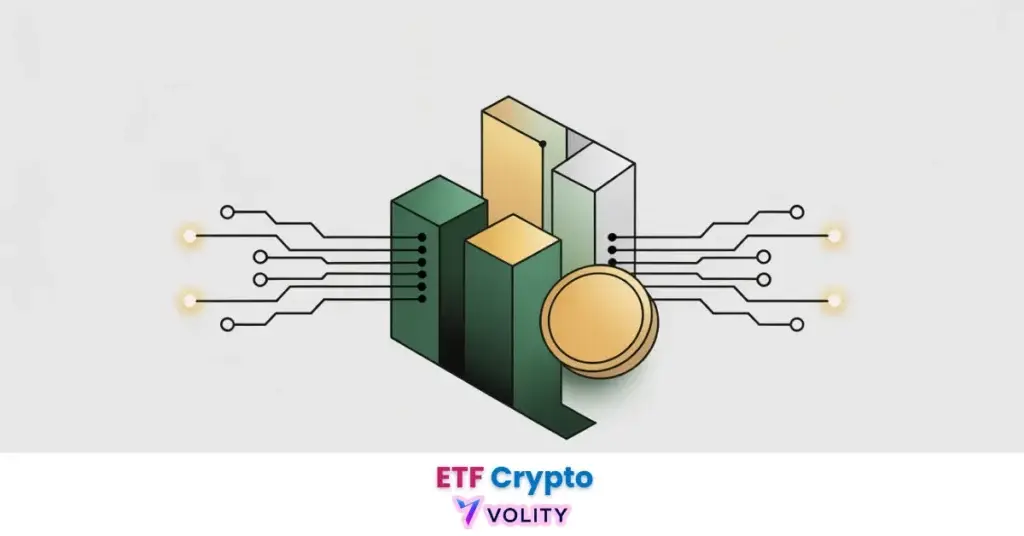
Etf crypto is a core topic for traders in 2026. The complete guide follows.
The Crypto Trading Starter Kit
A plain-English PDF: what to check before you trade, how orders and risk really work, and the mistakes to skip. Get it free.
Crypto ETFs are subject to high market volatility and regulatory changes. Spot approvals do not guarantee future performance or price stability. All investment decisions carry risk. Past performance is not indicative of future results. Capital at risk.
A crypto ETF identifies a pool of capital managed to track the real-time value of specific digital currencies or blockchain indices. This vehicle reveals a simplified path for traditional investors to access high-volatility markets through their existing brokerage accounts.
The technical evolution of the crypto market in 2026 focuses on “Institutional Integration,” where ETFs serve as the primary bridge. By removing the operational burden of self-custody, these funds opened the asset class to mandates that cannot hold private keys at all, including pension and long-term savings portfolios.
While understanding Crypto ETF is important, applying that knowledge is where the real growth happens. Create Your Free Crypto Trading Account to practice with a free demo account and put your strategy to the test.
What is a crypto ETF and how does it work?
A crypto ETF is a regulated investment vehicle that tracks the market price of digital assets by holding physical coins or derivative contracts.
The term “Exchange Traded” indicates that these funds trade on traditional securities exchanges like the NYSE and Nasdaq, allowing investors to buy shares using their existing brokerage accounts without accessing specialized crypto platforms. Creation and redemption mechanisms ensure the ETF price matches the underlying asset: authorized participants can create new shares when investor demand drives the share price above Net Asset Value, or redeem shares when demand weakens. This arbitrage mechanism maintains price alignment between the ETF and its underlying digital asset. When you purchase a spot Bitcoin ETF, you own shares representing a proportional claim on the physical Bitcoin held in regulated custody, you never hold the private keys directly, but you benefit from all price appreciation.
The blockchain technology explained guide documents the underlying blockchain infrastructure that crypto ETFs reference, and a futures-based fund differs structurally from a spot vehicle because it holds dated contracts rather than coins, so it has to roll those contracts as they expire.
Ready to Elevate Your Trading?
You have the information. Now, get the platform. Join thousands of successful traders who use Volity for its powerful tools, fast execution, and dedicated support.
Create Your Account in Under 3 MinutesSpot vs. Futures: Understanding the Different Types of Crypto ETFs
For European-regulated tokenized infrastructure, see LCX (Liechtenstein Crypto).
The distinction between spot and futures ETFs identifies whether a fund holds physical digital assets or agreements to buy them at a future price.
Physical (Spot) ETFs hold actual Bitcoin, Ethereum, XRP, or other digital assets in regulated custody vaults. Shareholders own a fractional claim on these physical coins, and the ETF price tracks the live market price throughout trading hours. Futures-Based ETFs, by contrast, use Chicago Mercantile Exchange (CME) contracts, agreements to buy or sell the asset at a future date. These contracts never result in physical delivery; instead, they settle in cash. The structural difference creates subtle but critical distinctions: spot ETFs track 24/7 crypto markets perfectly but have slightly higher custody costs, while futures ETFs trade only during market hours and suffer “contango” decay where rising futures prices create a tracking lag. Related Equity ETFs invest in blockchain-adjacent companies like Coinbase, MARA, and CLSK instead of the coins themselves. Hybrid models balance both approaches, using a combination of spot holdings and futures exposure to maintain immediate liquidity while minimizing tracking errors.
The digital currency market trends guide explains how market structure impacts different fund types and investor preferences in 2026.
The 2026 Crypto ETF Landscape: Bitcoin, Ethereum, and XRP Approvals
For tokenized US Treasuries with on-chain settlement, see ONDO Finance.
The 2026 crypto ETF market identifies a mature landscape featuring regulated spot offerings for the three largest digital assets by market capitalization.
Spot Bitcoin ETF approval in January 2024 marked the historical inflection point where institutional capital flooded into crypto through regulated vehicles. The Spot Ethereum ETF followed on July 23, 2024, giving the second-largest digital asset the same regulated wrapper and the same daily creation and redemption mechanics. Spot XRP funds followed in November 2025, once the Ripple litigation had concluded and the exchanges had generic listing standards to admit them under; the Bitwise XRP ETF listed on NYSE in that first cohort. Spot Solana products arrived slightly earlier, in late October 2025, and launched with staking built in rather than as pure price trackers: see Bitwise Launches BSOL, First Spot Solana ETP in U.S.
The Ethereum 2.0 institutional adoption guide explains how institutional capital flows through ETFs impact individual blockchain ecosystems and their underlying developer ecosystems.
Key Benefits: Why Investors Prefer ETFs Over Direct Ownership
Crypto ETFs reveal significant advantages in security, tax reporting, and ease of access compared to direct digital asset holding.
Security stands as the paramount advantage: crypto exchange hacks and self-custody key losses represent existential risks for direct holders, whereas ETF holders delegate custody risk to regulated financial institutions with insurance bonds. Tax reporting addresses a traditional investor pain point: crypto-ETF income and gains are reported to your national tax authority (HMRC in the UK) and integrate cleanly with standard tax filing, tax-advantaged wrappers such as an ISA or SIPP can hold crypto ETFs without triggering additional tax complications, and cost basis tracking occurs automatically. Diversification enables single-click exposure to index funds tracking multiple coins (e.g., a “Top 10 by Market Cap” index) rather than requiring manual allocation across individual holdings. The Bank for International Settlements sets out the structural risks of holding crypto directly, including custody and settlement, in The crypto ecosystem: key elements and risks. Removing those operational burdens is most of what the ETF wrapper sells.
Risks and Limitations: Market Volatility and Tracking Errors
Investing in crypto ETFs identifies inherent risks including extreme price volatility and potential tracking errors during high-volume periods.
Tracking Error occurs when an ETF’s price diverges from its underlying asset, this happens most often during volatile periods when the ETF trades on traditional exchanges (limited liquidity, extended hours only) while the underlying digital asset trades 24/7 on global cryptocurrency exchanges. A spot Bitcoin ETF might trade at $68,500 on Tuesday morning while Bitcoin markets (which never close) already trade at $68,800, causing ETF shareholders to experience temporary price slippage. Regulatory Risk represents a second-order threat: if future SEC leadership reverses course on crypto approvals or imposes new restrictions, existing ETF holders could face forced liquidation or regulatory status changes. Management Fees provide ongoing expense drag, while typical expense ratios of 0.20-1.5% represent a convenience premium over zero-fee direct holding, this cost compounds over decades.
ESMA’s Investor Corner publishes the regulator’s guidance for retail investors, including on fund structures.
How to invest in a crypto ETF safely in 2026
Investing in crypto ETFs identifies a straightforward process involving regulated brokerages and thorough fund research.
Selecting a broker means choosing a platform with access to the exchange the fund is listed on; most mainstream brokerages that already carry US-listed equities now carry the crypto ETF cohort alongside them, with no separate account needed. Researching fund prospectuses means examining the expense ratio (0.20-1.5% typical range), identifying the named custodian in the prospectus, and confirming whether the fund is spot-based or futures-based. Monitoring institutional inflows matters more in crypto than traditional assets: when major institutions announce ETF additions to their model portfolios, subsequent weeks typically show sustained buying that pushes prices higher. The crypto market capitalization guide provides real-time data on total market size and individual asset valuations that inform allocation decisions. The secure crypto wallet alternatives guide explains why ETF holders need not maintain personal wallets while also documenting how direct ownership differs fundamentally from ETF holding.
Key Takeaways
- Crypto ETFs identify a regulated gateway for investors to track digital asset prices through traditional brokerage accounts.
- Spot Ethereum ETFs launched in July 2024; spot Solana products arrived in October 2025 and spot XRP funds in November 2025.
- Physical crypto ETFs hold actual digital assets in custody, whereas futures-based funds track derivative contracts.
- Institutional adoption in 2026 has made crypto ETFs a core component of diversified model portfolios and retirement accounts.
- Tracking errors and management fees represent the primary costs of choosing ETFs over direct asset ownership.
- Spot Solana products have been trading since October 2025 and launched with on-chain staking built into the wrapper.
Frequently Asked Questions
This article contains references to crypto ETFs, digital assets, regulatory approvals, and Volity, a regulated CFD trading platform. This content is produced for educational purposes only and does not constitute financial advice or a recommendation to buy or sell any financial instrument. Always verify current regulatory status and platform details before using any trading service. Some links in this article may be affiliate links.
What our analysts watch: Spot crypto ETF flows have become the single most-watched institutional adoption signal. Three readings frame the picture. Net daily creations versus redemptions (sustained creations confirm institutional demand; multi-week redemption streaks signal regime stress). Premium or discount to net asset value (a tight spread indicates deep authorised-participant liquidity; a widening spread flags structural friction). Total assets under management across the spot ETF cohort (the dollar size of the wrapper is now a meaningful percentage of underlying market cap). The ETF tape now tells the institutional crypto story in real time.
Volity operates a trading platform and also publishes educational and analytical content about trading. The content on this page is for educational purposes only and should not be considered financial advice. Volity may benefit commercially when readers open trading accounts through links on this site.
Our content is produced and reviewed under documented editorial standards; see our comparison and review methodology.