There is no single cheapest choice among the discount brokers in the eurozone, because the price that matters is the total for your own trades. That total has seven layers: commission, spread, currency conversion, recurring charges, venue fees, transaction tax, and funding or interest on cash. This guide shows you how to add them up for one order, which costs no broker fee table shows, and how to check who protects your money.
TL;DR: Build a cost sheet for the order size you really use, and ask each broker for the itemised costs-and-charges breakdown that MiFID II entitles you to. Add the financial transaction tax that France, Spain and Italy charge on some share purchases. Check the firm on its regulator’s register, and know what compensation covers: a failed firm, never a falling price. If you only want price exposure, stock CFDs are a different product with their own costs.
Most broker rankings compare one headline commission. The euro is used by 21 of the 27 Member States of the European Union, according to the European Central Bank, and Bulgaria joined in 2026. The checks below come from EU law and regulator pages, so they work for any broker on your shortlist.
How to find the cheapest broker for your own trades
A discount broker lets you buy and sell shares online at a low price per order. A broker with no commission can still cost you more if its spread is wide or its currency conversion is expensive.
EU law gives you the tool to compare. Under Article 24 of MiFID II (Directive 2014/65/EU), a firm’s costs “shall be aggregated to allow the client to understand the overall cost as well as the cumulative effect on return of the investment”. The same article adds that “where the client so requests, an itemised breakdown shall be provided”. The firm must also report these costs at least once a year while you hold the investment.
Build your cost sheet in this order:
- Write down one typical order: the share, the amount in euros and how often you place it.
- Commission: the charge per order. Note any minimum charge. A fixed minimum weighs far more on a small order, such as fractional units (part of one share).
- Spread: the gap between the buy price and the sell price. See our guide to how a spread works. You pay it on the way in and on the way out, even when commission is zero.
- Currency conversion: a share priced in US dollars means you convert euros when you buy and again when you sell. Ask how the rate is set.
- Recurring charges: custody, account or platform charges, plus any charge for deposits and withdrawals.
- Venue fees and transaction tax: exchange charges passed on to you, and the tax some countries put on share purchases.
- Funding and cash interest: overnight financing on leveraged positions, and whatever the broker pays on cash you leave unused.
Multiply the per-order total by your orders per year, then compare brokers on that one figure. The UK regulator gives the same advice for CFDs. In its press release of 13 November 2025 on CFD providers, Mark Francis, the FCA’s director of sell-side markets, said: “It is also important that consumers shop around and ensure they fully understand the investment and its costs.”
Costs a broker’s fee table does not show
Some costs are set by governments, so a broker’s price list may not mention them. One that many comparisons skip is a financial transaction tax (FTT): a tax you pay when you buy shares of certain listed companies. Tax Foundation Europe’s 2026 table, updated on 2 June 2026, lists these eurozone examples:
- France: 0.4% on shares of listed French companies with a market value above EUR 1 billion.
- Spain: 0.20% on transfers of shares of listed Spanish companies with a market value above EUR 1 billion.
- Italy: 0.2% on regulated-market trades and 0.4% on over-the-counter trades.
The French rate rose from 0.3% to 0.4% on 1 April 2025, reports Legifiscal. It applies to purchases of shares in companies valued above EUR 1 billion on 1 December of the year before.
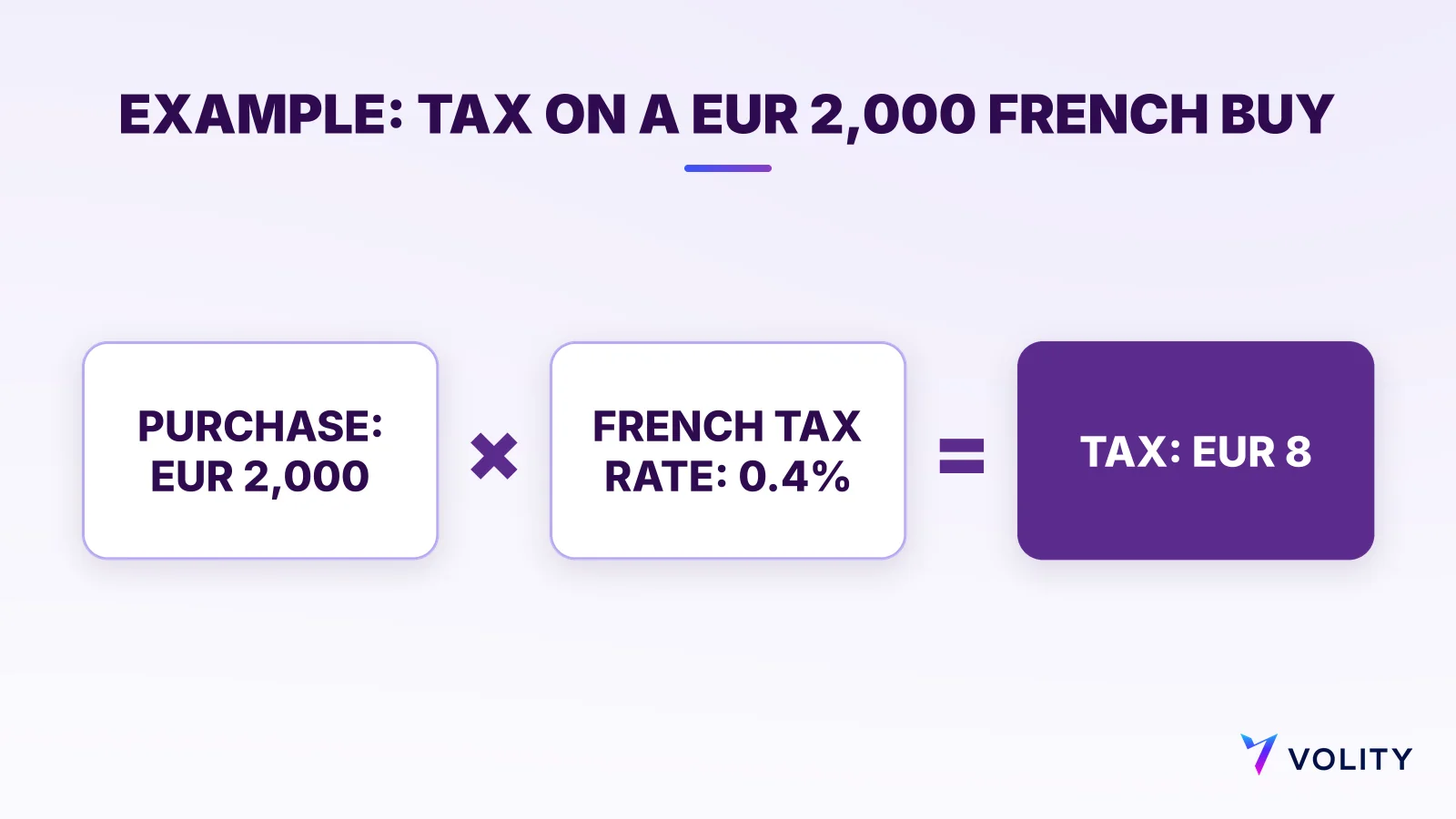
Here is a hypothetical example. Say you buy EUR 2,000 of shares in a large French company above that threshold. At 0.4%, the tax is EUR 8, whichever broker you use. Buy a company below the threshold and the French tax does not apply. Rates change, so check the tax on the exact share with the national tax authority.
Two more costs hide inside the price itself. Slippage is the gap between the price you expected and the price you got; our slippage guide explains it. This matters when you trade US shares from Europe, since the price can move while your order travels. Slippage cannot be ruled out on a market order, which fills at the next available price. A limit order sets the worst price you accept, but the order may not fill.
What the 2024 MiFID II changes mean for your orders
Payment for order flow (PFOF) means a third party pays a broker for sending your orders to a particular venue. Regulation (EU) 2024/791 added a ban to EU law. Firms acting for retail or professional clients “shall not receive any fee, commission or non-monetary benefit from any third party for executing orders from those clients on a particular execution venue”.
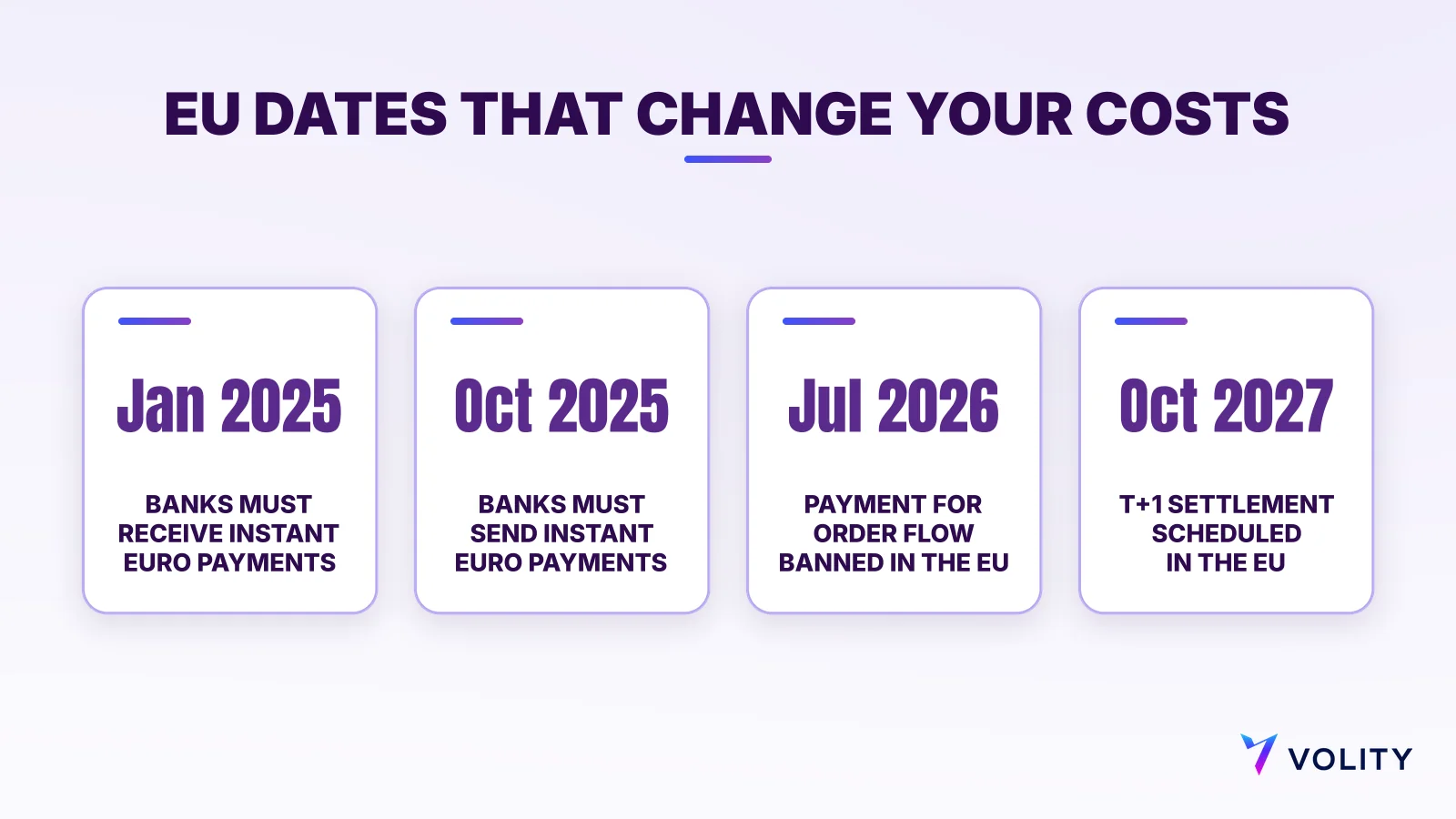
Countries where the practice existed before 28 March 2024 could exempt their firms until 30 June 2026. From 1 July 2026 the ban applies across the EU. If a broker changes its prices as a result, read its new costs-and-charges disclosure and compare the total, not one line.
Directive (EU) 2024/790 withdrew the periodic execution-quality reports from MiFID II. Its recital 8 says these reports “are rarely read and do not enable investors or other users of those reports to make meaningful comparisons”. For shares covered by EU trading obligations, a firm now tells you the venue where each order was executed.
Firms must still “monitor the effectiveness of their order execution arrangements and execution policy”. So the document to read is the broker’s order execution policy, which explains where orders go and how prices are set. Volity publishes its execution policy on its site.
Who protects your money and what the scheme covers
Check the firm, not the brand. Find the legal entity name in the broker’s terms and search for it on the ESMA registers or the home regulator’s site, such as CySEC in Cyprus or BaFin in Germany. For a UK firm, use the FCA register. See our guide to checking a platform’s safety.
Compensation is the next layer. The European Commission says the EU directive “protects investors by providing compensation if an investment firm fails to return the investor’s assets.” It adds: “All firms supplying investment services must belong to such a scheme.” The directive sets a minimum of EUR 20,000 per investor, and each country’s scheme applies its own rules on top.
It does not protect you from a falling market. The Commission says the directive “does not cover investment risk, such as when an investor has bought stocks which then fall in value.” UK readers have a separate scheme: the FSCS covers up to £85,000 per eligible person, per firm, and accepts no claims for poor investment performance.
Read the account terms for securities lending too. Under Article 5 of Delegated Directive (EU) 2017/593, a firm may not lend your shares unless “the client has given his prior express consent to the use of the instruments on specified terms, as clearly evidenced in writing and affirmatively executed by signature or equivalent”.
Funding, instant payments and settlement dates
Moving euros between banks has become faster. Under Regulation (EU) 2024/886, euro-area banks and payment firms had to receive instant euro transfers by 9 January 2025 and send them by 9 October 2025. The ECB says instant payments arrive “within ten seconds of a payment order being made”, and the scheme runs “24 hours a day, 365 days a year”.
Two limits matter. The rule caps what your bank charges for an instant transfer at what it charges for an ordinary euro transfer, which is not the same as free. Also, the duty sits with banks. Whether a broker accepts instant top-ups is the broker’s own choice, so ask before you count on it.
Cash you leave uninvested is the last layer. At the time of writing, the ECB deposit facility rate is 2.50%, effective 16 September 2026. Any interest a broker pays on idle cash is set by the broker, so read its terms.
Settlement is when the shares and the cash actually change hands. EU shares settle two business days after the trade (T+2) for now. ESMA’s press release of 20 July 2026 refers to the move to one day (T+1) “scheduled for 11 October 2027”, with a first deadline for firms on 7 December 2026. After the move, a sale settles one business day sooner.
Some investors want the share itself. When you own a share, you hold part of the company and any dividend is paid to you. Others only want exposure to the price, and for them a contract for difference (CFD) is the other route. A CFD pays the change in a share’s price, up or down, and you never own the share. You can go long, which gains if the price rises, or short, which gains if it falls.
CFDs use leverage: you put down a deposit, called margin, and your result is worked out on the full position. Leverage magnifies losses as well as gains. ESMA’s 2018 CFD measures set retail leverage limits “from 30:1 to 2:1, which vary according to the volatility of the underlying”. In 2018, ESMA also noted that “74-89% of retail accounts typically lose money”.
On Volity you can trade stock CFDs on the price of a share, long or short, without owning it. Leverage on stock CFDs goes up to 1:20. The Markets account is commission-free, spreads are dynamic and start from 0.6 pip, and there is no custody fee and no platform fee. A Volity Markets account starts from $1, with funding from 10 EUR, and withdrawals are free. Positions held past 22:00 GMT may pay or receive an overnight amount, so run the same cost sheet for a CFD. Every charge is listed on the Volity charges and fees page.
Client deposits are kept in separate (segregated) bank accounts, apart from the firm’s own money. Where UBK Markets Ltd provides the trading service, execution and client-money handling are governed by its client agreement and policies; UBK Markets Ltd is authorised by CySEC, licence 186/12. For eligible claims relating to covered investment services provided by UBK Markets Ltd, Cyprus Investor Compensation Fund protection may apply, subject to the scheme’s rules and limits.
A free demo comes with every account tier. If you are still choosing an app, our guide to choosing a euro trading app covers the first checks.
Before you pick any broker, fill in the cost sheet for your real order size, add the tax on the shares you buy, and confirm the firm on its register. The broker with the lowest total on that sheet is the cheapest one for you.
Fact check: EU rules from MiFID II (Directive 2014/65/EU), Regulation (EU) 2024/791, Directive (EU) 2024/790, Regulation (EU) 2024/886 and Delegated Directive (EU) 2017/593 on EUR-Lex. Investor compensation from the European Commission and the FSCS. Instant payments, euro area and interest rates from the ECB. T+1 settlement and CFD rules from ESMA, and the FCA’s November 2025 CFD review. Transaction tax rates from Tax Foundation Europe (June 2026) and Legifiscal. Volity details from volity.io. All checked 11 November 2026.
Frequently asked questions
Which is the cheapest stock broker in the eurozone?
No broker is cheapest for everyone. Add all seven cost layers for your own order size, then compare the yearly totals from each broker’s itemised breakdown.
Which costs should I add up besides commission?
Add the spread, currency conversion, custody or account charges, exchange fees, any financial transaction tax, overnight financing and the interest paid on idle cash.
Often, yes. Tax Foundation Europe lists a 0.4% tax on purchases of large listed French companies, 0.20% in Spain and 0.2% on Italian regulated-market trades. Check the rules for the exact share before you buy.
No. The EU scheme pays when an investment firm fails to return your assets, with a minimum of EUR 20,000 per investor. It does not cover shares that fall in value.
Are instant euro transfers to a broker free?
Not always. EU rules cap a bank’s charge for an instant euro transfer at its charge for an ordinary euro transfer. Whether a broker accepts instant top-ups, and on what terms, is the broker’s decision.
What changed for EU brokers on 1 July 2026?
The ban on payment for order flow in Regulation (EU) 2024/791 now applies across the EU, because national exemptions ended on 30 June 2026. Firms may not take third-party payments for routing client orders to a particular venue.