What makes a secure trading platform, and how can a beginner check one? It is run by a firm you can find on a regulator’s public register. It keeps client money apart from its own, names the compensation scheme that may apply and shows plain risk warnings. No platform makes the trades themselves safe. This guide takes you through each check in order, with the free official tools, before you open a demo.
TL;DR: Before you send money, find the firm on the regulator’s register and match its details. Read where client money is held and which compensation scheme may apply. Read the risk warning, rule out a clone firm, then practise on a free demo. Start live with an amount you can afford to lose, because no scheme pays back trading losses.
Each check takes a few minutes and needs no account. The FCA’s Firm Checker page sums up why they are worth doing: “While it won’t remove all risk, using an authorised firm with the correct permissions will greatly reduce your risk of harm.”
What a safe trading platform has to show you
Any website can call itself safe. The useful test is what you can verify yourself, from sources the platform does not control. Work through the checks in this order, because each one builds on the one before:
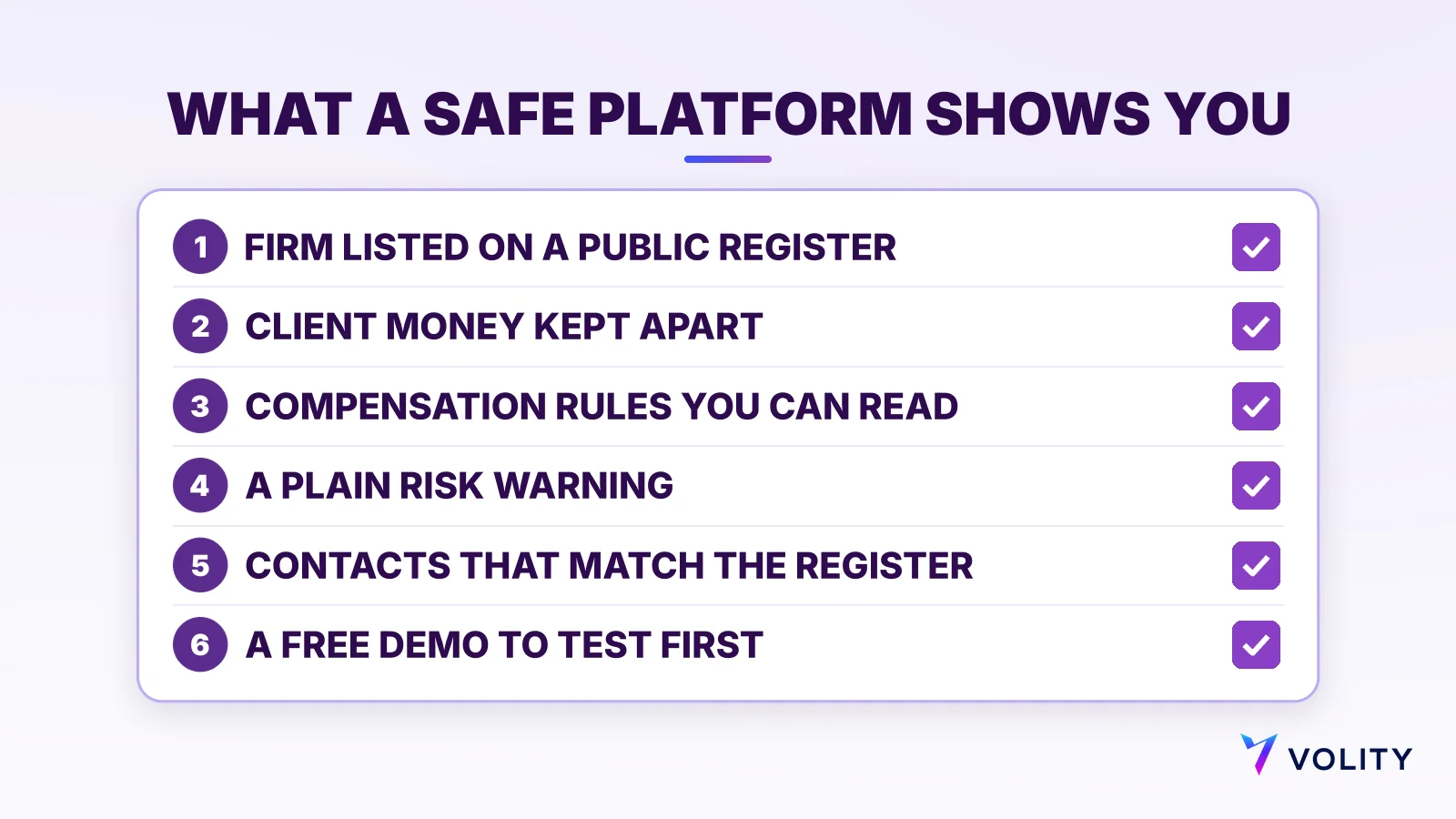
- The legal company behind the brand, listed on a regulator’s public register.
- A clear statement of where client money is held, apart from the firm’s own money.
- The name of the compensation scheme that may apply, and its rules.
- A standard risk warning for CFDs and other leveraged products.
- Contact details that match the register, so you know it is not a clone.
- A free demo account, so you can test the platform before any money moves.
“Secure” can also mean cyber security, such as two-step login and encryption. Those protect your account. They cannot protect money held by a firm that has no licence, so the regulatory checks come first. Once a platform passes them, our checklist for choosing a trading platform covers tools, costs and features.
Look the firm up on the regulator’s register
A licence belongs to a legal company, and the brand on the website may differ from it. Find the company name and licence number in the site footer or the client agreement. Then search for that company on the regulator’s own website.
In the UK, the FCA says: “Almost all financial services firms in the UK must be authorised or registered by us.” Its advice is to “Check that the firm reference number (FRN) and contact details you’ve been given match the details on the Firm Checker.” The FRN is the FCA’s ID for each firm, and the full record sits on the Financial Services Register.
Other regulators publish the same kind of list. Cyprus has the CySEC register of Cypriot investment firms. Australia has the ASIC professional registers, where you can find a person or organisation licensed to provide a service. For a firm based abroad, the FCA’s advice is short: “Check overseas regulators if you’re dealing with an overseas firm”.
Here is the check run on Volity. Where UBK Markets Ltd provides the trading service, execution and client-money handling are governed by its client agreement and policies; UBK Markets Ltd is authorised by CySEC, licence 186/12. Open the CySEC list of Cypriot investment firms and find UBK Markets Ltd. The entry shows licence number 186/12, the same number Volity publishes.
A register entry has limits. The FCA says its Firm Checker “can’t confirm whether Financial Services Compensation Scheme (FSCS) or Financial Ombudsman Service protection will definitely apply”. That is why the next two checks matter.
Where your money sits while you trade
Segregated client money means the firm keeps your deposits in separate bank accounts, apart from its own money. The aim is to protect your claim to that money if the firm becomes insolvent.
In the EU this is a legal duty. Article 16 of MiFID II, the EU law for investment firms, covers firms that hold client funds. They must “make adequate arrangements to safeguard the rights of clients and, except in the case of credit institutions, prevent the use of client funds for its own account”. In the UK, the FCA’s client money rules sit in chapter CASS 7 of its Handbook.
On any platform, look for a sentence that says where deposits are held and that they are kept apart. Volity’s reads: Client deposits are kept in separate (segregated) bank accounts, apart from the firm’s own money.
Segregation deals with one risk, the firm failing. It does nothing about market risk. If a trade goes against you, the loss is yours, whichever account the money sits in.
Compensation schemes and what they leave out
A compensation scheme pays eligible clients when an authorised firm fails and cannot return what it owes. Each scheme sets its own rules on who qualifies, which services count and how much it pays.
The UK’s Financial Services Compensation Scheme (FSCS) shows its investment limit as “up to £85,000 per eligible person, per firm” for firms that failed after 1 April 2019. The same page sets two conditions that matter to beginners. The provider must be “authorised by the Financial Conduct Authority (FCA) or Prudential Regulation Authority (PRA)”. And the FSCS states: “We can’t accept any claims that are for poor investment performance”.
EU countries run their own schemes under Directive 97/9/EC on investor-compensation schemes. In Cyprus this is the Investor Compensation Fund. For Volity, the wording is this. For eligible claims relating to covered investment services provided by UBK Markets Ltd, Cyprus Investor Compensation Fund protection may apply, subject to the scheme’s rules and limits.
Rules change from one country to the next. IOSCO, the global body of securities regulators, puts it this way: “Complaints procedures and compensation schemes may vary between jurisdictions, therefore it is recommendable to find out what your rights are in the jurisdiction where the firm is regulated.” So read the scheme of the country where the firm holds its licence. Wherever that is, no scheme pays you back for a trade that lost money.
Risk warnings and the CFD rules behind them
Many trading platforms offer CFDs. A CFD, or contract for difference, lets you trade the change in an asset’s price without owning the asset; our CFD glossary entry explains how it settles. CFDs use leverage, which lets you open a position larger than the money you put down. Leverage makes losses grow in the same proportion as gains.
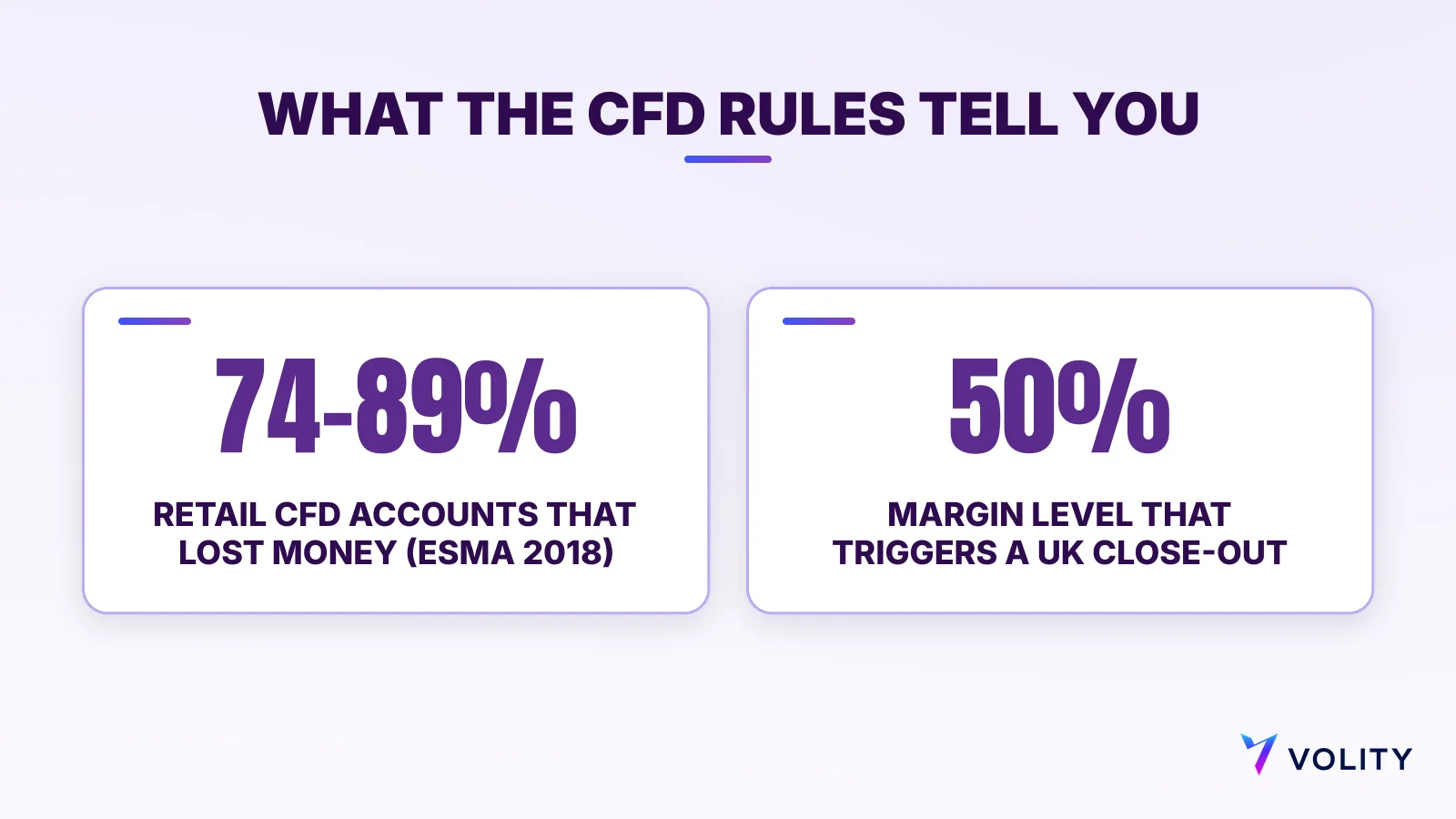
That is why regulators set extra rules for retail CFD clients. In 2018, ESMA reported national regulators’ analyses showing that “74-89% of retail accounts typically lose money on their investments, with average losses per client ranging from €1,600 to €29,000”. Those figures date from before the EU rules took effect.
The UK made its version permanent in 2019. Under the FCA’s CFD rules, firms that sell CFDs to retail clients in the UK must:
- “Limit leverage to between 30:1 and 2:1”
- “Close out a customer’s position when their funds fall to 50% of the margin needed”
- “Provide protections that guarantee a client cannot lose more than the total funds in their CFD account”
- “Provide a standardised risk warning, which requires firms to tell potential customers the percentage of their retail client accounts that make losses”
Margin is the deposit a leveraged trade ties up. These are UK rules for FCA-authorised firms, and other countries set their own. Whatever the rules, read the risk warning before you sign up. A firm that hides it or promises returns fails this check. Leverage magnifies losses on every platform, so plan each trade with a risk-reward ratio first.
Spotting clone firms and investment scams
A clone firm copies the name, address or licence number of a real authorised firm. The register check passes, because the real firm is listed. The FCA warns: “Remember, some firms pretend to be authorised firms, so always use the contact details on the Firm Checker.” Contact a firm only through the phone number, email or website on the register, never through a link in a message.
The FCA’s scam guide lists signs to watch for:
- Contact you did not ask for, by phone, email or social media.
- Pressure to act quickly.
- An offer that “sounds too good to be true”, or one sold as “exclusively for you”.
- Flattery, or a push to make you worried or excited.
- Someone “speaking with authority”. In the FCA’s words, “Scammers might claim that they’re authorised”.
To search warnings from many regulators at once, use IOSCO’s I-SCAN, which “provides a single point of access to alerts and warnings from IOSCO members”. CySEC also publishes warnings to investors. A clean search proves little. IOSCO says: “Potential investors should however not assume, in the absence of a relevant warning on I-SCAN, that companies who approach them offering investment services are authorized or legitimate.”
The losses are real. Australia’s Moneysmart reports that “Australians lost more than $837 million to investment scams in 2025”. In the UK, report a suspected scam to Report Fraud, the national service for fraud and cyber crime reports.
Practise on a free demo first, then start small
Once a firm passes the checks, test the platform before you fund it. A demo account lets you place trades with virtual money, so mistakes cost nothing. On Volity, a free demo account is available on every account tier. A hypothetical first session could run like this:
- Sign up and open the free demo.
- Pick one market you already follow, such as a major currency pair.
- Compare the buy and sell prices. The gap between them is the spread.
- Place one small order with a stop-loss, an order that closes the trade at a price you choose if the market moves against you.
- Close the trade and compare the result with what you expected, spread included.
- Read how orders are filled in Volity’s execution policy.
When you move to a live account, start with an amount you can afford to lose. A Volity Markets account starts from $1, with funding from 10 EUR. The Markets account is commission-free, there is no custody or platform fee, and withdrawals are free. Every other cost is listed on the Volity charges and fees page. More platform guides sit in the trading platforms hub.
Before your first live trade, you should be able to name the legal firm and its licence number. You should know where your money is held, which scheme may apply and what it leaves out. If any of those is missing, keep checking or keep practising.
Fact check: Register, client money and scam guidance from the FCA (scam page updated 19 January 2026), CySEC, ASIC and IOSCO. Compensation rules from the FSCS and EUR-Lex (MiFID II, Directive 97/9/EC). CFD rules from ESMA (27 March 2018) and the FCA (1 July 2019). Scam losses from ASIC Moneysmart (August 2026). Volity details from volity.io. All sources read 10-11 November 2026.
Frequently asked questions
What makes a trading platform safe?
A safe platform is run by a firm listed on a regulator’s public register. It keeps client money apart from its own and names the compensation scheme that may apply. It also shows a clear risk warning. None of this makes trading itself safe, because markets can still move against you.
How do I check a trading platform is regulated?
Find the legal company name and licence number on the website. Search for them on the regulator’s own register, such as the FCA Financial Services Register or the CySEC list of investment firms. Then check that the contact details on the register match the ones you were given.
What does segregated client money mean?
It means the firm keeps client deposits in separate bank accounts, apart from its own money. The aim is to protect your claim to that money if the firm fails. It does not protect you from losses on your trades.
Does a compensation scheme cover my trading losses?
No. Schemes pay eligible clients when an authorised firm fails and cannot return what it owes. The FSCS states it cannot accept claims for poor investment performance. Each scheme has its own rules and limits, so read the one where your firm is licensed.
How can I tell a clone firm from the real one?
Ignore the contact details in the message you received. Look the firm up on the regulator’s register and use only the phone number, email and website listed there. If the details differ, treat the contact as a likely scam and report it.
Should a beginner use a demo account first?
Yes. A demo lets you learn the platform, see the live spread and practise stop-loss orders with virtual money. Move to a live account only when the firm has passed your checks, and start with an amount you can afford to lose.