Investing in financial products involves risk. Losses may exceed the value of your original investment.
The Crypto Trading Starter Kit
A plain-English PDF: what to check before you trade, how orders and risk really work, and the mistakes to skip. Get it free.
Quick answer
To trade crypto contracts, pick a perpetual or dated futures market, set your leverage and margin, size the position to risk a small fixed percentage, and place a stop before you enter. Watch the mark price (not last price) for liquidation, and close or roll before funding turns against you. For what these instruments actually are, see contract trading crypto.
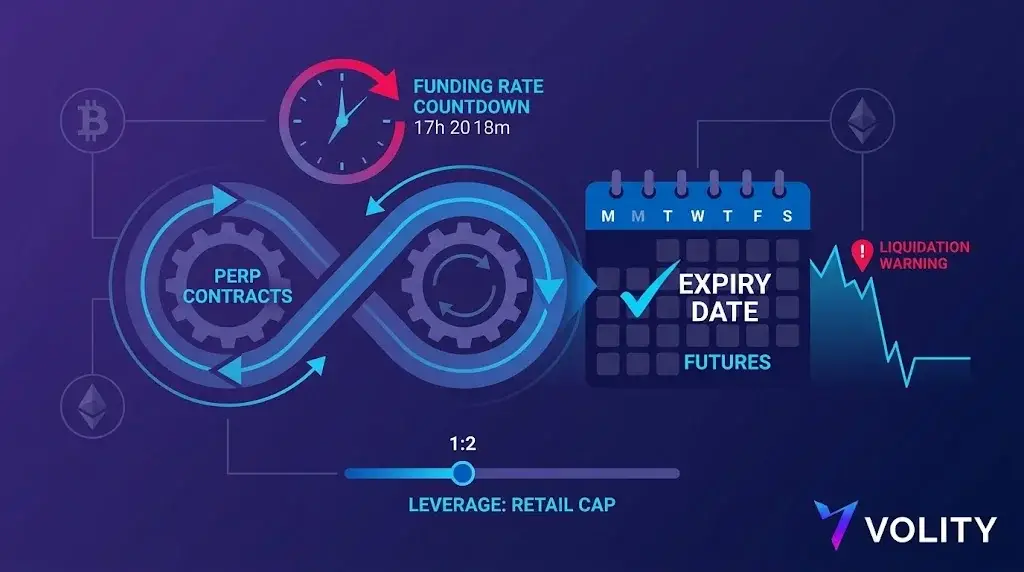
A crypto contract is an agreement to settle the price difference of a coin at some future point. You never own the underlying token. You post margin, the broker tracks the price, and your profit or loss is the price move multiplied by your contract size, minus the funding you paid or received along the way. Two formats dominate: perpetuals (no expiry, funding paid every eight hours) and dated futures (fixed expiry, no funding).
How a perpetual contract works
A perpetual is a futures contract with no expiry. To keep its price tracking the underlying spot, the protocol charges or credits a funding rate every eight hours. The mechanism:
- If the perp price is above spot, longs pay shorts.
- If the perp price is below spot, shorts pay longs.
- The rate scales with the gap: a 0.05% funding rate per 8 hours is a 54% annualised cost or income, depending on which side you are on.
Result: in a roaring bull market, perp longs bleed funding to shorts. In a deep sell-off, the opposite happens. A trader who ignores funding can hold a “winning” position for a month and net zero or worse after carry.
How a dated futures contract works
A dated future expires on a specific date. It trades at a basis to spot: the difference between contract price and spot price, which is the market’s implied cost of carry. As expiry approaches, basis converges to zero. There is no funding rate. The full carry is priced into the contract at trade entry.
Practical comparison:
- Perp: cleaner mental model on entry, but funding can grind a position over time.
- Dated future: known cost up front, but you have to roll positions before expiry or accept settlement.
Margin and liquidation
Three numbers run a contract trade:
- Initial margin: the deposit you post to open. At 1:2 retail crypto leverage (ESMA caps), the initial margin is 50% of notional.
- Maintenance margin: the minimum equity the broker requires to keep the position open. Below this, you receive a margin call.
- Liquidation price: the price at which the broker auto-closes your position to prevent further loss. Most retail platforms include negative balance protection, so liquidation caps your loss at the margin posted.
A long on one bitcoin at $60,000 is $60,000 of notional exposure, and at 1:2 leverage that requires $30,000 of initial margin. If BTC falls to $40,000 the position is down $20,000, leaving $10,000 of equity against $40,000 of notional. At a 25% maintenance requirement that is exactly the threshold, so the call and the liquidation arrive together rather than one before the other, which is why a margin call is not a safety net you can plan around. Negative balance protection means you cannot owe more than the $30,000 posted.
Why retail traders use contracts
Three reasons we see across retail flow:
- Capital efficiency. Same exposure, less cash tied up. The flip side: same loss, faster.
- Short exposure. Spot only goes long. Contracts let you express a bearish view.
- Hedging. A long-term spot holder can short a perp to neutralise short-term downside without selling the underlying.
What goes wrong
The four classic failure modes:
- Leverage creep. Starting at 1:2, then bumping to 1:5, then 1:10 after a winning streak. The risk-of-ruin curve is non-linear; a 50% drawdown at 1:10 wipes the account.
- Funding ignorance. Holding a perp for weeks without modelling carry. Track funding daily.
- Cross-margin contamination. A losing position on one contract eating margin from a winning one. Use isolated margin until you can quote your portfolio Greek-equivalent in your sleep.
- News-driven gaps. Crypto trades 24/7 but liquidity is uneven. A weekend ETF rumour or exchange exploit can move BTC 10% in 30 seconds. Protective stops fail to fill at advertised price.
Crypto contracts at Volity
Volity offers crypto CFD exposure on 20+ coins. Retail leverage is capped at 1:2 under ESMA. Professional clients on request may access higher leverage subject to MiFID II suitability assessment. Negative balance protection applies on retail accounts. Execution is by UBK Markets Ltd (CySEC 186/12). For an unleveraged alternative, see our guide on spot trading crypto.
Reading the contract specification before you trade is a habit that transfers everywhere. Our walkthrough of how prediction markets resolve applies it to event contracts, where a single clause in the rules decides the payout.
Volity operates a trading platform and also publishes educational and analytical content about trading. The content on this page is for educational purposes only and should not be considered financial advice. Volity may benefit commercially when readers open trading accounts through links on this site.
Our content is produced and reviewed under documented editorial standards; see our comparison and review methodology.