Investing in financial products involves risk. Losses may exceed the value of your original investment.
The Crypto Trading Starter Kit
A plain-English PDF: what to check before you trade, how orders and risk really work, and the mistakes to skip. Get it free.
Quick answer
Crypto options trading runs across two layers: regulated exchange-listed products and crypto-native venues. Options on bitcoin and ether futures list on regulated exchanges such as CME and clear centrally; crypto-native platforms like Deribit dominate global option volume but sit outside EU and UK retail protections. In the EEA, ESMA product-intervention measures cap retail cryptoasset CFD leverage at 1:2 with negative balance protection, and the EU’s MiCA regime now licenses crypto-asset service providers. Tax treatment depends on your jurisdiction; this is not tax advice.
Crypto options trading splits into two layers. Retail traders access exchange-listed derivatives, such as options on bitcoin and ether futures, through regulated brokers, and increasingly through crypto-asset service providers authorised under the EU’s MiCA regime. Crypto-native venues offer a far wider strike and expiry menu but operate outside EU and UK retail-protection rules. The result is a fragmented market where the venue you choose decides which regulator’s framework governs your account.
Who regulates what?
- ESMA. Sets EU-wide product-intervention measures for cryptoasset CFDs: retail leverage capped at 1:2, negative balance protection, and standardised risk warnings.
- National competent authorities. Bodies such as CySEC in Cyprus authorise and supervise the investment firms that offer these products to retail clients across the EEA.
- MiCA. The EU Markets in Crypto-Assets Regulation now licenses crypto-asset service providers and standardises conduct rules across member states.
Different frameworks, one underlying. The choice of venue maps directly to which regulator’s rules govern your account.
What venues are open to retail in 2026?
- Regulated futures-options exchanges. CME Group lists options on bitcoin and ether futures contracts, accessible via regulated futures brokers.
- Brokers offering options on listed crypto ETPs. Options on spot bitcoin and ether exchange-traded products trade on regulated exchanges and clear through central clearing houses. Standard options-account approval applies. The 2024 approval of spot bitcoin and ether ETFs widened the listed-product universe.
- MiCA-authorised crypto-asset service providers. A growing set of platforms list crypto derivatives and structured products under EU oversight.
Crypto-native venues that dominate global crypto-option volume sit outside EU and UK retail protections. Accessing them may breach those venues’ terms and exposes the user to KYC, withholding, and enforcement risk.
How does options approval work at a regulated broker?
Regulated brokers run an appropriateness assessment before granting access to complex derivatives, the same framework used for any listed equity option:
- Knowledge and experience. You disclose trading history and your understanding of leverage and options.
- Financial situation. Income, liquid net worth, and capacity to bear losses.
- Product-complexity tiers. Simple long calls and puts may be granted first; spreads and short or naked positions require demonstrated experience and higher margin.
The broker assesses the data and grants access accordingly. Options on crypto ETPs, on bitcoin futures, and on ether futures are assessed against the same framework.
What about tax treatment?
- Capital gains. In many jurisdictions, gains on crypto derivatives are taxed as capital gains on disposal. In the UK, HMRC treats disposals of crypto assets and derivatives under capital gains tax, subject to the annual exempt amount.
- Income versus capital. Frequent, business-like trading can be assessed as income in some jurisdictions; occasional trading is usually treated as capital.
- Underlying spot crypto. Held as an asset; gains are realised on disposal and reported under local rules, such as HMRC’s crypto-asset guidance.
Treatment depends on the precise instrument and your jurisdiction. This is not tax advice; consult a qualified tax professional.
What are the caveats?
- Liquidity is uneven. CME bitcoin-options open interest is real but skewed to monthly expiries and ATM strikes. Far OTM strikes and weekly expiries trade thinner than on crypto-native venues.
- Position limits and reporting. Exchange-listed contracts carry position limits; centrally cleared ETP options carry separate limits. Crossing them triggers reporting obligations.
- Margin requirements. Regulated-broker margin on short options can be materially higher than on crypto-native venues, particularly for naked short calls on volatile underlyings.
- Settlement nuances. Bitcoin and ether futures options settle into the underlying futures contract. ETP options settle into ETP shares. Plan the settlement path before expiry, especially around any income-distribution dates.
What goes wrong
- Retail traders chasing crypto-native weekly expiries. Lower premiums, no retail recourse, KYC traps. Save the regulatory headache and trade the listed product.
- Confusing futures options with ETP options. They are different instruments with different settlement, different tax treatment, and different broker approvals.
- Holding short options through expiry. Auto-exercise rules at the clearing house kick in on in-the-money options at expiry. Plan close-outs in advance.
- Sizing in premium without modelling vega. A 30% IV crush can offset what looked like a winning directional trade.
A note on jurisdiction
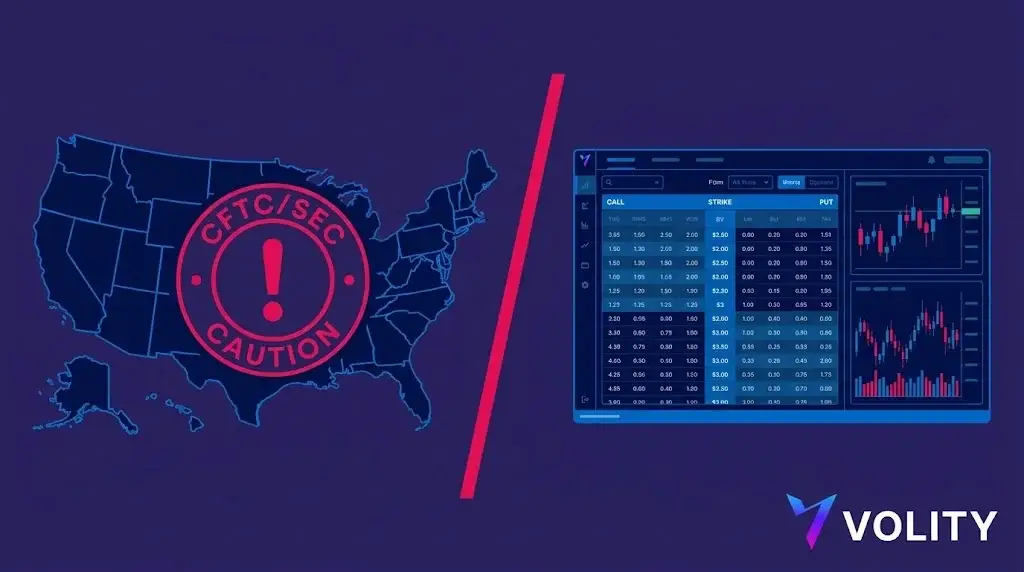
Regulatory treatment of crypto options varies widely from country to country. EEA retail clients access crypto exposure under ESMA product-intervention measures, with retail leverage capped at 1:2 on cryptoasset CFDs and negative balance protection on retail accounts. Volity provides crypto exposure to eligible clients via UBK Markets Ltd (CySEC 186/12). Confirm what applies where you live before you trade.
Crypto exposure at Volity
Volity offers leveraged crypto CFD exposure on 20+ coins to eligible clients, with retail leverage capped at 1:2 under ESMA and negative balance protection on retail accounts. Eligible retail clients of UBK Markets are covered by the Cyprus Investor Compensation Fund up to EUR 20,000 per client per firm. Execution is by UBK Markets Ltd (CySEC 186/12).
Volity operates a trading platform and also publishes educational and analytical content about trading. The content on this page is for educational purposes only and should not be considered financial advice. Volity may benefit commercially when readers open trading accounts through links on this site.
Our content is produced and reviewed under documented editorial standards; see our comparison and review methodology.