Investing in financial products involves risk. Losses may exceed the value of your original investment.
Quick answer
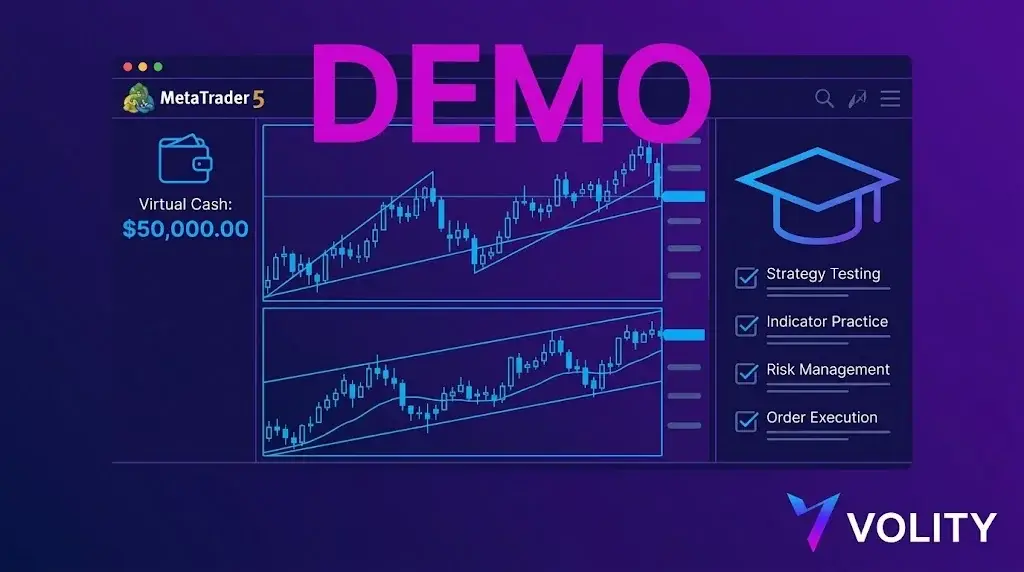
A MetaTrader 5 demo account is a free practice account that simulates live trading with virtual capital, typically $10,000 to $100,000. It uses the same platform, broker server, and live market data as a live account, but no real money is at risk. Use the demo to learn the order entry, validate Expert Advisors, and test broker execution before going live.
A MetaTrader 5 demo account is a paper-trading environment that runs on live market data with virtual capital. The price feed is real, the platform behaviour is real, the order types are real; only the money is fake. Used properly, the demo is the cheapest stress test of broker, platform, and strategy that you will ever run. Used carelessly, it teaches habits that crater the live account in week one. Here is the difference.
What a demo actually replicates
Three things faithfully:
- Price feed. Same quotes as the live account, broker-dependent.
- Order types and validation. Same min/max lot sizes, same stop-distance rules, same trading hours.
- Platform performance. Same charts, same indicators, same MQL5 environment for EAs.
And three things imperfectly:
- Slippage and requotes. Demo servers usually fill at the quoted price more reliably than live. The slippage profile of a live ECN execution does not show on demo.
- Liquidity at size. A 10-lot order may fill instantly on demo and partial-fill on live during a news spike.
- Emotional state. The biggest gap. Demo P&L does not feel like real P&L. A trader who is fearless on demo and paralysed live is a common pattern, not a rare one.
How to open a demo
- Install MT5 from the official source: MetaQuotes’ website for desktop, App Store for iOS, Play Store for Android.
- In the platform, File, Open an Account, then choose your broker from the search list.
- Select “Demo Account”. Set virtual deposit (default $10,000; choose a number close to your real funding plan, not $100,000).
- Pick leverage that matches what your live account will run (1:30 majors under ESMA for EU retail).
- Login auto-fills; password and account number are emailed.
What to test on demo
Five concrete tasks; allocate two weeks:
- Platform mechanics. Place every order type at least twice. Modify stop-loss and take-profit while the order is open. Close at market and at stop. Verify the trade history matches your expectation.
- Spread and execution timing. Watch the spread on your top three symbols at 08:30, 13:30, and 21:00 broker server time. Note widening at session changes.
- Strategy in market mode. If your strategy is mean-reversion, run it in a trending week. If it is trend-following, run it in chop. The point is not to validate the strategy; it is to feel it fail and survive.
- Risk-per-trade discipline. Calibrate position size to 1% of demo equity per trade. Hit fifty trades. Track your max drawdown. This is a behavioural test, not a strategy test.
- Recovery from a bad day. Force a 5R drawdown intentionally. Then trade the next session normally. The hardest skill in trading is acting like a professional after a bad session, and demo is the safest place to fail at it.
What not to do on demo
- Do not run unrealistic size. A $100,000 demo with 1:500 leverage on a $5,000 live plan teaches nothing transferable.
- Do not chase the demo P&L. The demo is for process, not for proving you can ten-x a virtual balance.
- Do not stay on demo forever. Two to four weeks is enough for most retail strategies. Endless demo trading is procrastination dressed as discipline.
The transition to live
The right cadence:
- Demo for two to four weeks at the size you plan to trade live.
- Fund the live account with one-quarter of the planned capital.
- Trade live at half your demo position size for the first thirty trades.
- Scale to full size only after thirty live trades that match your demo win rate within 5%.
The slippage and emotional gap shows up in those first thirty trades. Pretending it will not is the mistake.
Demo expiry
Most brokers expire demo accounts after 30-60 days of inactivity to free up server slots. The platform itself does not expire; you can open a new demo at any time. If you have built a custom workspace (templates, indicators, EAs), export it before expiry: File, Open Data Folder, then back up the MQL5 and templates folders.
MT5 demo at Volity
Volity provides MT5 demo accounts to prospective clients of UBK Markets Ltd (CySEC 186/12). The demo runs on the same price feed and execution engine as the live account. Set virtual deposit and leverage to match your live plan; ESMA retail caps apply on live accounts (1:30 majors, 1:20 minors and major indices, 1:10 commodities, 1:5 equities, 1:2 crypto). Negative balance protection is contractual on live retail accounts.
Volity operates a trading platform and also publishes educational and analytical content about trading. The content on this page is for educational purposes only and should not be considered financial advice. Volity may benefit commercially when readers open trading accounts through links on this site.
Our content is produced and reviewed under documented editorial standards; see our comparison and review methodology.
Frequently asked questions
What is an MT5 demo account actually good for?
Learning the platform mechanics without risking money: order types, stop placement, position sizing and how margin is reported. It is genuinely useful for that. It is far less useful for judging your emotional response to losses, because nothing is at stake.
Do demo results predict live results?
Rarely, and usually in an optimistic direction. Demo servers fill orders in conditions that flatter the strategy, and no demo can replicate the hesitation that appears when the money is real. Treat a profitable demo as evidence the mechanics work, not that the edge is proven.
How long should I stay on demo before going live?
Long enough to execute your plan mechanically without checking the manual, which for most people is several weeks rather than several days. A useful test is whether you can follow the same rules across at least one losing sequence.