Investing in financial products involves risk. Losses may exceed the value of your original investment.
Quick answer
Hedging in commodity trading uses futures, options, or swaps to lock in prices for producers (who fear falling prices), consumers (who fear rising prices), or traders (who hold inventory). Examples: a US wheat farmer short July wheat futures to lock harvest revenue; an airline long crude oil futures to lock fuel costs. Hedging trades certainty for upside.
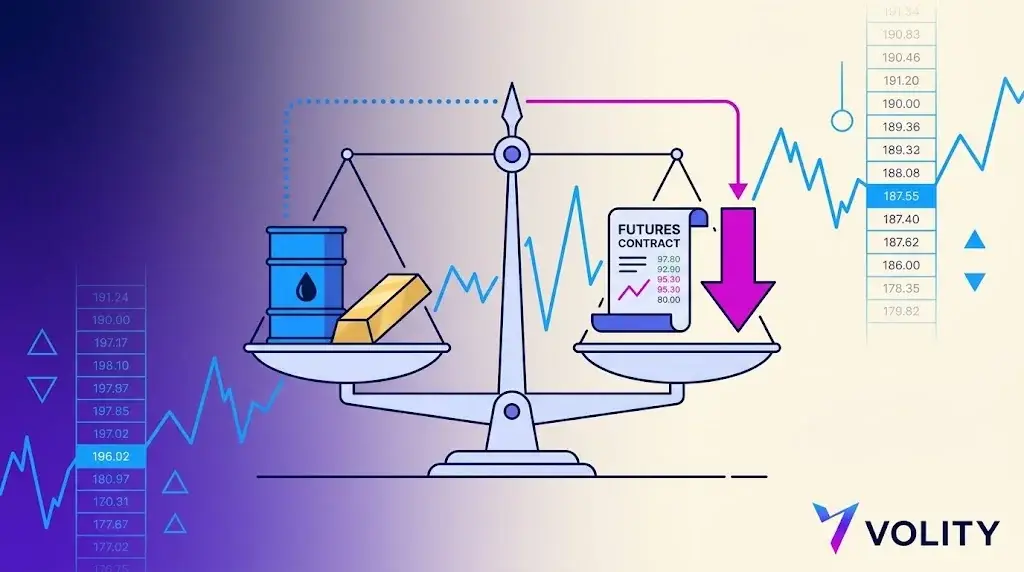
Hedging in commodity trading is the act of opening an offsetting position in a correlated instrument to neutralise the price risk of an existing physical or financial exposure. A wheat farmer who will harvest in three months sells wheat futures today; if the cash price drops by harvest, the futures gain offsets the lower physical revenue. The goal is not profit on the hedge. The goal is a known revenue or cost.
The two sides of a commodity hedge
- Producer hedge (short hedge). A miner, farmer, or oil major who will sell physical commodity in the future sells futures or buys puts to lock in a floor price.
- Consumer hedge (long hedge). An airline, food processor, or jeweller who will buy physical commodity in the future buys futures or calls to lock in a ceiling price.
The instruments used
- Futures. Standardised exchange contracts. Highest liquidity in WTI, Brent, gold, silver, copper, corn, soybeans, wheat.
- Forwards. Bilateral OTC contracts. Customisable size and date, but counterparty risk lives with you.
- Options. Pay a premium, get one-sided protection. A producer buys puts, a consumer buys calls.
- CFDs. Cash-settled derivatives that mirror the futures price. Used by traders and smaller corporates who want futures-like exposure without an exchange seat.
How a real hedge looks in numbers
A bakery needs 100 tonnes of wheat in 90 days. Spot wheat is $250/tonne. The CFO is comfortable at $250 and worried about a drought rally. The treasury team buys 100 tonnes of wheat futures at $252 (the 90-day forward). Three outcomes at delivery:
- Spot rises to $290. Physical cost up $4,000. Futures gain $3,800. Net cost increase: $200.
- Spot stays at $250. Physical cost flat. Futures lose $200. Net cost increase: $200.
- Spot falls to $220. Physical cost down $3,000. Futures lose $3,200. Net cost increase: $200.
The hedge converted a variable cost into a fixed cost of roughly $252/tonne, plus the small carry. That is the entire point.
When does hedging in commodity trading make sense?
- You have a known physical exposure. Production schedule, purchase order, inventory holding.
- The price move would change a business decision. If a 20% rally would force you to fire staff or shut a plant, hedge.
- The cost of certainty is acceptable. A hedge has a cost: the option premium, the futures basis, the margin opportunity cost. Quantify it before you trade.
- You will hold the hedge to expiry. Hedges that get closed early on a P&L scoreboard usually become speculation.
What goes wrong
- Basis risk. The futures contract and your physical commodity are not identical. Brent futures hedging West African crude leaves a basis exposure that can move 2-5% independently.
- Margin calls. A losing futures leg requires variation margin daily. A producer hedge with rising prices is profitable on physical but cash-negative on the futures account. Treasury must fund the call.
- Overhedging. Hedging 120% of expected production turns a hedge into a speculative short. If output disappoints and prices rally, both legs lose.
- Mark-to-market accounting. Under IFRS 9 and ASC 815, hedges that fail effectiveness tests get marked through P&L, creating earnings volatility.
Hedging at Volity
Volity offers CFD exposure to gold, silver, oil (WTI and Brent), copper, natural gas, and agricultural commodities on a regulated platform. Retail leverage on commodities other than gold is capped at 1:10 under ESMA product-intervention measures; gold is treated as a major and capped at 1:20. Trading is executed by UBK Markets Ltd, a Cyprus Investment Firm authorised by CySEC under licence 186/12. Eligible retail clients are covered by the Cyprus Investor Compensation Fund up to EUR 20,000 per client per firm.
Volity operates a trading platform and also publishes educational and analytical content about trading. The content on this page is for educational purposes only and should not be considered financial advice. Volity may benefit commercially when readers open trading accounts through links on this site.
Our content is produced and reviewed under documented editorial standards; see our comparison and review methodology.
Frequently asked questions
Who actually uses commodity hedging?
Producers and consumers of the physical commodity, primarily. A farmer locks in a selling price before harvest; an airline fixes fuel cost in advance. The aim is budget certainty, not profit from the hedge itself.
What is the cost of hedging?
You give up the favourable outcome to remove the unfavourable one. A hedge that protects against a price fall also caps the gain from a price rise, and there are financing and spread costs on the hedging instrument itself.
What instruments are used to hedge a commodity exposure?
Futures and options are the traditional tools, with forwards used where a bespoke size or date is required. Cash-settled derivatives such as CFDs can replicate the price exposure without arranging delivery.