Investing in financial products involves risk. Losses may exceed the value of your original investment.
Quick answer
To start commodity trading: open an account with a CySEC-regulated broker, fund it with at least $100 to $500, choose your commodity (gold and oil are beginner-friendly thanks to high liquidity), pick your instrument (futures, CFDs, ETFs, or options), define entry and exit rules with stop-losses, and practice on a demo account before going live with real capital.
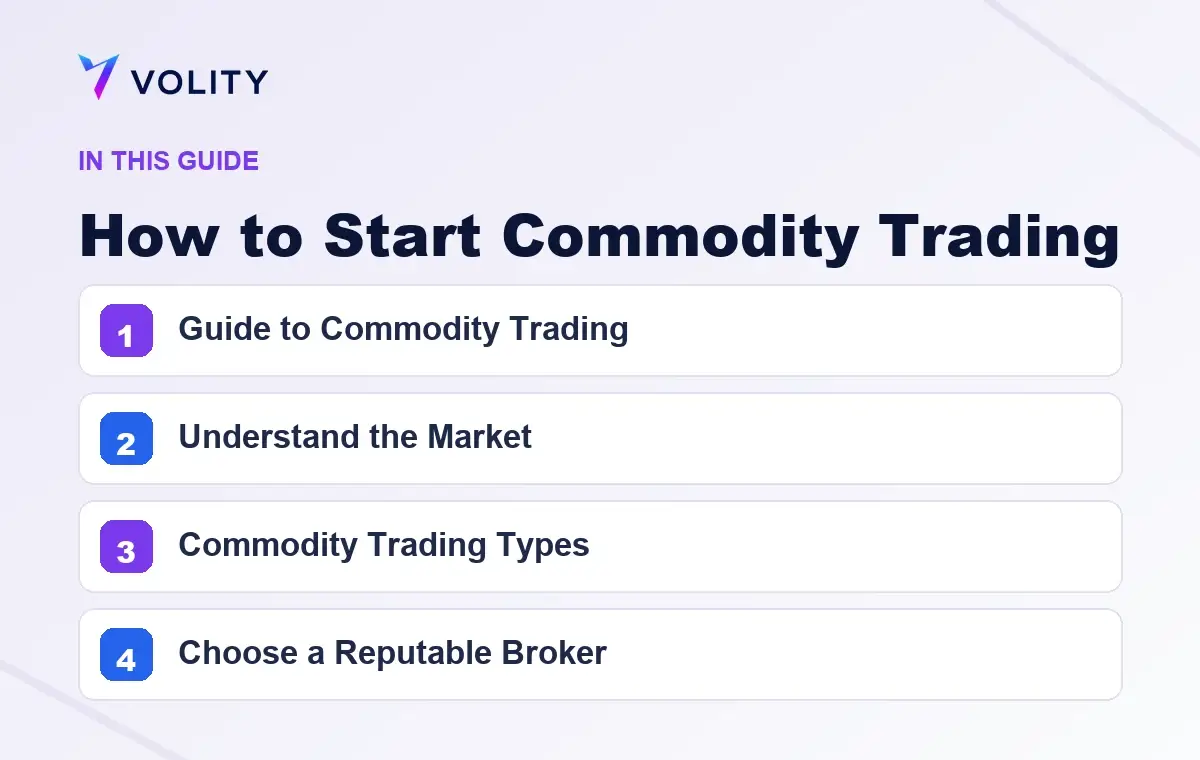
Commodity traders are involved in some of the world’s most popular markets, including metals, energy, and even agricultural goods. People often get involved in commodity trading to diversify their portfolio, but others enjoy opportunities presented by the likes of geopolitical events and economic trends.
In this guide, you’ll learn how commodity trading works, how to get started, and how to set yourself up for the best chance of success.
Key Points
Commodity traders speculate on the price of physical goods, such as metals (gold, silver, copper), energy (crude oil, natural gasses), and agricultural assets (wheat, corn, coffee).
Trading commodities is another form of financial trading, which means you don’t need to own the commodities themselves.
Commodity traders can access markets via futures, CFDs, ETFs, and options.
Commodity trading has become popular with people looking to diversify their portfolios or hedge against inflation.
Market research and risk management are crucial components of any successful commodity trading strategy.
Choosing a reliable commodity trading broker with competitive spreads and leverage is paramount.
What Is Commodity Trading and Why Does It Matter?
Commodity trading is the buying and selling of raw materials, such as metals, energy products, and agricultural goods. These assets play a huge part of the world’s economy, and their prices are inherently tied to supply and demand changes, geopolitical environments, natural events, and economic trends.
Trading commodities provides people with a way to speculate on price movements throughout these markets and can help to hedge against inflation and other market volatilities. One of the benefits of reliable platforms, like Volity, is that traders can access markets across a wide range of commodities with ease.
Guide to Commodity Trading
Understand the Market
Before getting started, it’s important to learn how commodity markets work. Commodities can be traded on futures exchanges, or through derivative products, like CFDs.
Commodity Trading Types
Futures Contracts: This is an agreement to buy or sell a commodity at an agreed price at a set time.
CFDs: These provide an opportunity to bet on whether a commodity’s price will increase or decrease in the future.
ETFs and ETCs: These allow traders to buy bundles that follow the price of a commodity or group of commodities.
Options: These provide traders with the right to buy or sell commodities at an agreed price, without an obligation to do so.
Choose a Reputable Broker
The next step is to find a reputable commodity trading broker. Volity provides access to key markets and boasts multiple account types, high leverage, access to MetaTrader platforms, as well as rapid onboarding and funding options.
Choose a Commodity
One of the best ways to ease your way into commodity trading is to select one you’re familiar with. For example, lots of beginners choose gold because it has reliable liquidity and it’s easy to find information about the market.
Commodity Consideration Examples
- Gold: Often considered a safe-haven asset
- Oil: Tends to be influenced greatly by geopolitical events
- Wheat: Can be impacted by weather conditions and agricultural policy
Learn How to Read the Market
Getting started with commodity trading is a simple process, but the learning curve doesn’t stop there. The next step is to learn how to read the market, and this can be achieved by analysing trends with technical and fundamental tools.
Tool Examples
- Technical Analysis: Charts, indicators, and price patterns
- Fundamental Analysis: Supply and demand, geopolitical risks, and economic trends
Managing Risk
It’s important to understand that commodity markets can be volatile and trading carries inherent risk. Therefore, risk management must be a priority for anyone jumping into these markets.
Key Risk Management Strategies
Leverage Control: Leverage should be used cautiously to avoid overextended losses.
Stop-Losses: These should be implemented to protect from large losses during market swings.
Position Sizing: Overall capital must be considered, with only small percentages risked per trade.
Portfolio Diversification: Risk can be reduced by avoiding overexposure to a single commodity.
Testing and Executing Your Strategy
Start with a Demo Account
Before trading with capital, you should test your strategies with a demo account. Volity provides access to a free demo trading account with $100,000 in virtual funds, so you can jump into a live market environment without risking any money. This will help answer ‘what is commodity trading’ and does it suit me?
Develop a Plan
- Outline goals
- Choose commodities
- Establish entry and exit rules
- Confirm risk to risk-to-reward ratio
Monitor and Adjust
Markets move quickly, so it’s important to ensure your strategy is flexible. Evaluate performance metrics regularly and keep an eye on news that could impact your chosen commodities. If required, adjust your strategy.
FAQs
What are the different ways to trade commodities?
Commodities can be traded via futures, CFDs, ETFs, and options. Volity allows users to trade through CFDs, which means you don’t need to own the asset.
What is the minimum amount needed to start commodity trading?
The minimum required balance to start commodity trading varies by broker. At Volity, you can start by depositing just $10 ($20 via crypto).
What are the main risks in commodity trading?
Commodity prices can be volatile, which means most of the risks traders face come from market swings, leverage losses, liquidity issues, and even geopolitical disruptions.
How does leverage work in commodity trading?
Leverage allows traders to control a large position in the market with a smaller amount of capital. For example, 1:30 leverage means $10 controls $300 worth of commodity exposure. This magnifies both potential gains and losses in the market.
Which commodities are best for beginners to trade?
Some of the best commodities for beginners to trade include gold and crude oil. This is because these markets tend to enjoy high liquidity, consistent trading volumes, and can be researched and analysed easily.
Common questions
What capital do I need to start commodity trading?
$1 opens a Volity Markets account, enough to learn position sizing on micro-lots of XAU/USD without material risk. A working live account that can express full commodity strategies wants $1,000 to $5,000. Futures contracts on COMEX or NYMEX require considerably more (often $10,000+ per contract); CFDs scale lower because they fractionalise the contract size.
Are commodity CFDs the same as futures?
The economics overlap (both give leveraged commodity exposure), but the structure differs. Futures are exchange-traded contracts with expiry dates and roll mechanics. CFDs are over-the-counter contracts with no expiry that track the front-month future or spot price. Volity routes CFD execution through UBK Markets Ltd under CySEC licence 186/12 with retail negative balance protection.
Is commodity trading riskier than forex?
On a per-pip basis, often yes. Commodities can gap on weather events, supply disruptions, or OPEC announcements that have no equivalent in major-currency forex. Volatility on natural gas can exceed any forex pair. The CySEC retail leverage caps reflect this: 20:1 on gold, 10:1 on most commodities, versus 30:1 on forex majors.
Volity operates a trading platform and also publishes educational and analytical content about trading. The content on this page is for educational purposes only and should not be considered financial advice. Volity may benefit commercially when readers open trading accounts through links on this site.
Our content is produced and reviewed under documented editorial standards; see our comparison and review methodology.