Investing in financial products involves risk. Losses may exceed the value of your original investment.
Quick answer
CFD vs share trading is a choice between leveraged short-term speculation (CFD) and owning equity in a company (share trading). CFDs offer 1:5 retail leverage on stocks, allow short-selling, no stamp duty in the UK, but pay overnight financing and miss dividends in cash. Share trading suits long-term wealth building; CFDs suit short-term tactical positioning.
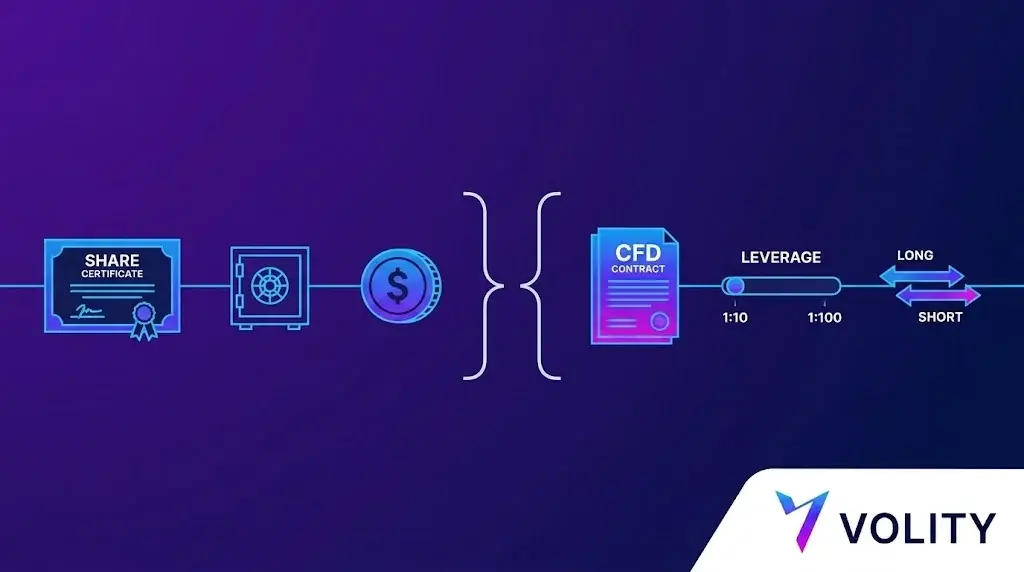
Share trading means buying the underlying equity and holding it in custody. See our walkthrough on how to buy shares in the UK for the practical steps. You own a fractional piece of the company. CFD share trading means contracting with a broker on the price difference of the same equity without ever owning it. The two paths look similar on a chart and behave very differently in your account, your tax return, and your risk profile. The right one depends on time horizon, capital, and what you are actually trying to do.
Side-by-side
| Feature | Share trading | CFD trading |
|---|---|---|
| Ownership | Yes, on share register | No, contract only |
| Voting rights | Yes | No |
| Leverage | Cash account: 1:1. Margin account: typically 1:2-1:4 retail | Up to 1:5 retail (ESMA) |
| Short selling | Difficult or unavailable for retail | Long or short with one click |
| Dividends | Paid as cash, often with withholding tax to reclaim | Cash adjustment to position, no reclaim paperwork |
| Overnight financing | None (cash); margin interest (margin) | Daily financing on the full notional |
| Stamp duty (UK) | 0.5% on purchase | None |
| Capital gains tax | Standard CGT in most jurisdictions | Varies; often treated separately |
| Time horizon fit | Months to decades | Hours to weeks |
Capital efficiency: the headline difference
Buying 100 shares of an EUR 200 equity costs EUR 20,000 of cash. Trading the same notional through an equity CFD at 1:5 retail leverage requires EUR 4,000 of margin. The other EUR 16,000 stays liquid for other positions, other instruments, or simply as a cash buffer.
This is the headline appeal of CFDs and the headline trap. The same leverage that frees capital amplifies losses. A 5% adverse move on a 1:5 position is 25% of your margin.
Two-way exposure: the second difference
Going short on physical shares as a retail trader is operationally hard: you need a margin account with a stock-borrow desk, you pay a borrow fee, and your broker may recall the loan at any time. CFDs short with one click. If your view is that an equity will fall, the CFD path is materially cleaner.
A long equity CFD held overnight pays daily financing equal to a benchmark rate (typically the overnight reference rate) plus a broker markup of 2.5-3.5%. On EUR 20,000 notional at a 7% all-in rate, that is roughly EUR 3.83 per day, or EUR 1,400 per year.
For a day trader, financing is zero. For a swing trader holding two weeks, financing is a small drag. For a buy-and-hold investor holding two years, financing eats your dividend yield and then some. This is the single biggest reason CFDs are not the right tool for long-term investing.
Tax: jurisdiction-specific, but the pattern matters
Share trading in most jurisdictions falls under capital gains tax, with allowances, exemptions, and dividend tax credits. CFD trading is often treated as a separate category and may not qualify for those allowances. Stamp duty applies to share purchases in some jurisdictions (UK, Ireland) and not to CFDs. The full picture is jurisdiction-specific; consult a local advisor.
Which one fits your goal
| Your goal | Better tool |
|---|---|
| Buy and hold for retirement | Share trading |
| Dividend reinvestment over decades | Share trading |
| Voting on company resolutions | Share trading |
| Day or swing trading equities | CFD |
| Shorting individual equities | CFD |
| Hedging an existing portfolio | CFD |
| Multi-asset trading on one account | CFD |
The honest frame
Share trading is for ownership. CFD trading is for activity. They serve different goals, and most experienced retail investors end up using both: shares for the long-term core, CFDs for the active sleeve.
Volity offers CFDs on 200+ equities across US, UK, EU, and select APAC listings. Retail leverage on individual equity CFDs is capped at 1:5 under ESMA. Negative balance protection applies. Execution is by UBK Markets Ltd (CySEC 186/12). Eligible retail clients of UBK Markets are covered by the Cyprus Investor Compensation Fund up to EUR 20,000 per client per firm.
Volity operates a trading platform and also publishes educational and analytical content about trading. The content on this page is for educational purposes only and should not be considered financial advice. Volity may benefit commercially when readers open trading accounts through links on this site.
Our content is produced and reviewed under documented editorial standards; see our comparison and review methodology.