Investing in financial products involves risk. Losses may exceed the value of your original investment.
Quick answer
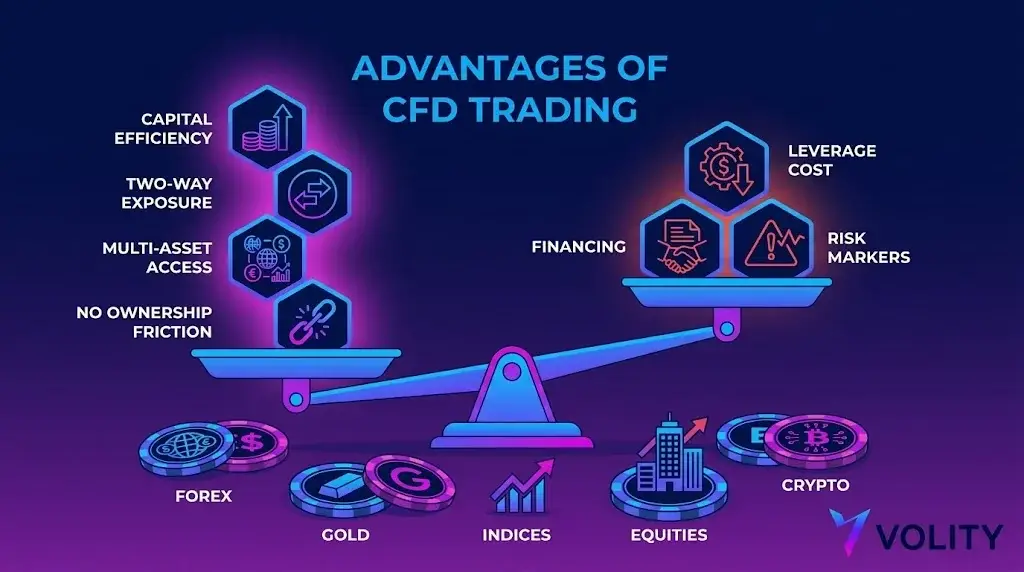
The advantages of CFD trading are leverage (capital efficiency), the ability to go short on any asset, multi-asset access from one account (forex, stocks, indices, commodities, crypto), no stamp duty in the UK, and 24/5 market access. The honest cons: overnight financing erodes returns on long holds, leverage amplifies losses, and gap risk on news events can exceed account equity.
A CFD (contract for difference) is an agreement to settle the price difference of an underlying asset between when you open and close the contract. You never own the asset. You post margin, the broker tracks the price, and your profit or loss is the price move multiplied by your contract size, minus financing and spread. The structure has six honest advantages and three honest costs. Understanding both is the difference between using CFDs as a tool and being used by them.
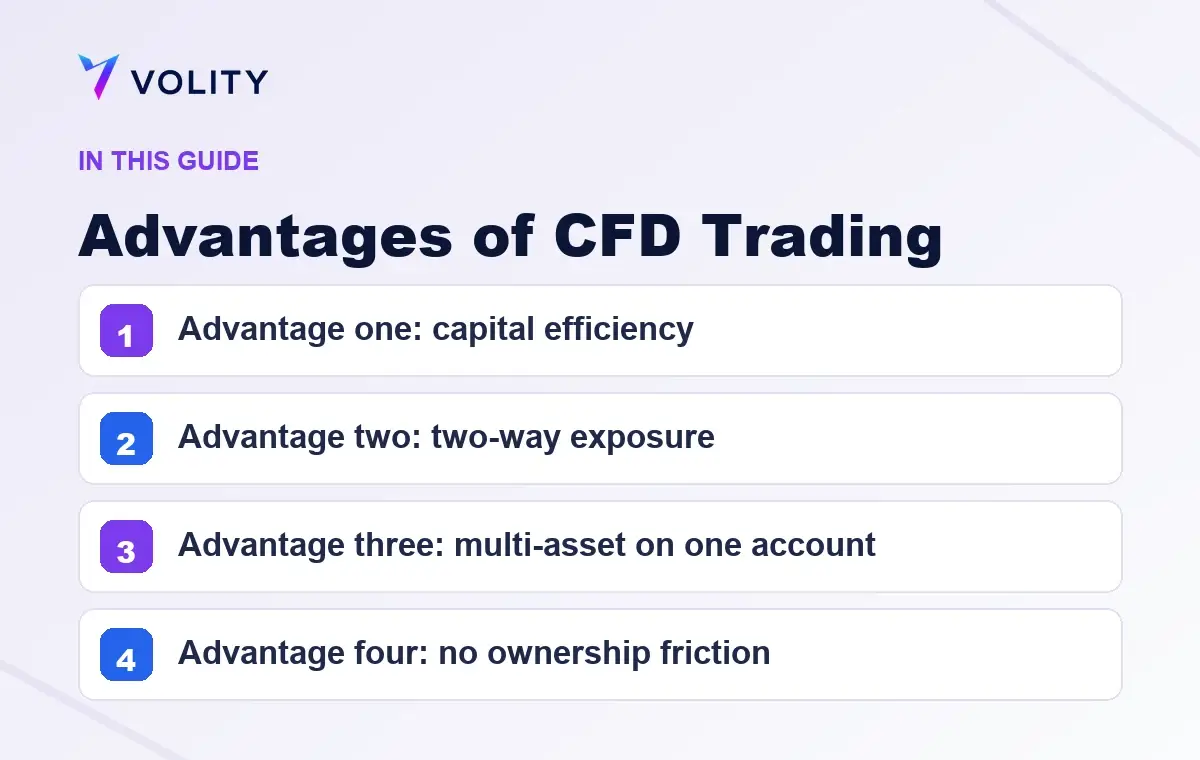
Advantage one: capital efficiency
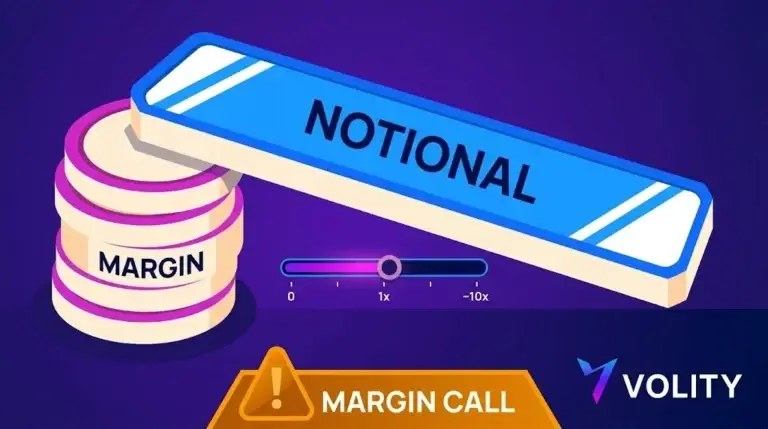
A CFD lets you control a large notional position with a fraction of the cash. Under ESMA rules, retail leverage is 1:30 on major FX pairs, which means EUR 1,000 of margin controls EUR 30,000 of EUR/USD notional. You free up the rest of your capital for other positions, other instruments, or simply to keep as a cash buffer.
The trade-off: leverage compounds losses as fast as gains. A 1% adverse move on a 1:30 position is 30% of your margin gone.
Advantage two: two-way exposure
You can short a CFD as easily as you go long. No stock-borrow desk, no locate fee, no uptick rule on most venues. If your view is that an index will fall, the trade is one click. Spot equities make this difficult for retail; CFDs solve it by design.
Advantage three: multi-asset on one account
One KYC, one funded account, one tax statement, one withdrawal rail. From that account you can trade FX, indices, single-name equities, gold, oil, and cryptoassets. The alternative is six separate brokerage relationships, six logins, six tax forms.
This is where Volity earns its place: the same wallet that holds your trading equity is the wallet that moves money in and out of your bank, into stablecoins, and across borders.
Advantage four: no ownership friction
You never custody the underlying. No share-registry fees, no dividend-tax reclaim paperwork, no crypto self-custody risk, no commodity warehousing. Dividends and corporate actions are reflected as cash adjustments on your CFD position. The friction goes away.
For dividend-equivalent payments on long equity CFDs, you receive 100% of the dividend on the ex-date as a cash adjustment. On short positions, the dividend is debited.
Advantage five: hedging existing portfolios
If you hold a long-term equity portfolio at a custodian and want to hedge a short-term move, a short index CFD is the cleanest tool. You do not have to liquidate your custody position, trigger capital gains, or deal with settlement timing. Open the hedge, hold it for the duration of the risk, close it.
Advantage six: precise position sizing
CFDs trade in fractional contract sizes. You can risk exactly 1% of your account on a trade because you can size the position down to the cent. Spot equities trade in whole shares (with a few brokers offering fractional shares); CFDs are continuous by design.
The three honest costs
- Spread and commission. Every trade pays the spread (the gap between bid and ask). Some brokers add commission. On Volity, FX majors typically run 0.6-1.2 pips, indices 0.4-1.0 points, gold 0.20-0.35 USD per ounce.
- Overnight financing. Long positions pay an interest charge based on the overnight rate plus a markup. Short positions may receive interest, depending on the rate. For day traders this is zero. For swing traders held over weeks, financing can equal half of gross returns.
- Counterparty exposure. You are trading against the broker, not on a public exchange. This is why the broker’s regulatory standing matters. UBK Markets (CySEC 186/12) holds client funds in segregated accounts at tier-1 banks, and eligible retail clients are covered by the Cyprus Investor Compensation Fund up to EUR 20,000 per client per firm.
When CFDs are the right tool
Three honest use cases:
- Active trading. Day and swing traders who need precise sizing, two-way exposure, and multi-asset access.
- Hedging. Holders of long-term portfolios who want to neutralise short-term moves without liquidating.
- Diversified speculation. Traders who want gold, indices, and FX exposure on one account without separate brokerage relationships.
When CFDs are the wrong tool
- Long-term buy-and-hold. Financing costs erode returns over years. Buy the underlying.
- Income strategies. Dividend reinvestment, covered calls, and similar income strategies live in spot custody, not CFDs.
- Tax optimisation. CFD treatment varies by jurisdiction; in some countries spot equities qualify for capital gains treatment that CFDs do not. Consult a local advisor.
CFD trading at Volity
Volity offers CFDs on 70+ FX pairs, 20+ indices, gold and silver, oil, 200+ equities, and 20+ cryptoassets. Execution is by UBK Markets Ltd (CySEC 186/12). Retail leverage is capped under ESMA: 1:30 majors, 1:20 minors and major indices, 1:20 gold, 1:10 other commodities, 1:5 individual equities, 1:2 cryptoassets. Negative balance protection applies.
Volity operates a trading platform and also publishes educational and analytical content about trading. The content on this page is for educational purposes only and should not be considered financial advice. Volity may benefit commercially when readers open trading accounts through links on this site.
Our content is produced and reviewed under documented editorial standards; see our comparison and review methodology.