Investing in financial products involves risk. Losses may exceed the value of your original investment.
Quick answer
CFD day trading is the practice of opening and closing CFD positions within a single trading session, avoiding overnight financing charges. Effective day trading on CFDs requires liquid instruments (major FX, S&P 500, gold, BTC), risk per trade capped at 0.5% to 1% of account equity, a daily max-loss circuit breaker, and edge that exceeds round-trip spread plus commission.
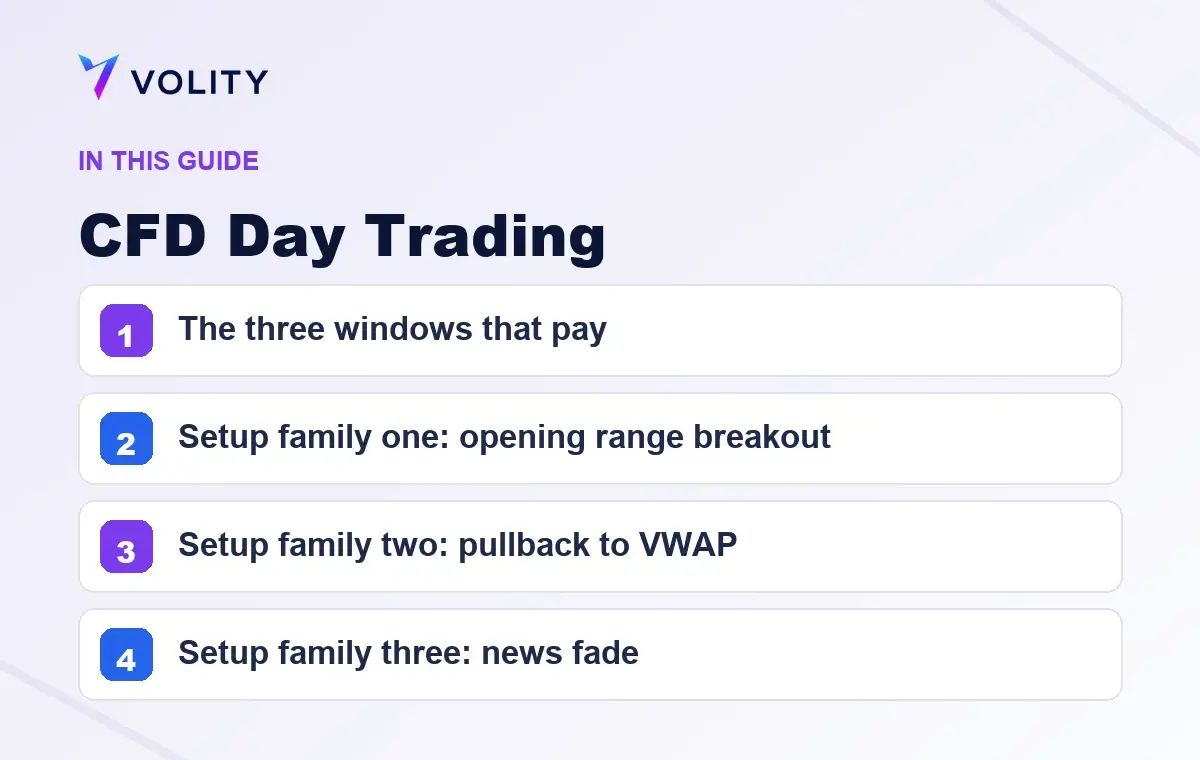
CFD day trading means opening and closing every position inside the same session, holding nothing overnight. The reasoning is mechanical: no overnight financing, no gap risk, no weekend headlines mauling your book. The trade-off is that everything that pays the day trader (volatility, volume, narrow spreads) only shows up for two or three windows per day. Outside those windows, you are paying the spread for the privilege of being bored.
The three windows that pay
Across forex, indices, and equity CFDs, three liquidity windows dominate retail intraday flow:
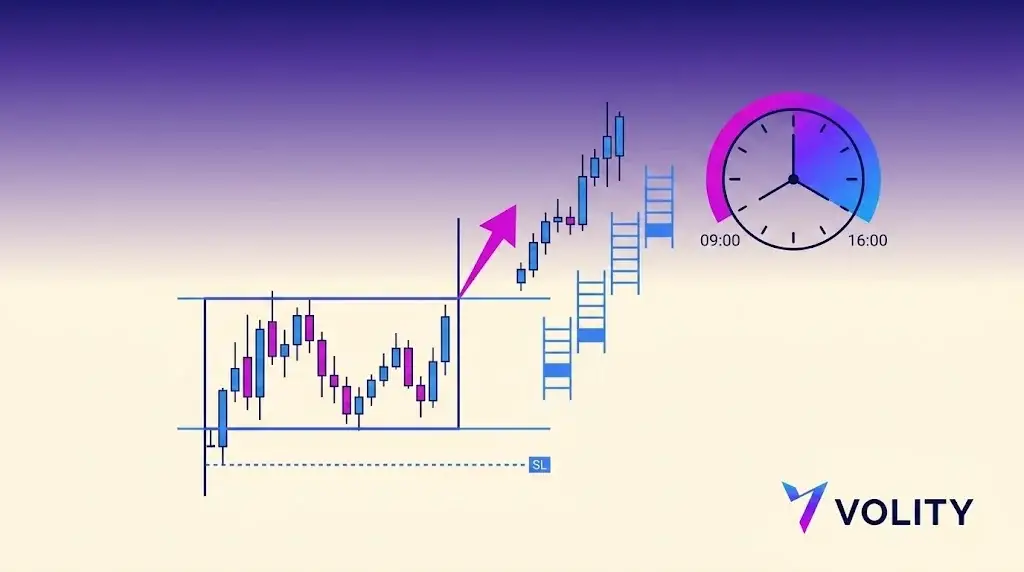
- London open (07:00-09:00 UTC). EUR, GBP, DAX, FTSE come alive. Opening-range breakouts are the cleanest setup family.
- London-New York overlap (12:00-16:00 UTC). Peak liquidity globally. Spreads tightest, news flow heaviest, false breaks most expensive.
- US cash open (13:30-15:00 UTC). SPX, NDX, single-name equity CFDs print their cleanest trends here.
If you are trading outside these windows on majors, you are renting volatility you cannot afford.
Setup family one: opening range breakout
The first 30-60 minutes of a session establish a price range. A close above the range high, on volume, is a long signal. Below the range low, a short. Stop is the opposite side of the range. Target is one to two times the range width.
Why it works: the opening range is a consensus price band built by the deepest order flow of the day. A clean break is order flow showing its hand.
Setup family two: pullback to VWAP
VWAP (volume-weighted average price) is the mean price institutions use to benchmark their own execution. Price tends to revisit it inside a trend, then resume. Long entries on a pullback to rising VWAP that holds; short entries on a pullback to falling VWAP that rejects.
Stop just beyond VWAP. Target the prior swing high (long) or low (short).
Setup family three: news fade
Major scheduled news (NFP, CPI, FOMC, ECB) creates an initial spike followed by a structured retracement 70% of the time on majors. The fade is the trade for traders who can read tape. Newer traders should sit out the first 15 minutes after the print and trade the second move, not the first.
Risk per trade: the 1% rule
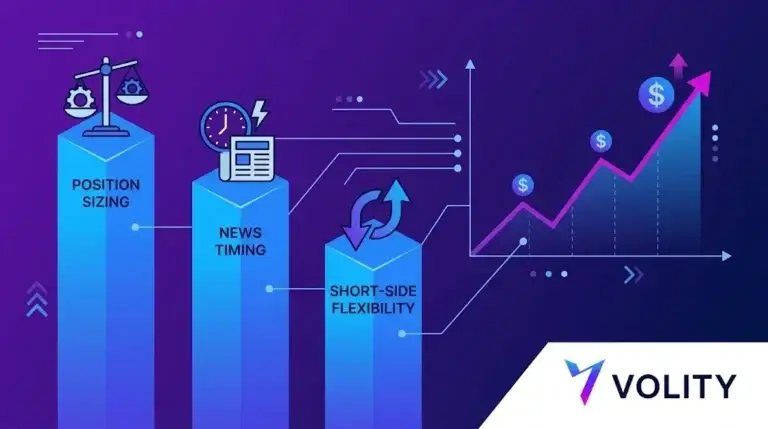
Day trading lives or dies on position sizing. Our desk runs the same rule across every desk seat:
Risk no more than 1% of account equity on any single trade. If your account is EUR 10,000, that is EUR 100 of risk. Position size is then EUR 100 divided by the distance from entry to stop.
Example: EUR/USD entry 1.0850, stop 1.0830. Distance is 20 pips. At EUR 10 per pip on a mini lot, that is EUR 200 risk per mini lot. To risk EUR 100, trade half a mini lot.
What kills retail day traders
- Overtrading. The market does not give you 10 A-grade setups per day. It gives you 1-3. The other 7 trades are tax on your discipline.
- Revenge sizing. Doubling size after a loss to recover. The Kelly math says this is the fastest way to bust an account.
- Spread bleed. Trading inside the spread on illiquid pairs (exotic FX, small-cap equity CFDs) means you start every trade 10-15 bp underwater.
- No journal. Without a journal you cannot tell which setup family is paying you. Without that data you cannot cut what is not working.
Leverage and CFD mechanics
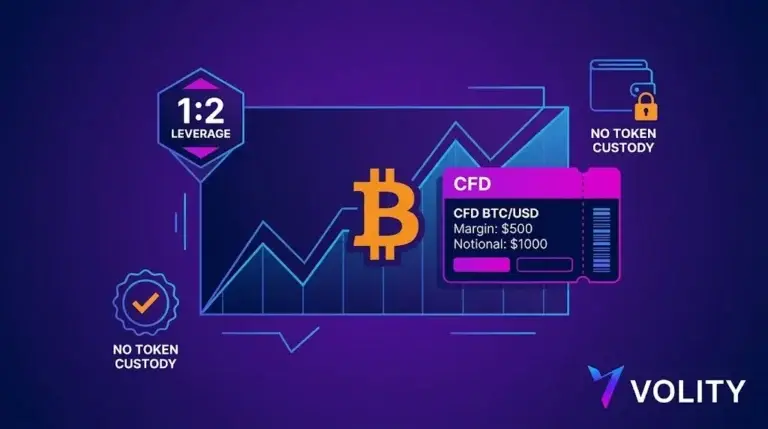
Volity offers leverage of up to 1:500 on major and non-major FX pairs, major indices, gold and other commodities, up to 1:50 on crypto CFDs and up to 1:20 on individual equity CFDs. Leverage magnifies gains and losses alike, so size each position so a single loss stays small and keep a stop-loss. Negative balance protection means you cannot lose more than the equity in your account. Eligible retail clients of UBK Markets are covered by the Cyprus Investor Compensation Fund up to EUR 20,000 per client per firm.
The first 90 days
If you are new to CFD day trading, run a 90-day apprenticeship. Pick one instrument (we suggest EUR/USD or the DAX), one setup family (opening range), and one session (London open). Trade small. Journal every trade. After 50 trades you will know whether you have an edge in that one cell of the matrix. If yes, expand. If no, change the cell, not the size.
CFD day trading at Volity
Volity offers CFDs on 70+ FX pairs, 20+ indices, gold and silver, oil, and 200+ equity references. Execution is on MT4, MT5, and the Volity web platform. Trading is executed by UBK Markets Ltd, a Cyprus Investment Firm authorised by CySEC under licence 186/12.
Volity operates a trading platform and also publishes educational and analytical content about trading. The content on this page is for educational purposes only and should not be considered financial advice. Volity may benefit commercially when readers open trading accounts through links on this site.
Our content is produced and reviewed under documented editorial standards; see our comparison and review methodology.
Frequently asked questions
Does CFD day trading suit beginners?
It is one of the harder starting points, because leverage and intraday noise both amplify small mistakes. Costs are also incurred more often, so a day trading approach needs a clearer edge than a longer-horizon one.
What costs matter most for CFD day trading?
Spread, because it is paid on every position and the trade count is high. Commission where charged, and the widening that occurs around scheduled news, matter for the same reason. Overnight financing is largely irrelevant if positions close intraday.
How many trades a day is reasonable?
Fewer than most beginners expect. A small number of well-defined setups will usually outperform continuous activity, because most intraday movement does not present a favourable ratio between risk and reward.