Investing in financial products involves risk. Losses may exceed the value of your original investment.
Quick answer
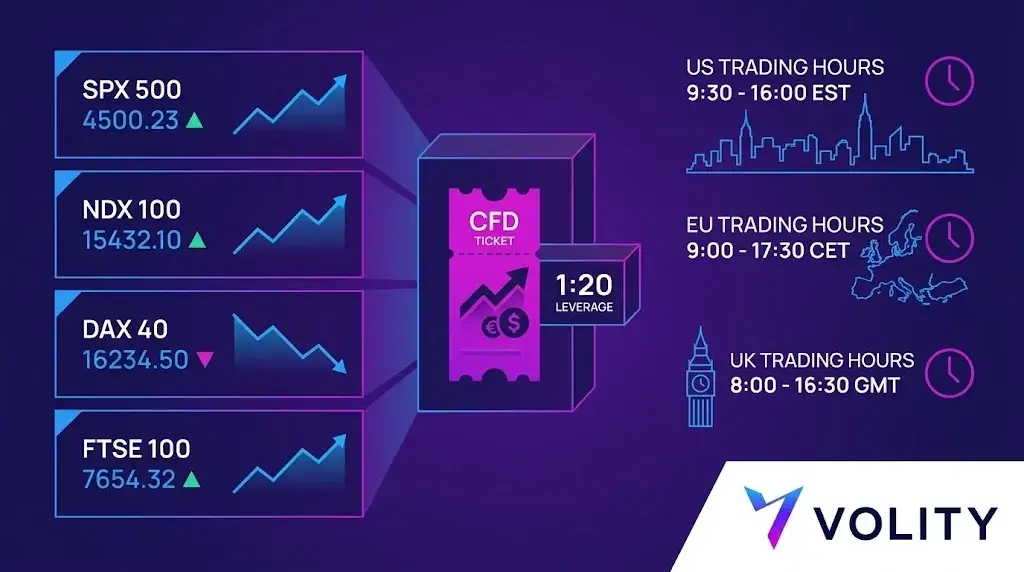
CFD index trading is leveraged speculation on stock-index futures (S&P 500, NASDAQ 100, DAX (or DE40), FTSE 100, Nikkei 225 and the Hang Seng) without holding the underlying basket. It trades 23 hours daily, has tighter spreads than spread betting, and runs at 1:20 retail leverage on majors under EU rules. Cash-settled, no expiry on most retail CFD contracts.
A stock index CFD is a contract on the price of a basket of equities settled against the broker. You take a single position and gain exposure to 30, 100, or 500 underlying companies in one ticket. The four indices that dominate retail flow globally are the S&P 500, the NASDAQ 100, the German DAX 40, and the UK FTSE 100. Each one has its own session, its own volatility profile, and its own use case in a multi-asset book.
The four indices, side by side
| Index | Constituents | Cash session (UTC) | Daily ATR (typical) | Character |
|---|---|---|---|---|
| S&P 500 | 500 large-cap US | 13:30-20:00 | 40-70 points | Broad US large-cap, financial sector heavy |
| NASDAQ 100 | 100 large non-fin US | 13:30-20:00 | 200-400 points | Tech and growth concentration |
| DAX 40 | 40 large-cap German | 07:00-15:30 | 150-300 points | Industrial and export heavy |
| FTSE 100 | 100 large-cap UK | 08:00-16:30 | 50-90 points | Financials, energy, miners |
How an index CFD works
You open a long position on US 500 (the S&P 500 CFD) at 5,200 with 5 contracts. One contract per point of index movement equals USD 5 on a one-lot CFD with USD 1 per point per contract (broker-specific contract sizing varies; check the contract spec on your platform).
Index moves to 5,220. Your position is up 20 points x 5 contracts = USD 100 (assuming USD 1 per point per contract). Index drops to 5,180, position is down USD 100. You close when you choose. Cash CFDs have no expiry; some brokers also offer dated futures CFDs that settle at expiry.
Leverage under ESMA
Major indices (S&P 500, NASDAQ 100, DAX 40, FTSE 100, CAC 40, Nikkei 225) qualify for the 1:20 retail leverage tier under ESMA. Initial margin is 5% of notional.
Non-major indices (e.g. mid-cap or single-country indices outside the major-index list) fall to 1:10 retail leverage, with 10% initial margin.
Negative balance protection applies. You cannot lose more than the equity in your account.
S&P 500: the workhorse
The most-traded index globally. Deep liquidity, tight spreads (0.4-0.6 points typical), 24-hour CFD trading with the deepest liquidity 13:30-20:00 UTC. Broad sector exposure means single-stock surprises rarely move the index more than 30-50 points.
Use case: macro views on US growth, US monetary policy, broad equity risk.
NASDAQ 100: the volatility play
Top-heavy in mega-cap technology. The top 7 names account for nearly 50% of the index. Daily ATR is 3-5x the S&P 500 in absolute points; in percentage terms, NDX runs 20-40% wider intraday range than SPX.
Use case: tech-sector views, AI thematic positioning, US growth-versus-value rotations.
DAX 40: the European session anchor
Most-traded European index. Industrial, automotive, chemical, and financial weight. Highly correlated to US futures during the US-EU overlap. Cleanest opening-range setups in retail CFD flow happen on the DAX between 07:00 and 09:00 UTC.
Use case: European macro positioning, EUR sensitivity, EU energy and industrial cycle.
Heavy weight in financials, energy supermajors, and global miners. The FTSE 100 trades inversely to GBP strength because most constituent revenue is foreign-currency. A weak pound lifts the index; a strong pound weighs on it.
Use case: GBP-driven macro views, commodity-cycle positioning, UK rates trades.
Common setups across indices
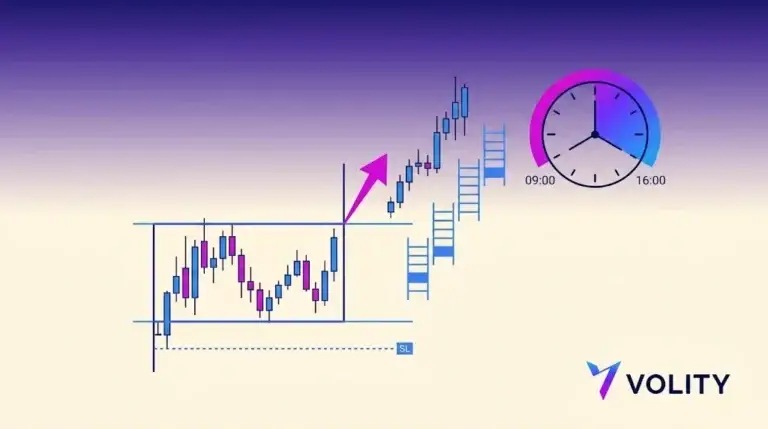
- Opening range breakout. First 30 minutes of the cash session establish a range. Close above on volume goes long; below goes short. Stop is the opposite side of the range.
- VWAP pullback. Price retraces to VWAP inside a trend, holds, and resumes. Long on rising VWAP rejection from below; short on falling VWAP rejection from above.
- News fade. Major US data (CPI, FOMC, NFP) creates an initial spike followed by a structured retracement on the SPX and NDX 60-70% of the time. The fade is the trade for traders who can read tape.
What goes wrong
- Single-stock event risk on NDX. A surprise from one of the top 7 names can move the NASDAQ 100 1-2% on its own. The index is more concentrated than it looks.
- Gap risk on overnight holds. Major after-hours earnings (esp. on NDX names) can gap the index 1-2% before the next session.
- Spread widening on news. Spreads on US 500 and US Tech 100 widen 3-5x during NFP and FOMC. Stop-losses placed too tight will fill at meaningful slippage.
Index CFD trading at Volity
Volity offers CFDs on S&P 500, NASDAQ 100, DAX 40, FTSE 100, CAC 40, Nikkei 225, the ASX 200, and 15+ other major and minor indices. Retail leverage on major indices is capped at 1:20 under ESMA. Spreads from 0.4 points on US 500 in liquid hours. Negative balance protection applies. Execution is by UBK Markets Ltd, a Cyprus Investment Firm authorised by CySEC under licence 186/12.
Volity operates a trading platform and also publishes educational and analytical content about trading. The content on this page is for educational purposes only and should not be considered financial advice. Volity may benefit commercially when readers open trading accounts through links on this site.
Our content is produced and reviewed under documented editorial standards; see our comparison and review methodology.