Market overview: bitcoin’s cold shower after the rally
Crypto finally got the pullback traders had discussed for weeks, then pretended would not arrive.
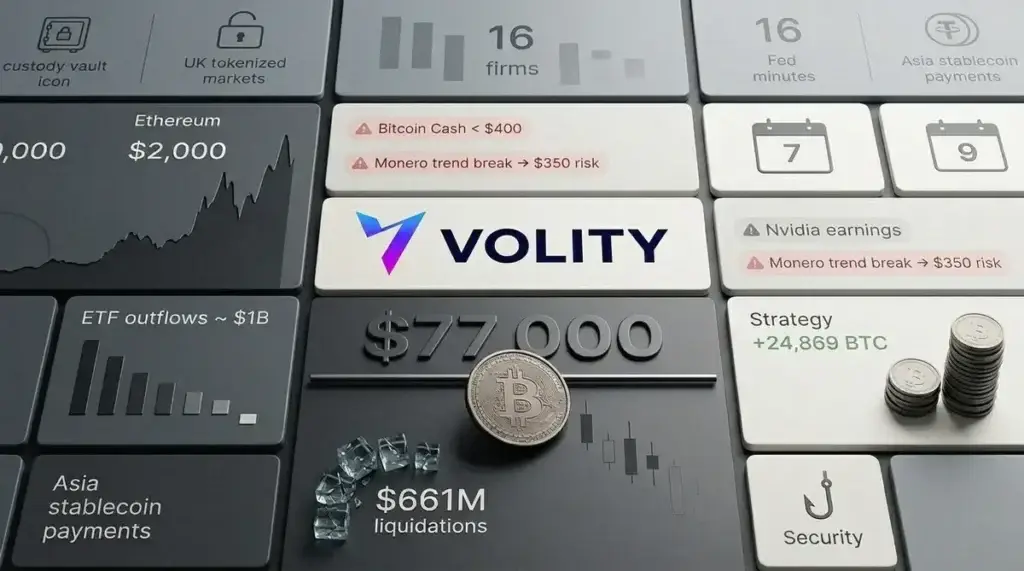
Bitcoin slipped below $77,000 as risk appetite thinned across speculative markets. Tech shares wobbled, bond yields rose, and oil’s latest jump added another headache for leveraged traders. Meanwhile, crypto ETFs saw about $1 billion in outflows, helping trigger roughly $661 million in liquidations.
The move looked less like a mystery than a routine deleveraging. Traders cut exposure before the next Fed minutes and Nvidia earnings. Therefore, positions built during the rally suddenly became expensive to defend.
Bitcoin was not alone. Ethereum has sketched a bearish “Adam and Eve” pattern, with traders watching the $2,000 area. Bitcoin Cash broke below $400. Monero, meanwhile, lost trendline support, raising the risk of a test below $350.
However, the tape is not uniformly grim. An old altcoin-season signal has started flashing again. That matters because the nastiest shakeouts often arrive just before capital rotates into higher-beta coins.
By the numbers
- $77,000 – bitcoin’s key broken level during the selloff.
- $1 billion – estimated crypto ETF outflows during the move.
- $661 million – market-wide liquidations after leverage snapped.
- 24,869 BTC – Strategy’s latest bitcoin purchase.
- 16 firms – participants in the UK’s tokenised markets trial.
Bitcoin: whales buy while funds rotate
Retail traders often sell first and think later. Large holders, however, behaved differently during this break.
Strategy, Michael Saylor’s bitcoin vehicle, added 24,869 BTC as the price fell below $77,000. The purchase followed Saylor’s recent comment that his “never sell” line needed a reset. For now, the reset means buying into weakness, not stepping away.
Another buyer, Capital B, used fresh funding for a $15.1 million bitcoin purchase. That is classic cycle behaviour. Public-market sentiment shakes, then specialist vehicles buy inventory from impatient hands.
Still, ETF flows deserve close attention. Bitcoin ETFs no longer receive automatic inflows on red days. Instead, investors took money off the table as volatility rose. That shift does not prove institutional abandonment. It does show that the ETF trade has become two-way.
Meanwhile, Goldman Sachs reportedly trimmed altcoin ETF exposure after first-quarter filings. Harvard exited an Ether ETF position, while Abu Dhabi increased bitcoin exposure. The split is revealing. Big allocators still like digital gold. They appear less certain about smart-contract beta at current prices.
Altcoins: the hunt for beta gets messier
If bitcoin is the market’s barometer, altcoins remain its rowdy back room. The action was messy, but useful.
- XRP briefly returned to the $2 area. ETF inflows into XRP products improved, while on-chain activity returned to March levels. However, traders chasing cloud-mining promotions should treat advertised passive income with care. Counterparty risk does not disappear because a dashboard looks tidy.
- OriginTrail’s TRAC jumped after Upbit opened KRW, BTC and USDT trading pairs. New Korean fiat access can reprice smaller tokens quickly, especially when liquidity was thin beforehand.
- Zcash continued its sharp rally, with some traders discussing $750 targets. Yet leverage is building under the move. A squeeze can cut both ways, especially in privacy coins.
Meme and presale names also kept pulling in money. DOGEBALL and Meme Punch drew attention from traders seeking early-stage upside. But these instruments depend on momentum, liquidity and timing. They should not be confused with durable investment assets.
Regulation and plumbing: custody, tokens and banks
The more important story may sit away from price screens. Market infrastructure keeps maturing, even as coins swing hard.
Standard Chartered has split Zodia, its crypto custody operation, into two distinct businesses. One lane appears built for conservative custody. The other can chase more flexible digital-asset services. For large allocators, that separation matters. It brings crypto closer to the boring, regulated plumbing they prefer.
In Britain, regulators opened a live tokenised markets experiment involving 16 firms. The trial focuses on tokenised versions of real-world assets. Bonds, money-market funds and private credit are the obvious targets. Over time, instant settlement and round-the-clock collateral could change how desks manage liquidity.
Asia is moving quickly too. In South Korea, KB is testing offline payments for a domestic stablecoin. That sounds niche until a payment network loses connectivity. Meanwhile, Hana Bank’s $668 million bet on Dunamu, the operator of Upbit, has drawn regulatory review.
In Japan, SBI, Rakuten and Nomura are preparing crypto investment trusts. The structure suits Japan’s cautious market. It wraps digital assets in a familiar, supervised format.
However, one distant risk keeps creeping into institutional memos: quantum computing. “Q-Day” remains a future problem, not this week’s trade. Still, major chains cannot ignore quantum-resistant signatures forever.
Geopolitics: bitcoin enters the Strait of Hormuz
The strangest story of the day came from the Persian Gulf.
Iran is linked to a proposed “Hormuz Safe” bitcoin-based insurance platform for ships crossing the Strait of Hormuz. The idea is to use bitcoin-linked reserves and settlement rails where traditional insurance is costly, slow or politically fraught.
If the platform gains real usage, the implications stretch beyond shipping. Bitcoin would be tested as neutral collateral in one of the world’s most sensitive trade corridors. Therefore, sanctions lawyers, insurers and energy traders will watch closely.
It also shows how crypto has moved from a market story into a geopolitical instrument. Governments and quasi-state actors now study blockchains as payment rails, collateral pools and pressure valves.
Security: bridges break and inboxes bite
Crypto’s old weaknesses also returned on cue.
The Verus-Ethereum bridge lost about $11.5 million through a forged-transfer exploit. Bridges remain among DeFi’s weakest structures. They are hard to audit, technically dense and rich enough to tempt skilled attackers.
Meanwhile, a new phishing campaign is using convincing Google-style emails to target traders. The messages imitate security alerts, recovery notices and login prompts. The lesson is dull but essential: do not click trading-related links from email. Use bookmarks, hardware wallets and strict address checks.
Kraken also cut staff as automation spreads through crypto operations. Leaner teams can lower costs and tighten service. Yet more automated compliance and support systems can become brittle during stress. Traders should expect faster platforms, but not always friendlier ones.
Policy: Washington waits, enforcers move
In Washington, the regulatory calendar remains awkward. A key Senate crypto bill could stall after the midterms, leaving exchanges and token issuers stuck in limbo. The CLARITY Act and key CFTC appointments still matter for market structure.
Enforcement, however, has not slowed. A Forsage co-founder pleaded not guilty in a $340 million Ponzi case. Separately, prosecutors allege a Dream Market administrator laundered crypto into gold.
There was also rare cross-border coordination. China, the United States and the UAE cooperated on a Dubai crypto-scam raid. Fraud remains global, but the response is becoming less scattered.
Related coverage on Volity
- Bitcoin Holds $78,000 as CLARITY Act Tightens Crypto Rules
- Bitcoin Drops Below $79k as Yields Rise, ETFs Stall
- Bitcoin Eyes $100k as CLARITY Act Drives Crypto Markets
- Bitcoin Near $80k as Tokenised Treasuries Hit $15bn
- How to Navigate Crypto and Investment Hype for Smart Returns
The thread continued the next day with Bitcoin staying below $80k as ETF flows shifted and tokenised Treasuries grew.
Key takeaways
- Respect the macro calendar. Fed minutes and Nvidia earnings can still move crypto through risk appetite.
- Watch ETF flows daily. The institutional bid now cuts both ways.
- Separate bitcoin from alt beta. Larger allocators are treating them differently.
- Avoid “easy yield”. Cloud mining, presales and thin tokens carry hidden risk.
- Price in security risk. Bridge exposure deserves a discount, not blind trust.
The market’s message is plain enough. Macro stress hit a levered crypto tape, and weak positions broke. Yet under the selloff, custody, tokenisation and regulated access keep advancing. For traders, that combination means sharper air pockets and better long-term rails.