How to Make a Trader’s Morning Note Worth Opening
A daily watchlist should not read like a tray of loose screws. Traders need order, evidence and timing. They need to know what can move today, what deserves patience, and what merely colours the background.
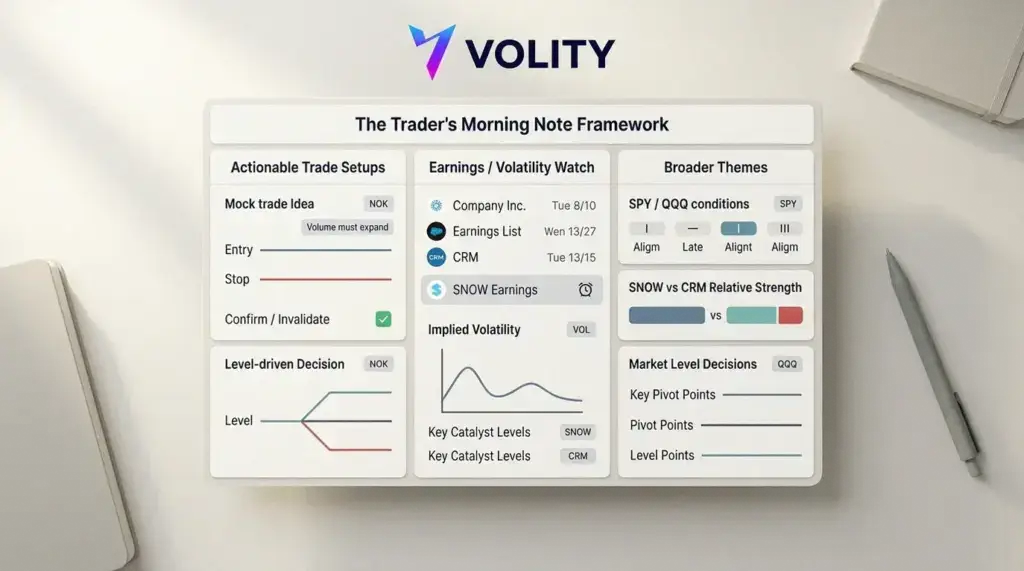
The fix is simple. Split every post into three lanes: trade setups, earnings watches and themes. Then keep each name in its proper lane. That alone turns a decent list into a usable morning note.
The Morning Note Needs Three Lanes
First, lead with high-conviction trade setups. These are names with a confirmed catalyst and a clean price-action trigger. Earnings, guidance, analyst action, sector rotation or macro data can all qualify. However, the catalyst must exist in plain sight.
This is where names such as $AVEX, $SNOW, $CRM, $MRVL, $NOK and possibly $ENPH belong, but only when the evidence supports them.
For example, $AVEX can sit near the top if the setup follows a real earnings reaction. The entry logic should then depend on price, volume and follow-through. Without that structure, it becomes a ticker mention, not a trade.
Second, create an earnings and volatility watch. This section should handle names such as $PATH, where the point is reaction tracking rather than immediate execution. Traders can prepare for volatility, guidance risk and post-print digestion. Meanwhile, they avoid pretending every earnings name is a live trade.
Third, put broad themes in their own section. A theme such as slowing demand for AI coding tools may matter. However, it should inform stock selection, not masquerade as a standalone trade call. Tie it to specific tickers, relative strength and observable flows, or leave it as context.
Catalysts Need Proof
Loose catalyst language damages trust quickly. A post can speculate, but it must label speculation clearly.
Take $UMAC and any policy or capital-allocation story. If there is no company filing, verified report, release or transcript, do not present it as fact. Instead, call it market speculation. Better still, cut it until the tape confirms interest.
The same rule applies to drone-funding angles and similar story trades. Unless recent news meets volume and price response, keep them out of the main trade section. Otherwise, they belong in a speculative watch box with clear risk language.
A useful line would read: “Story lacks confirmation; not a clean catalyst yet.” That tells a trader exactly how to size the information. It also prevents an unverified narrative from becoming the backbone of a trade.
Triggers Beat Wishes
Vague phrases waste space. “Watch for momentum” says very little. “Continuation valid only above yesterday’s high on volume above the 20-day average” gives traders a decision point.
Every actionable setup should answer three questions:
- What confirms the trade? A hold, break, reclaim or rejection at a defined level.
- What invalidates it? A failed breakout, loss of support or reversal into the prior range.
- What should volume do? Confirm the move, or warn that buyers lack conviction.
For $NOK, the language should focus on continuation only if the stock holds its recent consolidation zone. A long idea makes sense above the prior breakout area with strong volume. However, a return into the old range turns the setup neutral.
For $ENPH, the short-squeeze idea needs more conditions. The thesis works only if short interest remains elevated, the float stays relatively tight, and volume spikes through recent range highs. Otherwise, it is just a bounce inside a weak longer-term chart.
That distinction matters. Traders can buy a squeeze. They should not confuse one with an ordinary relief rally.
Relative Strength Should Carry the Piece
The strongest part of the framework is the comparison across related names. Keep leaning into it. Relative strength turns isolated opinions into tradeable rankings.
Among software names, compare $SNOW with $CRM after earnings. If $SNOW holds above its gap while $CRM fades into its prior range, the message becomes clear. Buy-the-dip interest favours $SNOW. Rally fades look cleaner in $CRM.
In semiconductors, use $MRVL against the SOX and stronger peers. If $MRVL lags after earnings while the group reclaims highs, it becomes a source-of-funds name. Meanwhile, stronger chips deserve cleaner long interest.
Index context should sit above every single-stock call. High-beta tech longs work better when $QQQ holds key support and mega-caps lead. If $SPY trades below yesterday’s low with weak breadth, fade laggard breakouts rather than chasing them.
This is the desk logic readers want. It tells them not only what to watch, but where conviction should rise or fall.
Targets Need Discipline
Numeric targets can help, but stale numbers do more harm than good. If a target cannot be verified from the last three sessions, avoid it.
Use fresh, visible levels instead. Last week’s high, a post-earnings gap, the 50-day moving average or a recent supply shelf all work. However, present them as zones rather than prophecy.
A better line would read: “First trouble area sits near last week’s high.” Another useful version: “Upside remains capped by the post-earnings gap high.” These lines give structure without pretending to know the future.
A Cleaner Template for Tomorrow
- Actionable trade setups. Put confirmed catalysts and defined triggers first. Start with names such as $AVEX, $SNOW, $CRM, $MRVL, $NOK and conditional $ENPH.
- Earnings and volatility watch. Place $PATH here if the setup is pre-earnings volatility or guidance risk, not a live entry.
- Indices and leadership. Use $SPY, $QQQ, AAPL, MSFT and NVDA to frame risk appetite.
- Themes and sentiment. Discuss AI coding tools, drones or policy narratives only as context unless price and flow confirm them.
Related coverage on Volity
- APLD Surges on $7.5bn AI Deal as NVDA Gauges Risk-On Mood
- Bitcoin Price Today: Crypto Outflows as RWA Tokenisation Soars
- NVDA & TSM: 26 Daily Watchlists to Spot Risk and Profit Fast
- Bitcoin Price Slips as ETF Outflows Hit Yearly High
- Zoom (ZM) Earnings Gap in Focus: Top Trade Levels
Key Takeaways
- Put live trades above watchlist names, so readers can act quickly.
- Call something a catalyst only when the evidence is clear.
- Replace “momentum” language with exact holds, breaks and invalidation levels.
- Use relative strength to rank tickers inside the same sector.
- Label unconfirmed stories as speculation, then size them accordingly.
The best version of this note reads like a sharp prep sheet before the opening bell. It does not need drama. It needs proof, levels and a clear map for the next few hours.