Your first deposit into a trading account is where a lot of new traders freeze. Which method, how much, how long until it arrives, and how do you get the money back out later? Funding turns out to be simple once you know the four things that decide speed and cost: your method, your verification status, the minimum, and whether the name on the payment matches the account. Get those right and money moves in minutes.
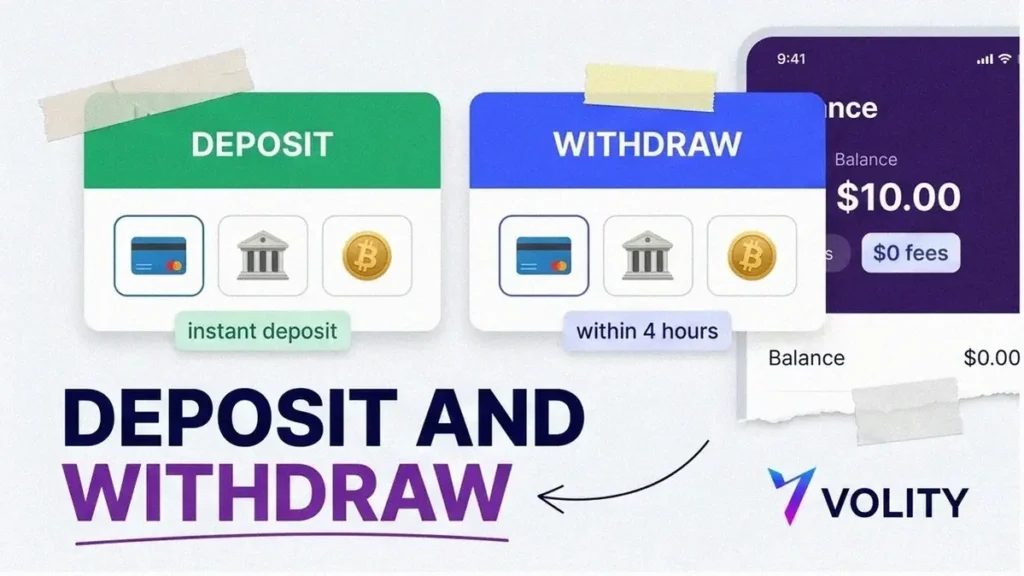
TL;DR / Quick insight: To fund a trading account, verify your identity (KYC), pick a method (card, bank transfer or crypto), and send at least the minimum. To withdraw, send it back to the same method and the same name you deposited with. Speed and fees vary by broker, so read its banking page. As a benchmark: on Volity, card and crypto deposits and withdrawals are instant, withdrawals and crypto deposits carry no fee, card deposits carry 2.99%, the minimum is EUR 10, and withdrawals generally land within 4 hours.
This guide covers moving your own money in and out of a brokerage account. It does not cover prop-firm “funded accounts”, where a firm gives you its capital after you pass a challenge. Here the money is yours, sitting in an account in your name.
1. Deposit and withdrawal basics
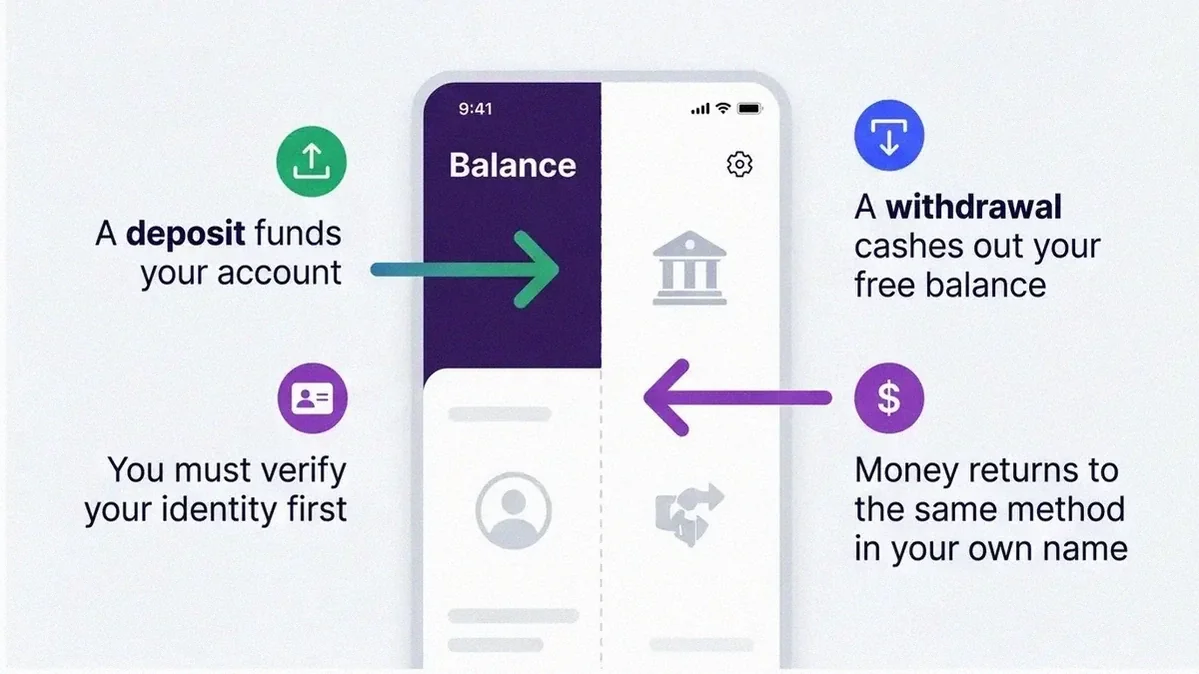
A deposit moves money from your bank, card or crypto wallet into your trading account. A withdrawal sends your available balance back out. Two plain terms keep coming up. KYC (“Know Your Customer”) is the identity check every regulated broker runs before letting you move money: ID, proof of address, and sometimes proof of funds. Free balance is the part not locked in open trades, the part you can actually withdraw.
One rule prevents most problems. The payment method and the name on it must belong to you. Reputable brokers do not allow third-party transactions, so you cannot deposit from a friend’s card or withdraw to someone else’s account. The account and the payment method both have to be in your own legal name.
2. Compare the methods: card, bank and crypto
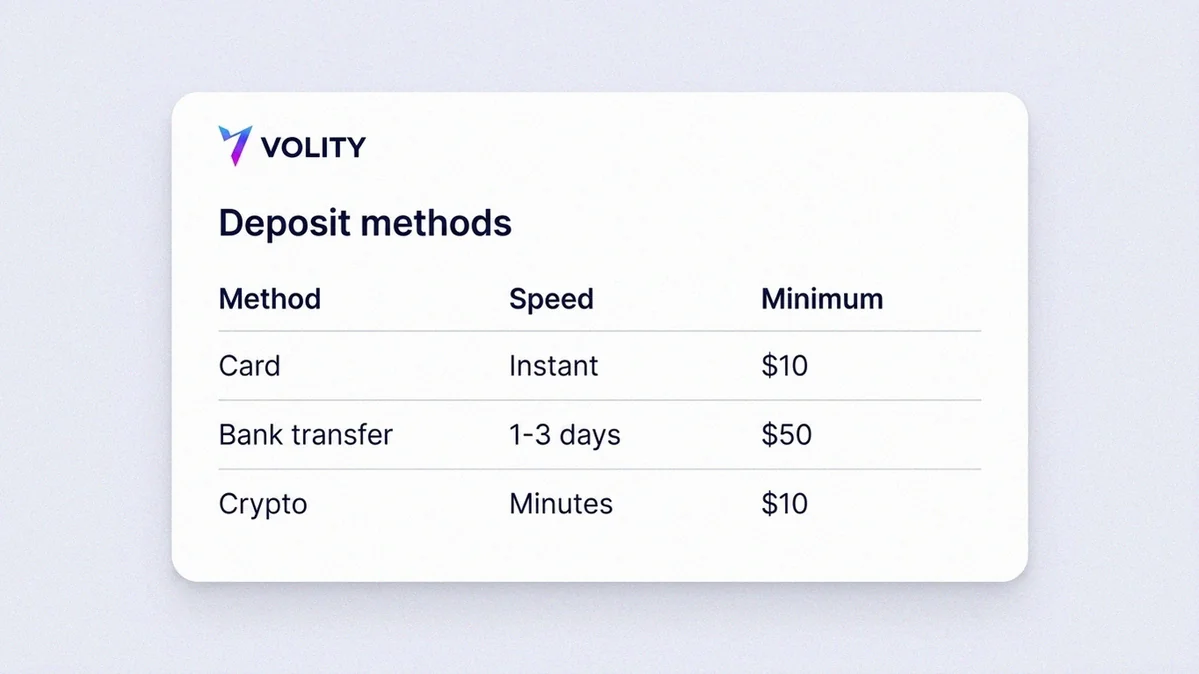
Most brokers offer some mix of card, bank transfer and crypto. They differ on three things: speed, cost, and familiarity. No single method wins outright; the best one matches your priority.
| Priority | Card (VISA/Mastercard) | Bank transfer | Crypto (BTC/ETH/USDT) |
|---|---|---|---|
| Speed | Usually fastest; often near-instant | Typically slowest; varies by bank | Fast once the network confirms |
| Cost | Varies by broker; check its page | Your bank may add a fee | A network (“gas”) fee may apply on-chain |
| Familiarity | High; like any online card payment | High; the usual bank route | Lower if you are new to crypto |
| Best when | You want speed and simplicity | You move a larger sum, timing flexible | You already hold crypto |
The table gives no exact fees or times for other brokers, because those genuinely vary and a made-up number would mislead you. Decide whether speed, cost or familiarity matters most, then read your broker’s banking page for the stated fee and timing. If a broker hides those details, treat it as a warning sign.
3. Make your first deposit, step by step
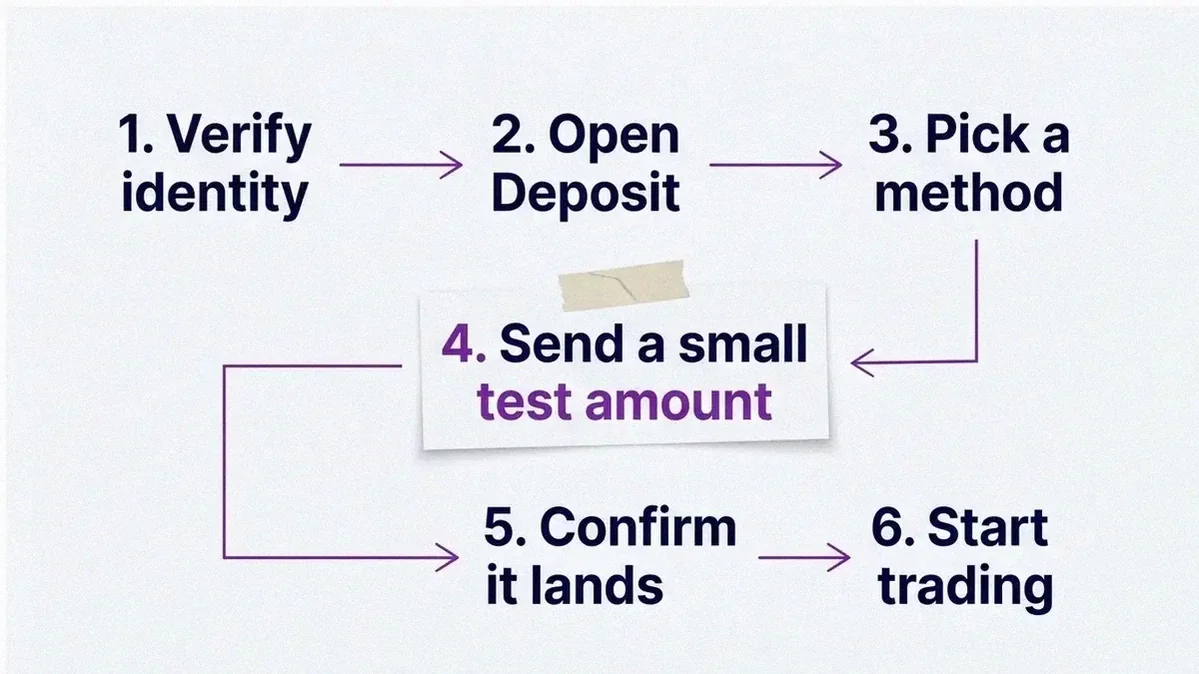
Do not send a large sum into a brand-new account on your first try. Verify first, send a small test amount to confirm the rail works, then scale up.
- Open and verify the account. Complete identity verification (KYC) before anything else. An unverified account is the top reason a first deposit or withdrawal stalls.
- Choose your method. Pick card, bank transfer or crypto based on your priority, in your own name.
- Check the minimum and any fee. Read the broker’s banking page for its minimum and any fee on that method.
- Send the minimum first as a test. Deposit the smallest allowed amount to confirm the funds arrive and credit.
- Confirm it landed, then top up. Once the test shows as available balance, send the larger amount you plan to trade.
- Note the method you used. You will usually withdraw back to it later.
On Volity the flow runs fast: deposits work 24/7, the minimum is EUR 10, and card and crypto deposits are instant (free on crypto, 2.99% on card), so the test step costs very little.
4. Withdraw your money, and know how long it takes
Withdrawing comes down to matching. Almost every broker asks you to withdraw back to the same method and name you deposited with, both for anti-fraud reasons and because card networks route refunds to the original card. Deposit by card, withdraw to that card; deposit by crypto, withdraw to a wallet in your name.
The steps are short. Make sure the balance is free (not locked in open trades), open the withdrawal screen, pick the matching method, enter an amount at or above the minimum, and submit.
Online, the “how long do withdrawals take” phrase often pulls up retirement-account content with nothing to do with trading. For a trading account it depends on the method and broker, so read the stated window. As a benchmark, Volity withdrawals generally process within 4 hours, any non-instant ones within 24 business hours. Withdraw to the matching own-name method, then wait out the stated window.
5. Fees, limits and the rules that trip people up
Most delayed or surprise-charged withdrawals trace back to a small set of rules. Check these four before you move money.
- The minimum. Every account has a minimum deposit and withdrawal; send below it and the request will not go through. On Volity both sit at EUR 10.
- Per-day withdrawal limits. Some brokers cap how many withdrawals you can place per day. On Volity it is one per day (VIP exempt).
- Withdrawing right after depositing. Pulling money back immediately can trigger a charge. On Volity, an early withdrawal within 48 hours of a deposit is charged an amount equal to the deposit fees incurred, so avoid depositing and withdrawing the same funds inside that window.
- Security holds. After a sensitive change such as a new password, brokers often pause withdrawals briefly. On Volity, a 24-hour hold applies after a password change, so change it well before a withdrawal, not right before.
6. How Volity handles deposits and withdrawals
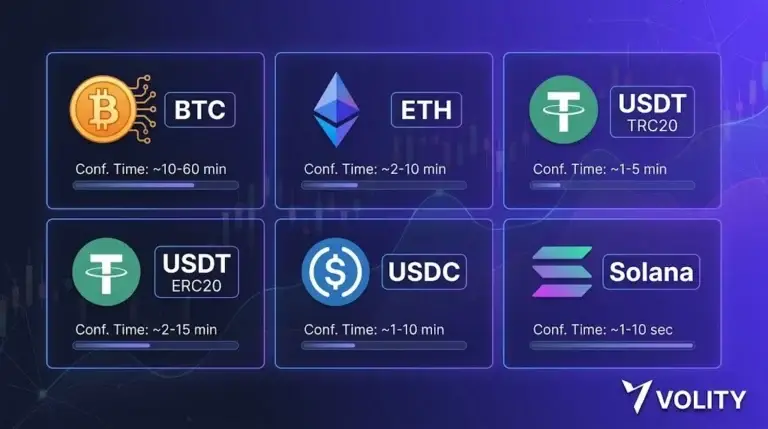
Generic guides can only say funding “varies by broker”. Here is a real example to hold them to. On Volity, card (VISA and Mastercard) and crypto (BTC, ETH and USDT) deposits and withdrawals are instant and run 24/7; withdrawals and crypto deposits carry no fee, card deposits carry 2.99%, and the minimum is EUR 10.
Volity funding at a glance:
Verify (KYC) → deposit by card or crypto (instant, from EUR 10; free on crypto, 2.99% on card) → trade → withdraw to the same own-name method → generally settled within 4 hours.
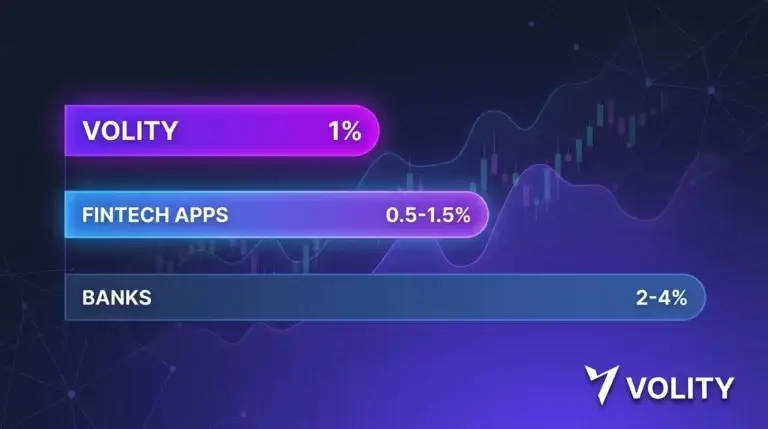
Account opening, closure, statements and KYC all cost nothing. Internal transfers in the same currency are free; a 1% fee applies only when you convert currency. Standard accounts get one withdrawal per day (VIP exempt), with the usual guardrails: verification required, own-name transactions only, plus the early-withdrawal and password-hold rules. Open the Volity payments page and the full fee schedule and confirm every claim yourself.
Want to practise without risking real money first? TRY A FREE DEMO ACCOUNT on any tier, then move to a live deposit.
7. Your before-you-move-money checklist
Run this before every deposit and withdrawal. Tick all six and you separate a clean, instant transfer from a stuck one.
- Verified: KYC is complete on the account.
- Own name: the card, bank or wallet and the trading account are all in your legal name.
- Minimum met: your amount sits at or above the minimum.
- Method matched: for a withdrawal, you are sending back to the deposit method.
- Timing understood: you have read the broker’s stated window.
- No rule surprise: per-day limits, the early-withdrawal window, and any security hold are checked.
That is the whole game. Decide your method, verify, test with the minimum, and keep deposits and withdrawals on the same own-name rail. Ready to do it on an account that funds free, instant and from EUR 10? OPEN A VOLITY ACCOUNT, or SEE FEES AND ACCOUNT TYPES first.
Reviewed for accuracy: Volity editorial desk (A. Bennett byline).
Data integrity: all Volity figures (EUR 10 minimum, free and instant card/crypto transfers, within-4-hours processing, one withdrawal per day, 48-hour early-withdrawal rule, 24-hour password hold) are verified against the published Volity fee schedule. Timings and fees for other brokers are left qualitative because they vary.
Related Volity guides
- How to avoid currency conversion fees
- How to choose a trading platform
- How much money do you need to start trading?
Funding an external venue follows the same discipline as any other transfer: check the destination, send a test amount, confirm it arrived. For the prediction-market version of that routine, read how to fund a Polymarket account.
Frequently asked questions
How long do trading withdrawals take?
It depends on the method and broker, so read its stated processing window; the “how long” question online often surfaces retirement-account results that do not apply to trading. As a benchmark, Volity withdrawals generally process within 4 hours, any non-instant ones within 24 business hours, and card and crypto withdrawals are instant.
What is the cheapest deposit method?
Cost varies by broker and method, so check the banking page for the exact fee first. On Volity, withdrawals via VISA, Mastercard, BTC, ETH and USDT and crypto deposits carry no fee; card deposits carry a 2.99% fee.
Is there a minimum deposit?
Yes, almost every broker sets a minimum deposit and withdrawal, and the figure differs between brokers. On Volity both minimums are EUR 10, so you can start small and test first.
Why is my withdrawal delayed?
Usual causes: KYC is not finished, you are withdrawing to a method or name that does not match the deposit, a security hold is active (such as after a password change), you have hit a per-day limit, or part of your balance is still locked in open trades.
Can someone else fund my trading account for me?
No. Reputable brokers do not permit third-party transactions, so you can only deposit from, and withdraw to, accounts in your own legal name. On Volity this is a firm rule: every card, bank account or wallet must belong to you.
Sources
The guidance above draws on the following public sources.
- Bank of England – how payments actually move money
- European Central Bank – instant payments settle in seconds
- Federal Reserve Board – instant payment rails run 24/7
- Federal Reserve Board – card and transfer payment data
- Corporate Finance Institute – what KYC verification involves
- Cyprus Securities and Exchange Commission – investor protection rules for brokers
- Financial Services Compensation Scheme – how client money is protected
- Bank for International Settlements (CPMI) – payment systems vary by country
- Europol – payment fraud and third-party risk