Funding a trading venue is the easy half. Getting the money back out is where people find that a balance on a screen is not the same thing as cash they can spend. This guide walks the return trip in order: what you actually hold before you start, what has to be closed or settled first, how to withdraw from an external trading platform, and where the money lands afterwards. Volity is the funding and tracking layer in this flow. The withdrawal itself runs on the venue’s rules, and those rules are what set the timing.
TL;DR / Quick insight: Money at an external platform sits in one of three states: free balance, collateral committed to an open position, or a contract that has not resolved. Only the free balance can leave. Close or settle the rest, use the venue’s own withdrawal control, and the funds move to the address you nominate. Balances and positions are held on the external platform, not by Volity, and trading, availability and withdrawals are subject to each platform’s own terms. Volity does not place or manage orders on your behalf.
Nothing here is personal advice, and no timing quoted below is a promise. Leveraged positions can be closed against you at a loss. An event contract can settle at zero. Venue mechanics and fee schedules change, so check the current page at the venue before you rely on any figure.
Where your money is before you start
Open the Markets section of your Volity dashboard, headed “Trade and prediction markets”, and look at the connected venue before you touch anything. The panel is there so you can see the position without logging in somewhere else.
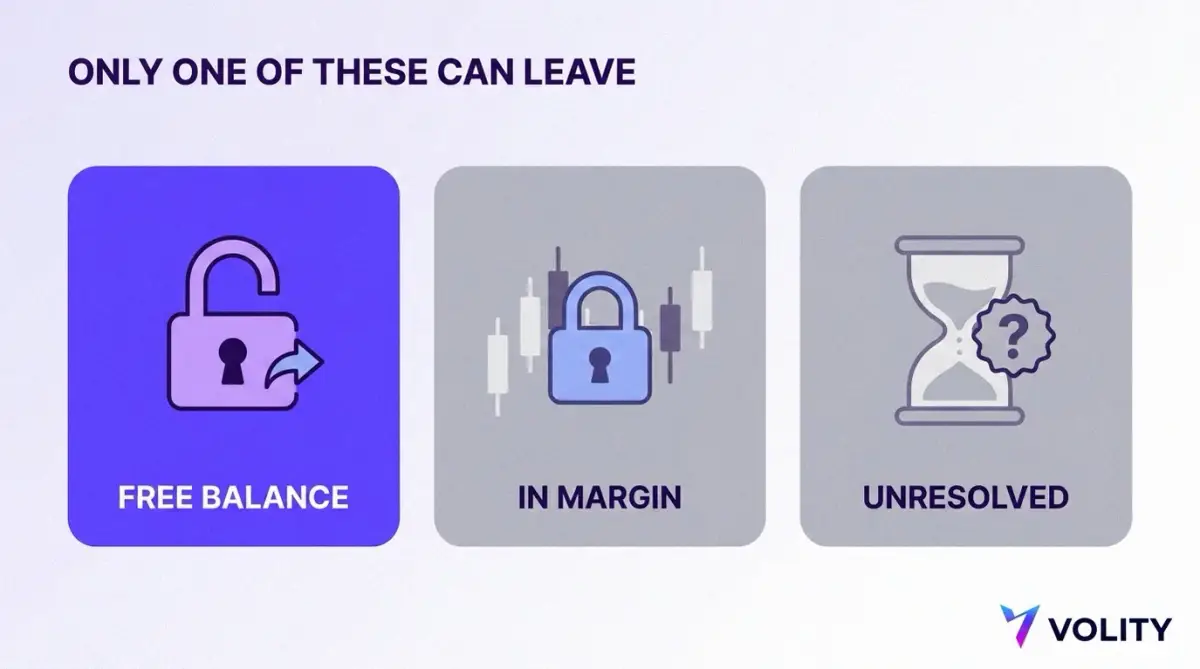
For Hyperliquid, the panel shows available balance, account value, margin used, open positions and unrealised profit and loss, all denominated in USDC and labelled held at Hyperliquid, with a refresh timestamp. Those five numbers are not interchangeable. Account value includes everything, including money the venue has already committed to your positions. Available balance is the part with nothing claiming it.
Polymarket splits differently. A funded account holds a dollar stablecoin balance plus whatever outcome tokens you bought. The stablecoin balance is spendable. The tokens are positions, and Polymarket’s own documentation is clear that winning tokens become redeemable for $1.00 each and losing tokens become worthless, which only happens once the market resolves. A position marked at 87 cents is worth 87 cents to a buyer, not 87 cents in your bank.
If the funding side of this is unfamiliar, our guide to connecting external trading platforms to your wallet covers what the connection does and what it does not.
Close or settle what needs closing
Committed margin is the single most common reason a withdrawal comes up short of the number the trader expected. Hyperliquid documents it plainly: the initial margin is used by the position and cannot be withdrawn for cross margin positions. Isolated positions do allow margin to be added and removed after opening, which is one practical difference between the two modes.
Unrealised profit is not automatically free either. The same page states that unrealised profit and loss can be withdrawn from an isolated position or a cross account only if the remaining margin is at least 10% of the total notional value of all open positions, and only if the account still meets its initial margin requirement afterwards. Pull too much and the venue simply refuses the transfer.
So the order of operations is: decide what to close, close it, then withdraw. Reducing a position releases margin proportionally as it closes. Leaving the position open and hoping the withdrawal screen finds the money somewhere does not work, and thinning your margin to fund a withdrawal moves you closer to the point where account equity falls below the maintenance margin and the position is liquidated. Our walkthrough of reading margin health and liquidation price shows how to check that before you press anything.
On a prediction market the equivalent question is whether the event has actually happened. Getting to cash means one of the following. Sell the tokens into the order book at whatever the market will pay. Merge a balanced set of outcome tokens back into collateral, which Polymarket documents alongside splitting and redeeming as a way to manage outcome-token inventory outside the order book. Or wait for resolution and redeem the winning tokens. Selling gets you out today at a discount to the eventual payout. Waiting pays in full or pays nothing. Our explainer on how prediction markets resolve covers what sits between the event and the payout.
Withdraw from the platform
The withdrawal control belongs to the venue, and it is the venue’s terms that govern what happens next.
Hyperliquid’s onboarding documentation describes the flow as a Withdraw button on the trading screen, where you enter the amount of USDC and confirm a withdrawal to Arbitrum. The venue states that the transaction does not cost gas and carries a $1 withdrawal fee instead, as published on 2 August 2026. Underneath, the withdrawal is a validator process rather than a button press: the venue’s bridge documentation describes validators signing the withdrawal, an on-chain request once two thirds of the staking power has signed, then a dispute period before finalisation transactions distribute the USDC to the destination addresses. That dispute window is a safety feature, and it is also why a withdrawal is not instantaneous.
Polymarket runs its exit through a bridge as well. You specify the destination chain, the destination token and the recipient address, the service returns an address to send to, and the funds are bridged and swapped on the way. The documentation states that withdrawals are instant and free and that Polymarket does not charge withdrawal fees, again as published on 2 August 2026. It also carries a warning worth repeating: do not generate withdrawal addresses in advance, because each address is configured for one specific destination. Generate it when you are ready to send.
How the funds land back in your Volity wallet
Both venues send to an address you nominate, so the destination is a decision you make rather than something that happens automatically. Get it right and the return leg is uneventful. Get the chain wrong and there is no support desk that can reverse it.
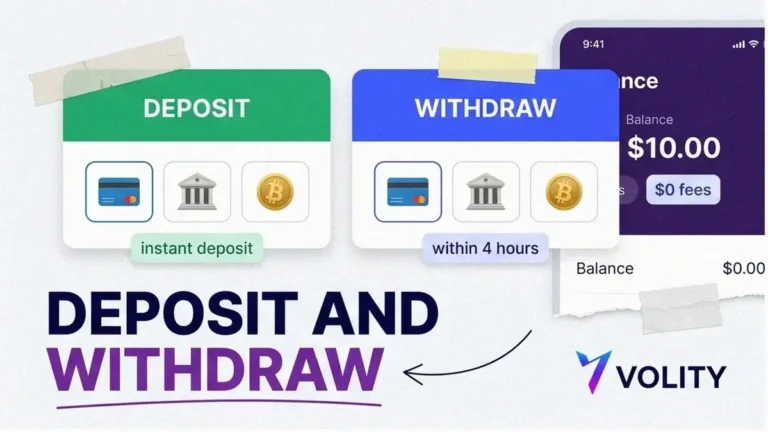
Once value is back inside your Volity wallet, the wallet’s own published terms take over and they are considerably simpler. Deposits and withdrawals run 24/7, the minimum is EUR 10, and withdrawals generally process within 4 hours. Withdrawal by BTC, ETH, USDT, Visa and Mastercard is free and instant, and the full schedule is published at charges and fees. None of that describes the venue’s leg, which is governed by the venue.
If you want the mirror image of this article, the funding guides for Polymarket and Hyperliquid walk the same route in the other direction, and the wider payments section covers moving money in and out of the wallet itself.
What can hold a withdrawal up
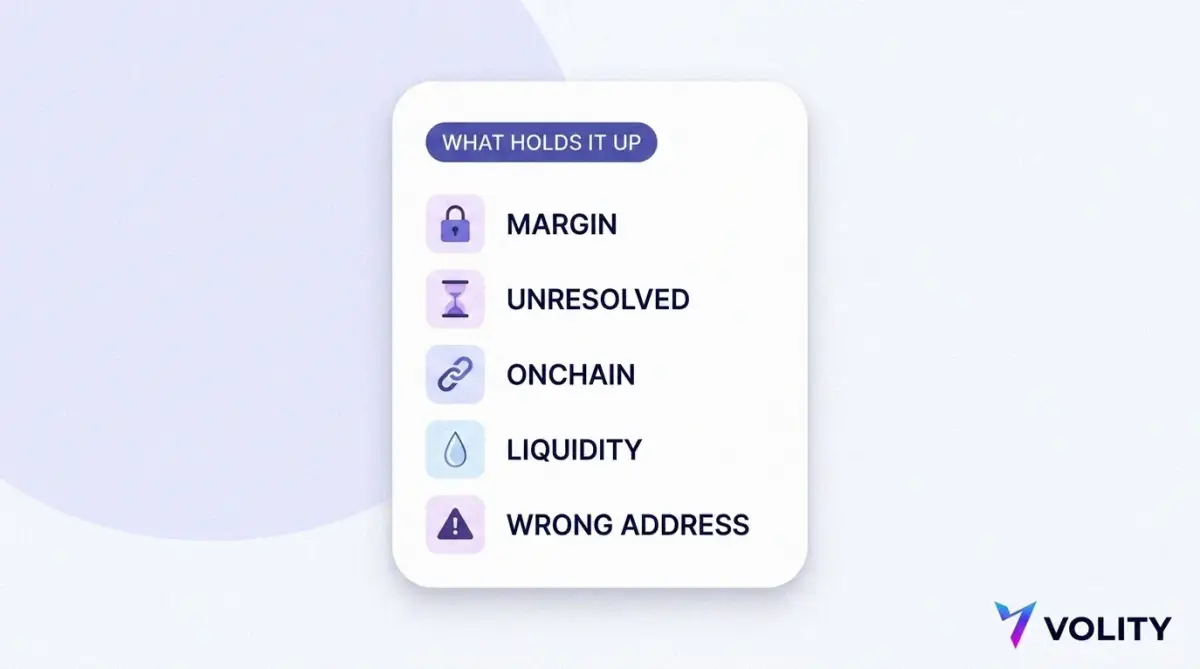
Most delays trace back to the same short list, and nearly all of it is visible before you start.
- Margin still committed. Covered above. The venue will not release collateral that is holding a live position.
- A market that has not resolved. Polymarket documents a two-hour challenge period after a resolution is proposed, a 24 to 48 hour debate period if it is disputed, and roughly 48 hours of UMA token holder voting if it escalates. A contract in that queue is not cash yet.
- On-chain confirmation. Blockchain settlement has its own rhythm. Polygon, where Polymarket balances live, reaches final settlement through periodic checkpoint submissions to Ethereum rather than instantly at the moment you press send.
- Thin liquidity on the way out. Polymarket’s withdrawal documentation notes that the unwrap from pUSD to native USDC routes through a Uniswap v3 pool, that the pool can be exhausted at times, and that the fix is to break the withdrawal into smaller amounts or wait for the pool to rebalance. It suggests the same for withdrawals over $50,000 to limit slippage.
- A wrong destination. Sending an asset to an address configured for something else is the one failure with no remedy. Hyperliquid warns specifically that each spot asset has its own unique transfer address and that sending a different asset to it will lose the asset.
Converting back out of the stablecoin
The money coming back is a dollar token rather than a bank balance, and the two venues do not use the same one. Hyperliquid margin is USDC on HyperCore. Polymarket’s collateral is pUSD, an ERC-20 token on Polygon backed by USDC and enforced on-chain by its onramp and offramp contracts, which is why a withdrawal there involves an unwrap step at all. The Volity product describes funding as delivered as USDC, which is what you experience at the client layer.
A stablecoin is, in Ethereum’s own words, a digital representation of a traditional currency you can buy at a 1:1 ratio and redeem with the issuer. Circle states that USDC is backed by highly liquid cash and cash-equivalent assets and always redeemable 1:1 for US dollars, with monthly third-party assurance. Regulators are formalising the category rather than leaving it alone: the Bank of England has published its policy positions on sterling-denominated systemic stablecoins, and the Financial Conduct Authority has consulted on a UK regime for stablecoin issuance and custody. A dollar stablecoin is not a bank deposit under any of them. If the collateral side interests you, our piece on USDC margin goes deeper.
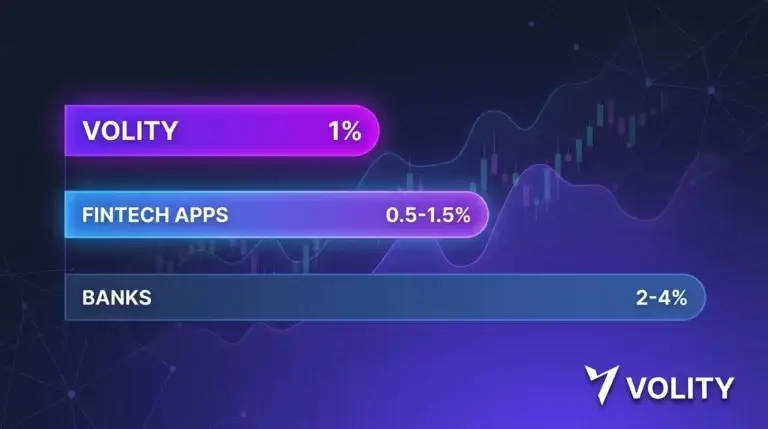
Converting back to your home currency inside Volity is a separate, ordinary step. An internal transfer in the same currency is free, and a currency conversion carries a 1% fee.
How to keep a withdrawal clean
Run the same short sequence every time and the return trip stops being interesting, which is the goal.
- Read the available balance, not the account value, and treat that as your ceiling.
- Close or reduce whatever you intend to close, then refresh the panel and read the number again.
- Withdraw a small test amount the first time you use a new destination address.
- Generate the withdrawal address at the moment you send, never in advance, and check the chain as well as the address.
- Split a large withdrawal into tranches rather than fighting slippage in one go.
- Keep the venue’s transaction record, since it is the venue that holds the funds and the venue’s terms that govern the withdrawal.
Frequently asked questions
How long does a withdrawal from a trading platform take?
That depends entirely on the venue, and neither venue’s timing is something Volity sets. Hyperliquid’s withdrawal passes through validator signing and a dispute period before finalisation. Polymarket describes its bridge withdrawals as instant. On-chain settlement adds its own confirmation behaviour on top. Treat any published timing as the venue’s current statement rather than a guarantee, and check the venue’s own page on the day.
Do I need to close my positions first?
You need to free up whatever the position is holding. On Hyperliquid the initial margin behind a cross margin position cannot be withdrawn while the position is open, so a full withdrawal means closing. On a prediction market an open position is outcome tokens rather than cash, so you either sell them, merge a balanced set back into collateral, or wait for resolution and redeem.
What if my funds are still tied up as margin?
Then that portion is not withdrawable, and the venue will decline the request rather than silently borrow against your position. Reduce or close the position to release the collateral. Hyperliquid also caps how much unrealised profit you can pull out while a position is open, requiring remaining margin of at least 10% of your total open notional.
Can I withdraw part of my balance?
Yes, partial withdrawals are normal at both venues, and splitting a large amount into smaller ones is what Polymarket’s own documentation recommends when liquidity on the exit route is thin. Leaving enough behind to keep any remaining position healthy is the part people forget.
What currency does the money arrive in?
It leaves the venue as a dollar stablecoin, because that is what these venues settle in. Hyperliquid withdrawals are denominated in USDC. Polymarket unwraps pUSD to USDC on the way out. Converting to your own currency happens afterwards inside your wallet, where a same-currency internal transfer is free and a currency conversion carries a 1% fee.
Balances and positions in this flow are held on the external platform, not by Volity, and trading, availability and withdrawals are subject to each platform’s own terms.