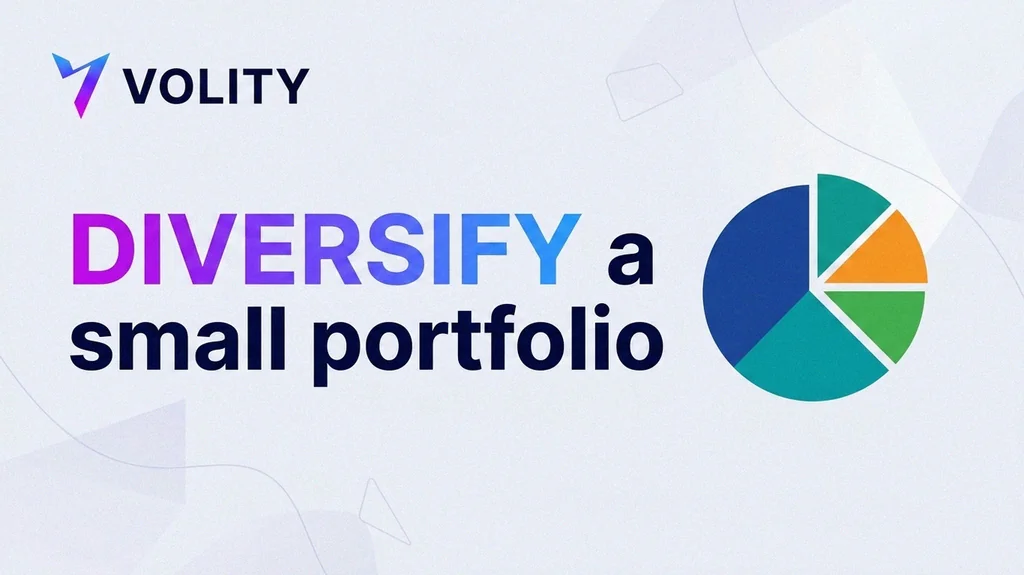
The biggest myth about diversification is that you have to be rich to do it. You do not. With a small balance, fractional shares and a couple of broad funds, you can spread money across thousands of companies, several industries and different regions in one account. This guide shows a beginner how to build that mix from a tiny amount, then keep it healthy without overtrading.
TL;DR / Quick insight: Diversification just means not putting all your money in one place, so a single bad holding cannot sink you. A small account can diversify because a fractional share lets a few dollars buy a slice of an expensive company, and one broad ETF (a basket fund) holds many companies at once. Spread across three axes – asset types, industries and regions – then top up the weakest slice once or twice a year instead of trading constantly. With Volity you do all of it in one commission-free account.
What follows is the plain-English version, with a step-by-step build you can run today on a demo or for real. Nothing here is personal advice – investing carries risk.
What diversification really means
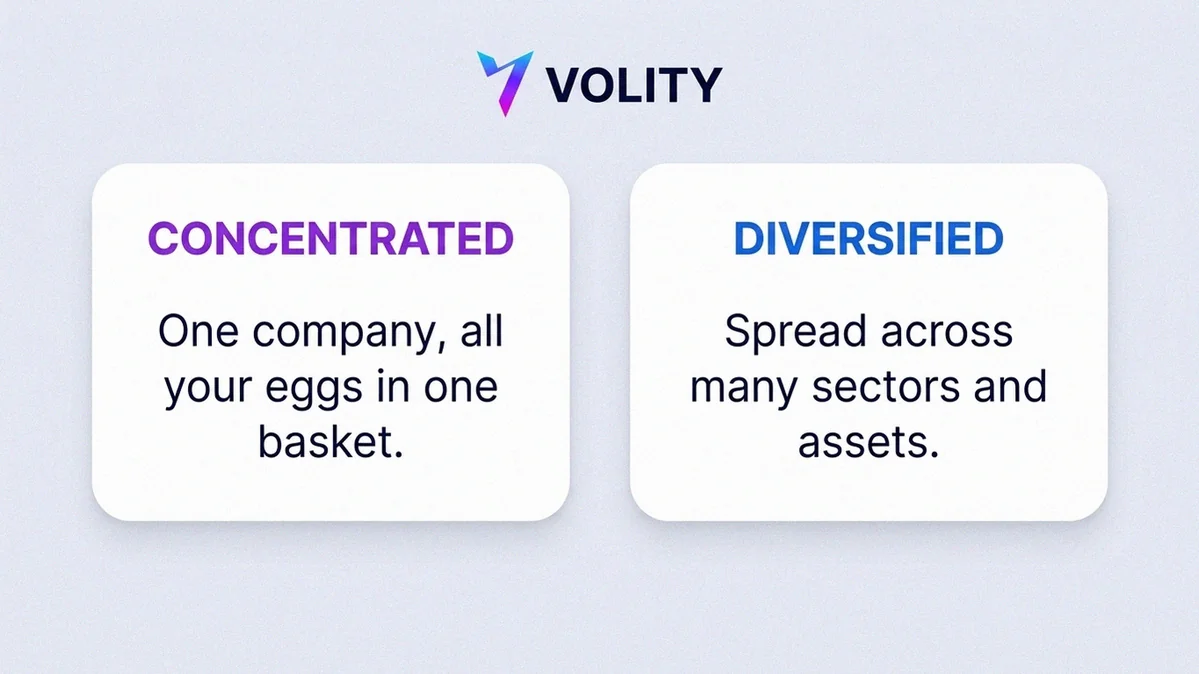
Diversification means spreading your money so no single holding can wreck you. If one company stumbles, the rest of your portfolio keeps you standing.
Here is the trap. Owning ten things is not diversification if all ten move together. Ten companies from the same industry in the same country rise and fall as one block. On paper you “own ten stocks”; in practice you hold one bet wearing ten name tags. The fix is to own things that move differently.
Look at what you own and ask yourself one question: do these holdings move differently, or are they the same bet in disguise?
Kill the “you need a big balance” myth
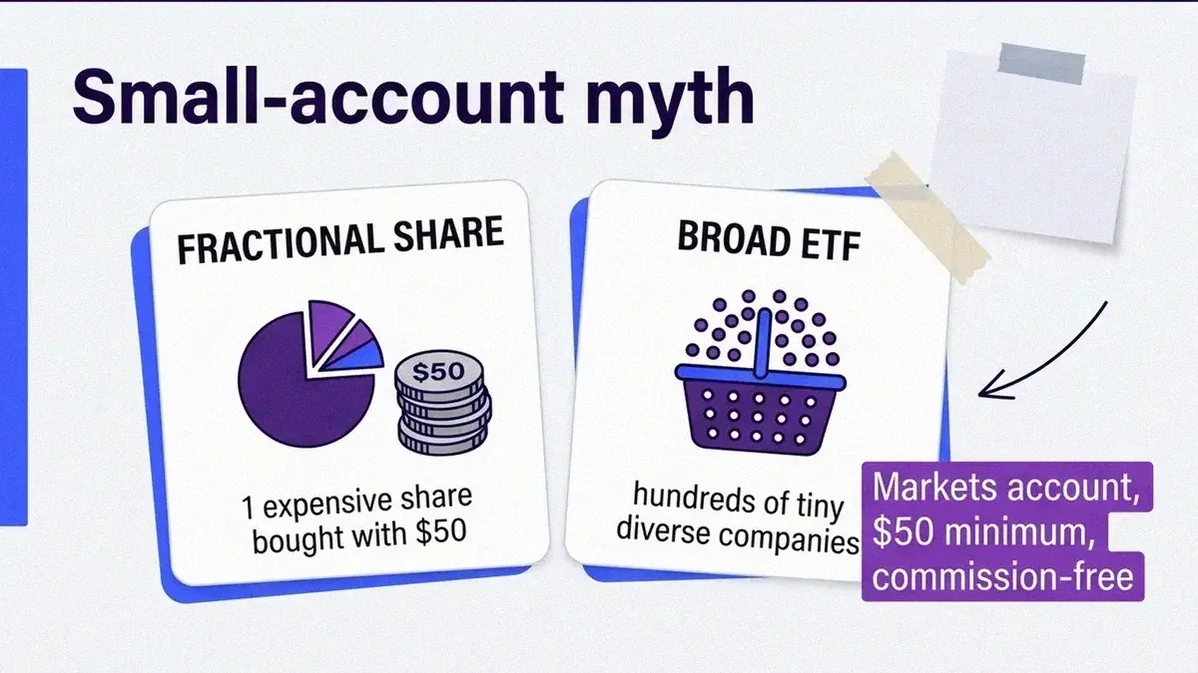
A diversified portfolio is not just for the wealthy. Two tools collapse the entry cost.
The first is the fractional share, a slice of one share. Instead of paying the full price, you buy a small piece with any amount, so a modest balance can touch dozens of companies rather than one.
The second is the ETF (exchange-traded fund), a ready-made basket. One purchase, and you own a tiny piece of every company inside. A single broad-market ETF can hold hundreds or thousands of companies. That is instant spread.
Put those together and the “small account” objection disappears. Volity suits this entry point. The Markets account has a minimum deposit of just $1, trading is commission-free, and you can hold real shares, fractional shares, crypto and CFDs in one login. (A CFD, or “contract for difference”, tracks a price without you owning the asset – handy to know, not essential here.)
Decide the small amount you can commit, then open a free demo and build a practice mix with zero money at risk. Every Volity tier has one.
Spread across assets, sectors and geographies
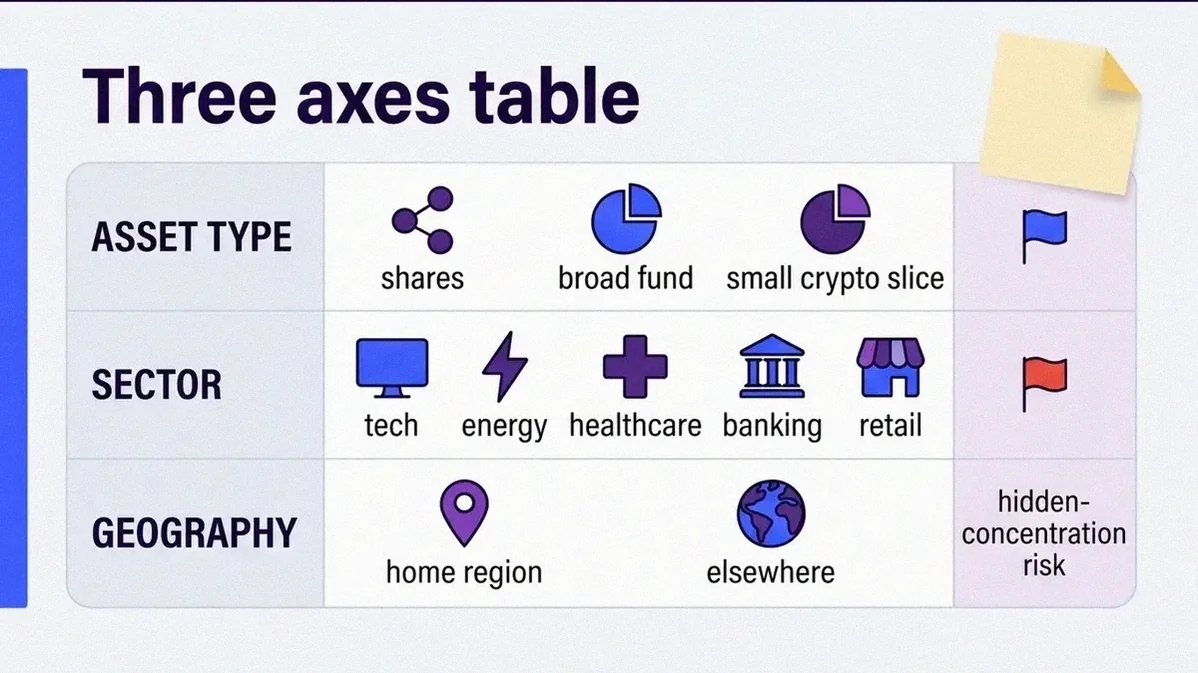
Forget fund shopping lists. The skill that lasts is a checklist with three axes. Spread along all three and you are diversified. Ignore one and you carry hidden concentration.
| Axis | Plain meaning | Risk if you ignore it |
|---|---|---|
| Asset type | Shares, a broad fund, a small slice of crypto. | One type only: a bad stretch for that type hits everything at once. |
| Sector | The line of business – tech, energy, healthcare, banks, retail. | All-tech: one industry’s bad news drags the whole account down. |
| Geography | The region a company operates in – home versus elsewhere. | One country’s wobble hits a single-region portfolio with no offset. |
A broad-market ETF often handles the sector axis in one move. Geography is the axis beginners forget most. It is easy to end up entirely in your home market.
Before you buy, sketch your target spread across the three axes on a single line. That sketch stops impulse buys.
The two tools do different jobs. A broad ETF is your core, one purchase that holds many companies across many sectors. A fractional share is your top-up, a slice of one company that fills a region your core runs light on.
This stays cheap on Volity because trading on the Markets account is commission-free, so small, regular buys are not eaten by per-trade charges, and a $0 wallet keeps cash ready. Fractional shares and ETFs are the small-account workhorses, which is why the Volity stocks hub builds on them.
Decide which slices the broad ETF covers and which the fractional shares handle. Settling each tool’s job first stops accidental overlap.
Build a simple diversified starter mix, step by step
This is a repeatable process, not a recommendation of holdings. Try the demo first.
- Set the goal and amount. Decide how much you commit now and how long you leave it.
- Pick a broad core. One broad-market ETF as your foundation gives wide sector spread from the start.
- Add a second region or asset. Use a fractional share for a region your core runs light on, or a slice of a different asset type.
- Size each slice sensibly. Keep the core largest and the experimental slices small. You spread risk, you do not chase it.
- Fund it from your wallet. With a $0 multi-currency wallet, deposits via card or crypto are free and instant.
- Place the orders in one account. Shares, fractional shares, crypto and CFDs all live together on Volity.
- Record what you bought and why. One line per holding covers what it is and which axis it serves.
Place your first small, diversified set of orders, or run the steps on the demo until they feel routine.
If you are deciding how much of your savings to move into gold, our gold vs savings account guide compares the two over five years and shows how to size a gold slice.
Rebalance without overtrading
Once your mix is live, it will drift. Some slices grow faster than others, and the portfolio tilts toward whatever has run hottest, which quietly undoes your spread. Correcting that drift is rebalancing, or nudging the mix back toward your plan.
The beginner mistake is to do this too often. Trading on every wobble racks up effort for no benefit. A calmer approach uses a set cadence, a couple of times a year, or whenever a slice drifts well away from your sketch. The gentlest fix tops up the laggard rather than selling the winners.
The second mistake is over-diversifying. Past a point, more holdings only create an expensive, hard-to-track collection. A few well-chosen positions beat fifty scattered ones.
Put a recurring rebalance reminder on your calendar, then leave the portfolio alone between reviews. The discipline to do nothing is itself a skill.
Run the first-portfolio checklist before every contribution
Run this each time you add money. Treat it as a standing pre-flight check.
- Have I set a clear goal and time horizon for this money?
- Is the amount one I am comfortable putting at risk?
- Do my holdings actually move differently, or are they the same bet repeated?
- Do I have a broad core doing the heavy diversification work?
- Asset-type axis covered – more than one kind of holding?
- Sector axis covered – more than one industry?
- Geography axis covered – more than one region?
- Is any single holding too large a share of the whole?
- Am I using commission-free buys and a $0 wallet to keep costs low?
- Is a rebalance date booked, and am I resisting trading between reviews?
If any line gets a “no”, fix that before you add money. The checklist catches concentration you cannot see while buying.
What to do next
Sketch your three-axis target, rehearse on the free demo, then fund from your wallet and place your first diversified orders in one account – shares, fractional shares, crypto and CFDs, plus a $0 wallet for ready cash. OPEN A VOLITY ACCOUNT to build your starter mix commission-free, or browse the trader education hub. Want the numbers first? SEE FEES AND ACCOUNT TYPES.
Reviewed by: A. Bennett, Volity editorial desk.
Data integrity: every product figure here (Markets minimum deposit, commission-free trading, $0 wallet, free demo, one account for shares, fractional shares, crypto and CFDs) is verified against Volity’s published account and fee docs.
Related Volity guides
- ETF vs index fund: which to pick
- Dollar-cost averaging explained
- Growth investing vs value investing
Related coverage on Volity
- Fractional Shares Explained: How to Start Investing With
- ETF vs Index Fund: The Difference and Which to Pick
- Dollar-Cost Averaging Explained: A Beginner Guide
- How to Size a Trade: Position Sizing and Risk Per Trade for Beginners
- How Much Money Do You Need to Start Trading? A Realistic Guide
Frequently asked questions
How do you diversify a portfolio with little money?
Use fractional shares and a broad ETF. A fractional share lets a few dollars buy a slice of an expensive company, and one broad ETF holds many companies at once. On Volity’s commission-free Markets tier, with a $1 minimum, you spread a small balance across many securities in one login. Practise on the free demo first.
How many stocks do you need to be diversified?
There is no single magic number, and be wary of anyone who states one as a hard rule. Many studies suggest a few dozen holdings that behave differently capture most of the benefit. The simpler route for a beginner is one broad ETF, which gives that spread in a single purchase.
Can you over-diversify a small portfolio?
Yes. Past a point, more holdings just create an expensive, hard-to-track collection with no extra protection. A few well-chosen broad positions beat fifty scattered ones. If you cannot explain why each holding is there, you have too many.
What is the simplest way to diversify?
Buy one broad-market ETF as your core, then add a small slice for a region or asset type it is light on using a fractional share. That covers all three axes without a long shopping list. Keep it commission-free and rebalance once or twice a year.
What does diversification actually protect against?
It protects against any single holding sinking your whole account. It does not remove market risk – if a whole market falls, a diversified portfolio can fall with it. What it does is stop one company, industry or region from being a single point of failure.
Sources
The guidance above draws on the following public sources.
- Investor.gov – asset allocation and diversification
- Investor.gov – how funds hold many companies
- Corporate Finance Institute – what diversification really means
- Corporate Finance Institute – how an ETF works
- arXiv (How to quantify the influence of correlations on investment diversification) – correlation decides real diversification
- arXiv (Sparse spanning portfolios and under-diversification) – research on under-diversified portfolios
- Euronext – browse listed ETFs
- World Federation of Exchanges – markets across different regions
- Financial Services Compensation Scheme – check your investment protection
- ASIC (Australian Securities and Investments Commission) – regulator guidance for retail investors