Should some of your savings move from the bank into gold? From end-September 2021 to late September 2026, EUR 10,000 in one-year deposits, renewed each September, grew to about EUR 10,882. In a physically backed gold fund charging 0.12% a year, it reached about EUR 24,686. After euro area inflation of about 23%, the deposit was worth about EUR 8,843 in 2021 money, while gold roughly doubled in real terms. Run your own numbers below and set your split.
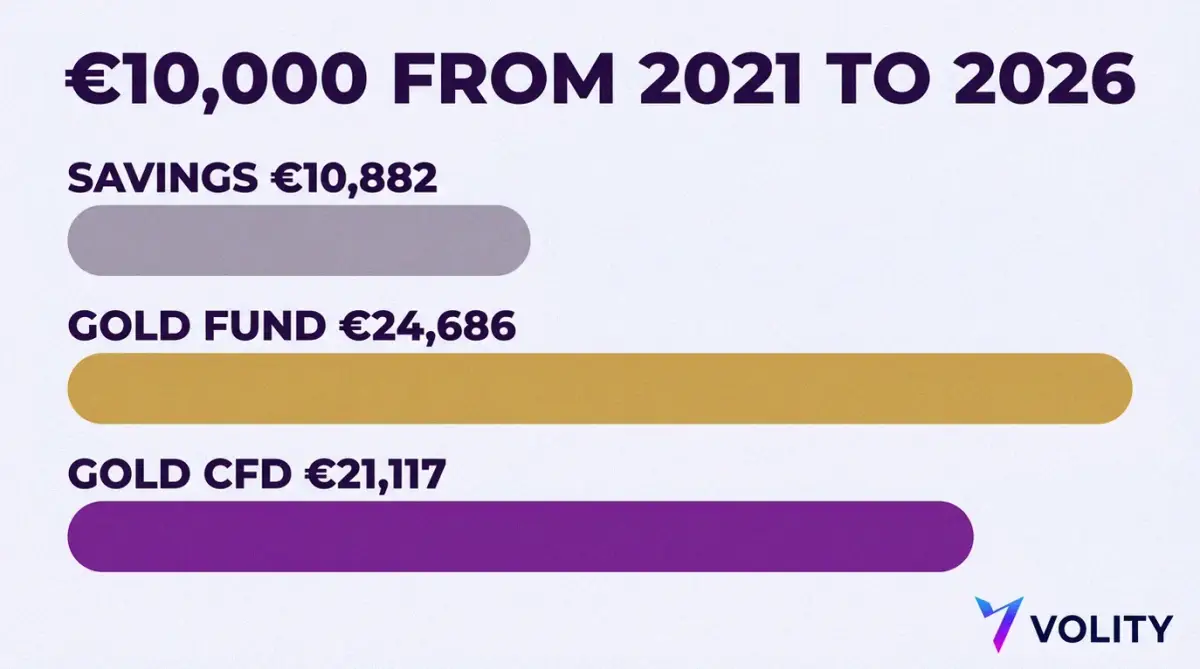
TL;DR: Between 30 September 2021 and 25 September 2026, EUR 10,000 became EUR 10,882 in one-year deposits, EUR 24,686 in a 0.12% gold fund and EUR 21,117 in a gold CFD held throughout after overnight financing (an illustration). Gold fell 23.2% in euros from March to July 2026 and pays no interest. Keep emergency money in a guaranteed deposit, size gold to a fall you could sit through, and keep CFDs for trades of days or weeks.
Figures come from the European Central Bank (deposit rates), Eurostat (inflation) and the LBMA Gold Price PM, London’s benchmark gold auction price. This gold vs savings account comparison is in euros, before and after inflation.
Run the five-year numbers on 10,000 euros
Each path runs from 30 September 2021 to 25 September 2026, the latest fixing when this guide was checked. “Real value” is what the result buys in 2021 prices. Euro area prices, measured by the harmonised index of consumer prices (HICP) behind the official inflation rate, rose 23.06% by August 2026: a basket that cost EUR 10,000 in 2021 cost EUR 12,306.
| Path | End value | Real value (2021 euros) | What it assumes |
|---|---|---|---|
| One-year deposits, renewed each September | EUR 10,882 (+8.8%) | EUR 8,843 (-11.6%) | ECB one-year household rates each September: 0.15%, 0.60%, 3.10%, 2.97%, 1.74% |
| Gold in a physically backed fund | EUR 24,686 (+146.9%) | EUR 20,060 (+100.6%) | LBMA Gold Price PM, EUR 1,505.08 to EUR 3,737.79, less 0.12% a year |
| Gold CFD held throughout (illustration) | EUR 21,117 (+111.2%) | EUR 17,160 (+71.6%) | No leverage, financing at the euro short-term rate plus 2.5%: EUR 3,717 |
An easy-access account reached only EUR 10,112 (EUR 8,217 in real terms) and a three-month notice account EUR 10,620 (EUR 8,630). Tax, which depends on where you live, is left out, as are dealing costs, spreads and storage.
Before you compare, write down what your own savings earned since 2021 and in which account. That, not the table’s best case, is your benchmark.
What a savings account paid from 2021 to 2026
Savers earned almost nothing at first. The ECB’s deposit facility rate, paid on money banks leave with the central bank overnight, steers what banks pay savers. According to the ECB’s official interest rates, it was -0.50% until 27 July 2022, peaked at 4.00% from 20 September 2023 and fell to 2.00% by June 2025. After a rise in June, the decision of 10 September 2026 took it to 2.50%.
Banks passed on only part of this. The average new rate on household deposits fixed for up to one year (a fixed deposit) rose from 0.15% in September 2021 to 3.33% in November 2023 and was 2.10% in July 2026, per the ECB release of 2 September 2026. Overnight deposits, meaning current accounts and most easy-access savings, paid 0.28% that month, and three-month notice accounts 1.18%.
| 12 months to end September | Deposit rate for the year | Inflation (HICP) | Gold in euros |
|---|---|---|---|
| 2022 | 0.15% | +9.93% | +13.65% |
| 2023 | 0.60% | +4.33% | +3.37% |
| 2024 | 3.10% | +1.75% | +33.21% |
| 2025 | 2.97% | +2.23% | +38.48% |
| 2026 | 1.74% | +3.15% (to August) | +14.59% (to 25 September) |
The deposit beat inflation in only two of the five years, gold in four. Keeping pace needed about 4.3% a year, every year, while the average one-year rate peaked at 3.33%. Eurostat puts August 2026 inflation at 3.2%.
What a deposit gives you is certainty. Under EU rules, up to EUR 100,000 per depositor at each bank is guaranteed, as the ECB and the European Commission explain, and the balance does not swing with markets. That makes a savings account the right home for an emergency fund.
Compare your rate with the ECB average for your account type and with inflation. Spare cash in a current account near the 0.28% average can earn more in a notice or fixed-term deposit.
What gold did over the same five years
The gold price five years ago, on 30 September 2021, was EUR 1,505.08 per troy ounce (gold’s standard unit) on the LBMA Gold Price PM. On 25 September 2026 it was EUR 3,737.79, up 148.3% in euros, or about 20.0% a year compounded, with each year’s gain building on the last. Past performance is not a reliable indicator of future results.
After a record fixing of USD 5,405.00 on 29 January 2026, gold lost 11.8% in euros in the next two trading days. From its euro high of EUR 4,537.54 on 2 March it fell 23.2% to EUR 3,486.77 on 16 July, and on 25 September it was still 17.6% below that high.
Longer history has worse: a 70.3% fall in dollars from 1980 to 1999, a 44.6% fall from 2011 to 2015 (the 2011 high was not regained until July 2020) and a 36.8% fall in euros in 2012-2013. Gold also pays no interest, so in a flat year it earns nothing while a deposit still pays.
To hold gold for years, the usual tool is a physically backed fund, in Europe mostly an exchange-traded commodity (ETC): a security that trades like a share and is backed by gold bars in a vault. The iShares and Invesco physical gold ETCs charge 0.12% a year, about EUR 148 over five years on EUR 10,000. Bars and coins avoid the fund charge but add dealer margins and storage costs. Physical gold vs gold ETFs compares both.
Before you buy, look at the 23.2% fall of 2026 and the 36.8% fall of 2012-2013 and ask whether you would have held on. If not, keep your gold slice small.
Why a gold CFD is a trading tool and not a five-year holding
A contract for difference (CFD) is an agreement with a broker to settle the change in a price in cash. You never own the gold, and you can go long (gain if it rises) or short (gain if it falls). CFDs are leveraged: you put down part of the position’s value as margin, and leverage magnifies losses as well as gains.
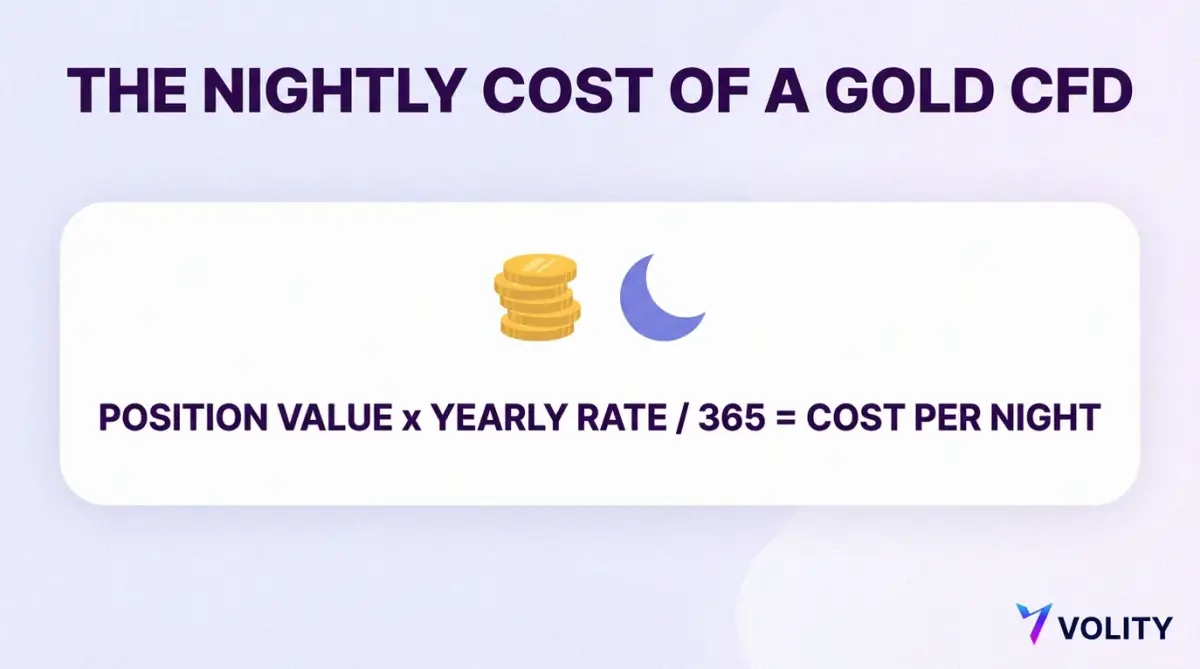
For long holdings, the cost that matters is overnight financing: interest charged every night on the full position value, not on your margin. The UK Financial Conduct Authority’s review of CFD providers calls it “a substantial ongoing cost for clients when they hold open CFD positions longer term” and found wide variations in rates.
CMC Markets gives the daily cost as units x price x yearly rate / 365. The yearly rate is a benchmark interest rate plus the broker’s markup: IG adds 0.8% a year on spot gold and CMC at least 3% on commodities, so published markups run from about 0.8% to 3% or more. The table applies this to EUR 10,000 of gold over the same window, unleveraged, with the euro short-term rate (what banks pay to borrow euros overnight) as the benchmark. The 2.5% row is an illustrative assumption, not any firm’s actual rate.
| Markup over the benchmark | Financing over five years | Value at the end |
|---|---|---|
| None | EUR 1,721 | EUR 23,114 |
| 0.8% | EUR 2,359 | EUR 22,475 |
| 2.5% (illustration) | EUR 3,717 | EUR 21,117 |
| 3.5% | EUR 4,516 | EUR 20,319 |
At 2.5% the CFD ended EUR 3,569 behind the fund, and the charge grew with the price, from EUR 228 in the first year to EUR 1,129 in the last. ESMA, the EU markets regulator, caps retail leverage on gold at 20:1, so EUR 500 of margin can open a EUR 10,000 position that is still financed in full. A 2.5% fall halves that margin, and at 50% of required margin the broker must start closing positions.
On Volity, the overnight fee applies to positions held past 22:00 GMT and can be positive or negative depending on direction and product. The rate for each instrument is shown on the platform. Before you open a gold CFD:
- Find the XAU/EUR or XAU/USD overnight rate for your direction.
- Multiply it by the full position value, not your margin.
- Divide by 365 for the cost of one night.
- Multiply by the nights you expect to hold.
- Compare the total with your target move and skip the trade if financing eats much of it.
- Set a stop-loss, an order that closes the trade at a price you choose, and practise on the free demo.
A CFD is built for trading gold’s moves over days and weeks, in either direction, with a stop and a plan, and that is the job a gold CFD on Volity is built for. Over several years the financing adds up. See also gold CFD trading and gold ETFs vs gold futures.
Work out your own numbers with the calculator
Enter your amount and the years, then change the savings rate, the yearly gold price change, the fund cost, the CFD overnight financing and inflation.
Gold vs savings calculator
The defaults approximate this article’s 2021 to 2026 figures. Change any input to test your own numbers. This is an illustration, not a forecast.
Adjusted for – a year inflation: savings –, gold fund –, gold CFD –. The CFD line assumes no leverage and overnight financing on the average position value in each year; it ignores spreads and tax.
Past performance is not a reliable indicator of future results. The value of gold can fall as well as rise.
The calculator shows each path's end value, the gain or loss, and the value after inflation. Try gold at 0% and at a negative rate, then your bank's current rate.
Decide how much of your savings belongs in gold
A strong five-year return is a poor reason to move all your savings. In the gold vs cash question, sequence matters more than size. World Gold Council research tested adding 2.5% to 10% gold to a hypothetical mix of 50% stocks, 40% bonds and 10% alternatives from December 2005 to December 2025. Across that range, gold raised risk-adjusted returns (return per unit of risk) and reduced the deepest falls, and at 5% gold it also cut volatility (how sharply values swing). That is research, not a rule, and nothing here is personal advice.
Size the slice from the fall. A 10% gold slice of EUR 10,000 is EUR 1,000, so a 37% fall costs EUR 370 of the total and a 23% fall EUR 230. Set your split in this order:
- Keep your emergency fund in a guaranteed bank deposit.
- Keep money you need within a few years in deposits too.
- Pick the largest fall you could sit through without selling.
- Size the gold slice so that fall hurts without forcing a sale, for example within the 2.5% to 10% range tested.
- Build the position in stages.
- Rebalance once a year: trim gold after a strong year, top it up after a fall.
Buying fixed amounts at regular intervals is dollar-cost averaging. See also gold vs the S&P 500, how to diversify a small portfolio and how to invest in gold for beginners.
Timing is a separate decision: our guide to whether it is a good time to buy gold covers buying in stages after the 2026 record, and the best gold trading platforms comparison shows what a gold trade costs on seven platforms.
Get gold exposure and keep your cash in one account
One Volity account holds your investing cash and your gold exposure. Cash waits in a $0 multi-currency wallet. Spot gold CFDs on XAU/USD and XAU/EUR, long or short, sit on the Volity gold trading platform. The Markets account is commission-free and starts from $1, with funding from EUR 10, and also holds real shares, fractional shares and crypto.
Crypto deposits and all withdrawals are free, and every account tier includes a free demo. Use it to check the live gold spread and the XAU/EUR overnight rate, then open your Volity account. Fees are on the charges and fees page and more guides in the gold section. For market insights, education and platform updates, subscribe to Volity's "Start Your Days Smarter" at the foot of this page.
Fact check: Gold prices are the LBMA Gold Price PM, cross-checked with World Gold Council data. Deposit rates are ECB household statistics to July 2026, and inflation is Eurostat's HICP to August 2026. Fund costs come from issuer pages, CFD rules from the FCA, ESMA and broker pages. Figures checked on 28 September 2026. The CFD result is an illustration.
Frequently asked questions
Is gold better than a savings account?
Over 2021-2026 it returned far more: EUR 10,000 became EUR 24,686 in a 0.12% gold fund against EUR 10,882 in one-year deposits. But gold fell 23.2% in euros in 2026, while a deposit is guaranteed up to EUR 100,000 and holds its euro value. Keep deposits for money you may need.
How much would 10,000 euros in gold five years ago be worth now?
About EUR 24,834 before costs, from EUR 1,505.08 per ounce on 30 September 2021 to EUR 3,737.79 on 25 September 2026 (LBMA Gold Price PM). GBP 10,000 became about GBP 24,871 and USD 10,000 about USD 24,449.
Should I put all my savings in gold?
No. Keep your emergency fund and money you need within a few years in a guaranteed deposit first. Gold fell 44.6% in dollars in 2011-2015 and 70.3% in 1980-1999, took years to recover, and pays no interest while you wait.
Is a gold ETF safer than a savings account?
The risks differ. A deposit is guaranteed up to EUR 100,000 per depositor and holds its euro value. A physically backed gold fund owns real bars, but its price moves with gold, down 23.2% in euros from March to July 2026. In Europe most are ETCs rather than ETFs.
Can I lose money on gold?
Yes. Gold fell 23.2% in euros from 2 March to 16 July 2026 and 36.8% in 2012-2013. With a leveraged CFD, losses come faster because a small fall eats a large share of your margin. Hold only gold you could leave alone through such a fall.
How do I start investing in gold with a small amount?
For a holding of several years, the lowest-cost physically backed gold funds charge about 0.12% a year. To trade gold's moves over days or weeks, a Volity Markets account starts from $1, with funding from EUR 10, and offers XAU/USD and XAU/EUR CFDs. Try the free demo first.