If you hold shares that pay dividends, you face a simple fork every payday: take the cash, or buy more shares with it. A dividend reinvestment plan automates the second choice, turning each payout into extra shares without you lifting a finger. This guide explains how a DRIP works, who it suits, when cash is smarter, and why small accounts gain the most.
TL;DR / Quick insight: A dividend reinvestment plan takes the dividends a holding pays you and automatically buys more of that holding instead of paying out cash. Reinvested shares then earn their own dividends, so your position compounds over time. It suits long-horizon investors who do not need the income now, and it shines on small balances where fractional shares let every small payout buy a sliver more. On Volity you can reinvest commission-free in one account.
Nothing here is personal advice – investing carries risk, and dividends are never guaranteed.
What a dividend reinvestment plan is, in one line
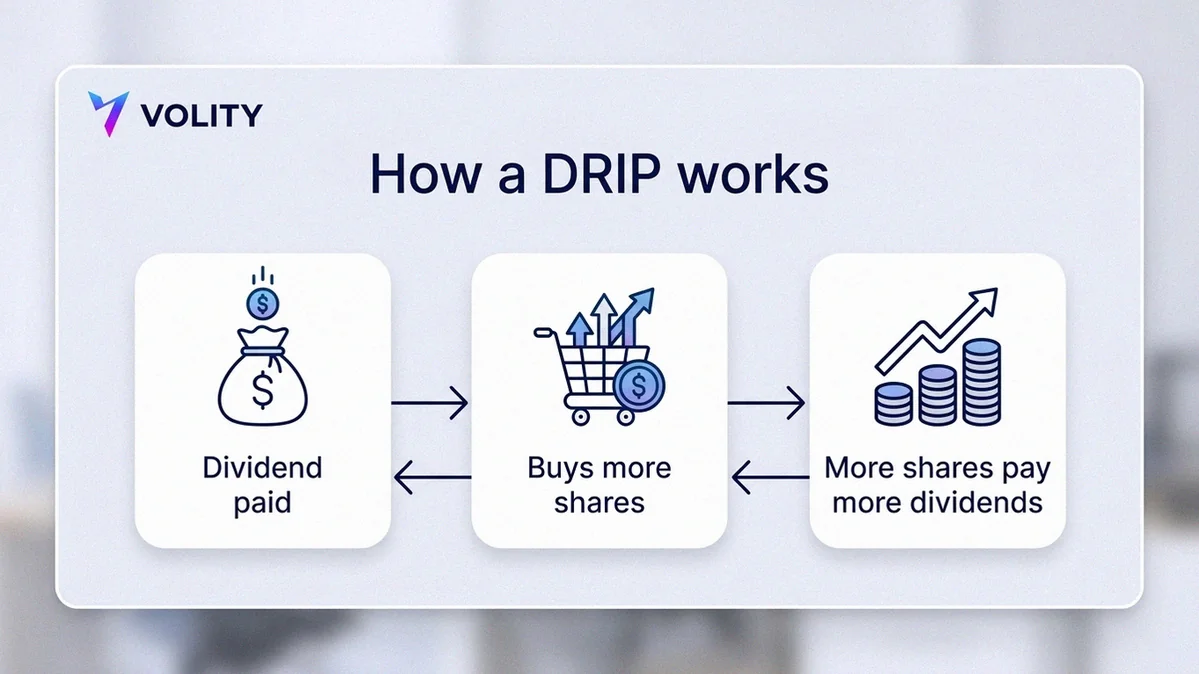
A dividend reinvestment plan is a standing instruction that uses each dividend to buy more of the share or fund that paid it, instead of depositing the money as cash.
Picture a share that pays a small dividend every quarter. Normally that money lands in your wallet and waits. With a DRIP on, the platform takes that payout the moment it arrives and buys a little more of the same holding automatically, so your share count creeps up each payday with no order to place. That is the whole mechanism, and the appeal is what happens when you repeat it for years: the holding grows itself.
How a DRIP actually works, step by step
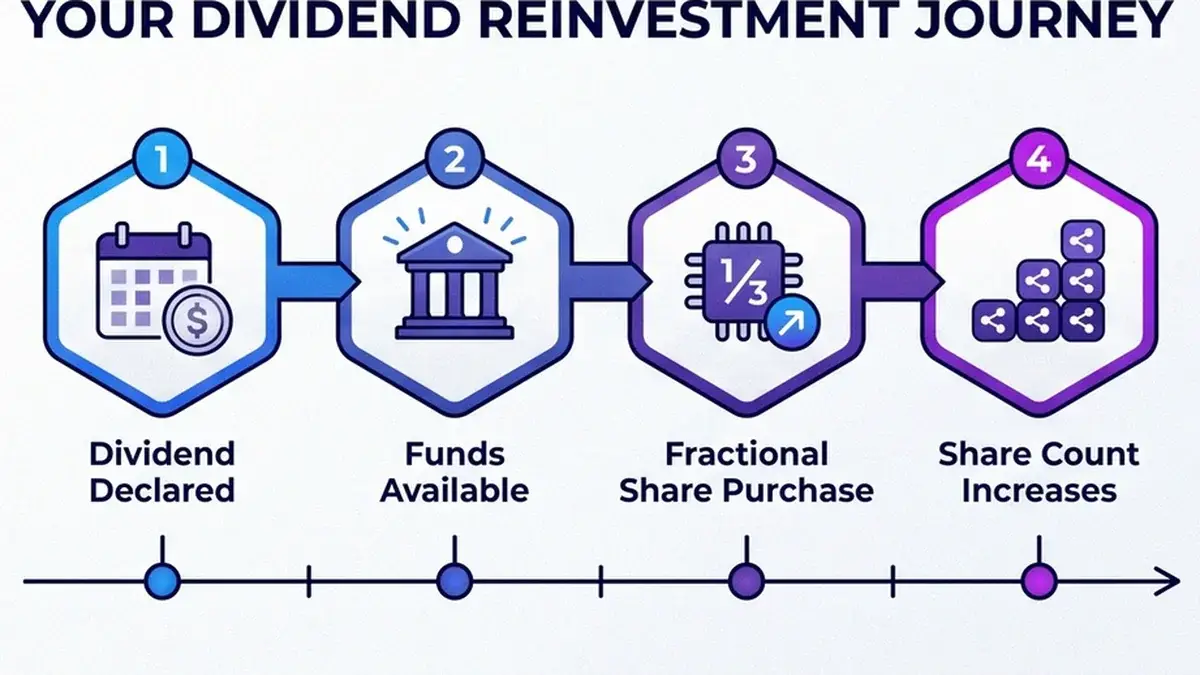
Here is the cycle a reinvested dividend runs through.
- A company or fund declares a dividend for everyone who holds the share on a set date.
- On the pay date, your share of that dividend is calculated from how many shares you own.
- Instead of sitting as cash, that amount is routed straight back into buying more of the same holding.
- Because the payout rarely matches a whole share price, the platform buys a fractional share so none of the money idles.
- Your position is now slightly larger, so the next dividend is calculated on a bigger holding.
Step five is the engine. Each cycle you own a touch more, so the next payout is worked out on a larger base. Left alone over years, that loop is what people mean when a dividend reinvestment plan compounds your stake. The free demo on every Volity tier lets you watch it first.
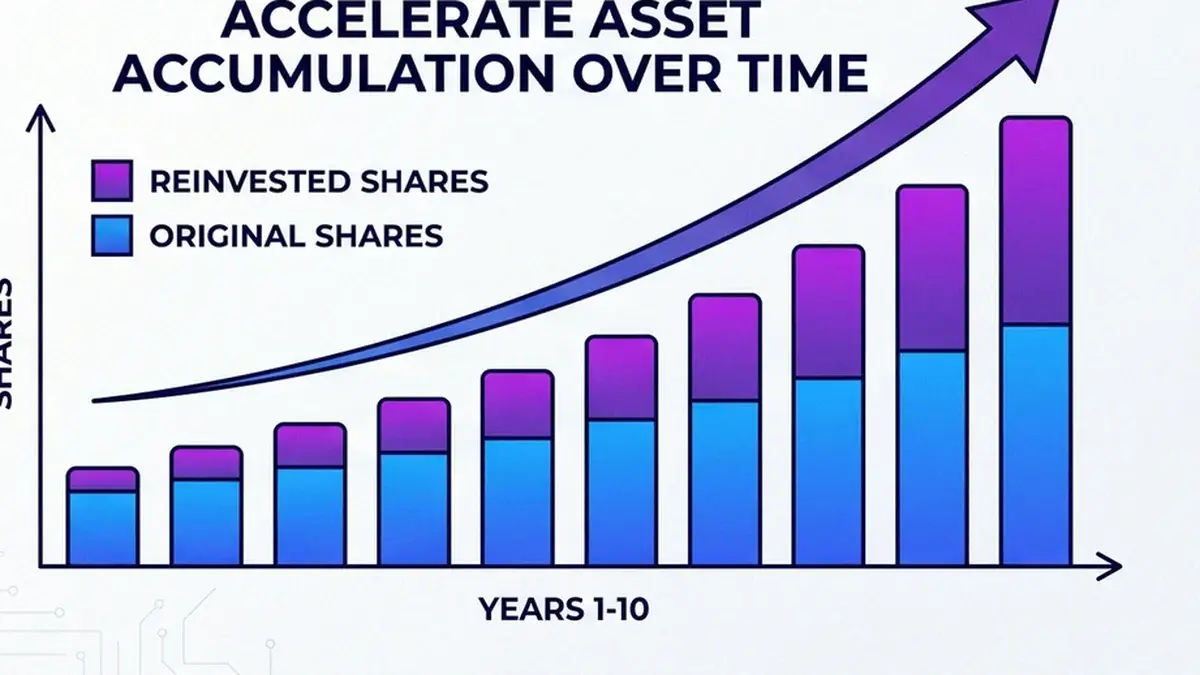
Reinvesting matters because of one quiet idea: dividends that buy shares go on to earn their own dividends. The growth feeds itself.
Take a holding worth 1,000 in your currency that pays 4 in dividends a year, purely as an illustration. Reinvest that 4 and next year your dividend is figured on roughly 1,004. The extra is tiny at first, but each year the base grows and the share count climbs. Over a decade or two, that slow build becomes the bulk of your return.
Reinvesting also removes two human weak spots. You never forget to put the money to work, and you are not tempted to spend a payout that felt too small to bother with. The caveat is that compounding needs time, and reinvesting multiplies whatever the underlying does; it is no shield against a poor holding.
When taking dividends as cash makes more sense
Reinvesting is not always the right answer. Cash wins in a few real situations.
If you actually need the income now, take the cash. Someone drawing on a portfolio to top up spending should not be quietly buying shares with money they mean to live on. The same goes for anyone near a goal who wants to lower risk rather than add to it.
Cash also helps when you want control over where new money goes. Reinvesting always feeds the same holding, which can slowly overweight one position. If a share has grown too large, taking the dividend as cash and directing it elsewhere keeps your spread healthier.
| Question | Lean towards reinvesting | Lean towards cash |
|---|---|---|
| Do you need the income now? | No, this money can sit for years. | Yes, you draw on it to spend. |
| Is the holding already a big slice? | No, it is a sensible size. | Yes, reinvesting would overweight it. |
| Your time horizon? | Long, you are building. | Short, you are winding down risk. |
Run those questions against each holding. The answer can differ from one share to the next, so reinvest some and take others as cash.
This is where small accounts used to lose out. A dividend is often a handful of units in your currency, far less than a whole share price, so without fractional shares it could buy nothing and the loop stalled.
Fractional shares fix that. A fractional share is a slice of one share, so even a small dividend buys a sliver more of the holding. No payout is too small to put to work, so the loop runs at full strength on a modest balance.
Cost is the other half. If every reinvestment carried a commission, small payouts would be swallowed by fees, which is why commission-free trading matters so much here. On the Volity Markets account, trading is commission-free with a minimum deposit of just $1, fractional shares are built in, and the $0 multi-currency wallet keeps cash ready. Together those make small-balance reinvesting genuinely cheap.
How to set up reinvestment on Volity
Rehearse on the free demo until the flow feels routine, then switch to real money.
- Open an account and complete KYC. You will need ID, proof of address and source of funds, and you must be 18 or over.
- Fund the account from your wallet. Crypto deposits are free and instant, card deposits carry a 2.99% fee, and the Markets entry minimum is just $1.
- Buy the dividend-paying shares or fund you want, using fractional shares to size each position.
- Choose reinvestment for that holding so future dividends buy more shares rather than cash.
- Reinvest the long-term positions and leave any income you need set to pay out as cash.
- Review once or twice a year to check no holding has grown into too large a slice.
Because trading is commission-free and custody is free, the running cost of a reinvestment habit stays close to nothing.
Is a DRIP right for you? A quick checklist
Run this before you switch reinvestment on for any holding.
- Can this money genuinely sit for years without you needing to spend it?
- Do you believe in the holding enough to keep buying more of it automatically?
- Is the position a sensible size, so reinvesting will not overweight it?
- Are you using fractional shares so every payout, however small, gets put to work?
- Are your reinvestment buys commission-free, so fees do not eat small dividends?
- Have you booked a yearly review to check the holding has not grown too large?
- Are you clear that dividends are not guaranteed and the holding can still fall?
If a line gets a firm “no”, lean towards taking that dividend as cash.
What to do next
Pick the holdings you want to grow for the long run, rehearse on the free demo, then fund from your wallet and switch reinvestment on in one commission-free account, with fractional shares so no payout is wasted. OPEN A VOLITY ACCOUNT to start reinvesting, or browse the stocks hub. Want the numbers first? SEE FEES AND ACCOUNT TYPES.
Reviewed by: A. Bennett, Volity editorial desk.
Data integrity: every product figure here (Markets entry minimum of $1, commission-free trading, fractional shares, $0 multi-currency wallet, free custody, free demo, one account for shares, crypto and CFDs) is verified against Volity’s published account and fee docs.
Related Volity guides
Related coverage on Volity
- Dividend Investing for Beginners: How to Start
- Dollar-Cost Averaging Explained: A Beginner Guide
- Fractional Shares Explained: How to Start Investing With
- ETF vs Index Fund: The Difference and Which to Pick
- What Is a P/E Ratio and How to Use It
Frequently asked questions
Is a dividend reinvestment plan worth it?
For a long-horizon investor who does not need the income now, usually yes. Reinvested dividends buy more shares that earn their own dividends, so the holding compounds over years. It is less worthwhile if you need the cash to spend, or if reinvesting would overweight one position.
Do you pay tax on reinvested dividends?
In many places a dividend can still be taxable even when you reinvest it, because you received income that was then used to buy shares. Tax treatment depends entirely on your country of residence and your situation, and rules change. This is general information, not tax advice, so check your local rules or an adviser.
Can you turn a DRIP off?
Yes. Reinvestment is a setting you control per holding, not a lock-in. Switch it off whenever you like to have future dividends pay out as cash, or turn it back on later. Shares already bought through reinvestment stay yours; the change only affects how the next dividend is handled.
Does reinvesting dividends beat taking the cash?
Over a long horizon, reinvesting tends to build a larger position than taking cash, because each reinvested payout earns future dividends of its own. That edge depends on time and on the holding doing reasonably well. It is not a guarantee, and cash is the better choice when you need income or want to avoid overweighting one share.
How small a balance can use a dividend reinvestment plan?
A very small one, thanks to fractional shares. Because a fractional share lets even a tiny dividend buy a sliver more of the holding, the loop works on a modest balance, not just a large one. On Volity’s commission-free Markets tier, with a $1 minimum and a $0 wallet, small-balance reinvesting stays genuinely cheap.
Sources
The guidance above draws on the following public sources.
- Dividend reinvestment plan (Wikipedia) – how a DRIP works
- Dividend (Wikipedia) – declaration, record and pay dates
- Nasdaq – a real dividend payment history
- Nasdaq – check a share's dividend record
- Compound interest (Wikipedia) – the maths behind reinvesting
- arXiv (Non-Stationary Dividend-Price Ratios) – research on dividend yields over time
- ASIC (Australian Securities and Investments Commission) – regulator guidance on income investing