HK50 is the CFD ticker for the Hang Seng Index, Hong Kong’s benchmark. It tracks the largest companies listed on the Hong Kong Stock Exchange, weighted heavily towards Chinese technology and finance. Trading it as a CFD lets you take a position on the whole index from one order on Volity MT, long or short, without owning a single Hong Kong share. The name is a leftover from the days when the index held about 50 members. It has grown since, but the HK50 label stuck.
What is the HK50?
The HK50 is the trading ticker for the Hang Seng Index, the main gauge of the Hong Kong stock market. Hang Seng Indexes Company has compiled it since 1969, and it covers a basket of the largest and most liquid companies quoted in Hong Kong. It is one of Asia’s most watched benchmarks and a quick read on how investors feel about Chinese business, because many of its members are mainland China giants that chose Hong Kong for their listing. Across platforms you will also see it written as HSI, Hang Seng or Hong Kong 50. They are the same index, and HK50 is simply the generic CFD label. If index products are new to you, our guide to what an index is covers the groundwork first.
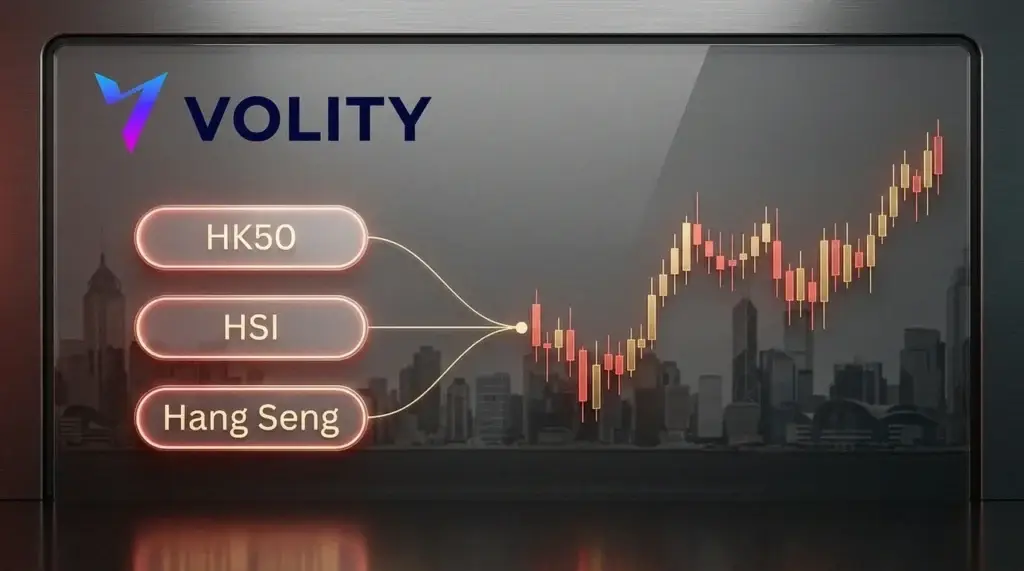
Why is it called the “50” when the Hang Seng has more members?
The number is a historical hangover. For most of its life the Hang Seng held around 50 constituents, and the HK50 ticker was coined in that era. A reform that began in 2021 started widening the index towards a target of up to 100 companies, so today it carries closer to 80 members. The HK50 name survived the change and is still what most trading platforms print. One thing worth keeping straight: the Hang Seng Index is not the same as the Hang Seng China Enterprises Index, a separate benchmark built around mainland “H-share” companies. When you trade HK50, you are trading the flagship Hang Seng, not the China Enterprises version.
What companies are in the HK50?
Two blocks dominate the HK50: Chinese internet and technology groups, and Hong Kong and Chinese financials. A single-constituent cap stops the very largest names from swamping the index, but the tilt towards tech and banks is unmistakable. The table below groups the best-known members by sector.
| Sector | Representative HK50 members |
| China internet and technology | Tencent, Alibaba, Meituan, Xiaomi, JD.com |
| Banks and insurance | HSBC, AIA, China Construction Bank, ICBC, Ping An |
| Exchanges and telecom | Hong Kong Exchanges and Clearing, China Mobile |
| Autos and industry | BYD and other mainland industrial names |
Because the tech and financial weights are so large, the HK50 tends to swing on the fortunes of a handful of megacaps. A sharp move in Tencent or Alibaba can carry the whole index, which is why traders watch those names closely even when the headline is about the broader market.
What moves the HK50?
More than any other major index, the HK50 answers to decisions made in Beijing. Chinese economic policy, stimulus announcements and regulation of the technology sector can send it sharply in either direction. Money flowing from mainland investors through the Stock Connect scheme adds another lever, and so does the health of the Chinese property market, where several past shocks began. Relations between the United States and China feed in too, given the trade and technology links at stake, and daily Hang Seng moves often track the latest headline on that front.
Currency is a smaller factor here than you might expect. The Hong Kong dollar is pegged to the US dollar within a set band, so the index is not buffeted by a floating exchange rate the way the Japanese benchmark is. What you are left with is a headline-driven market that can move fast, which cuts both ways for anyone trading it.
What are the HK50 trading hours?
The Hong Kong cash market runs in two sessions with a lunch break: a morning session from 09:30 to 12:00 and an afternoon session from 13:00 to 16:00 Hong Kong time, opened by a pre-market auction from 09:00 and closed by an auction shortly after 16:00. You can check the current windows on the HKEX trading hours page. Hong Kong sits eight hours ahead of the UK, so in winter the cash session runs from roughly 01:30 to 08:00 UK time. Hang Seng index futures add a long after-hours session that stretches into the early hours of the next Hong Kong morning, which is why an HK50 CFD feed usually quotes across a far wider window than the cash market alone. For UK and European traders, the practical point is simple: most of the Hong Kong session happens overnight.
How do you trade the HK50 as a CFD?
You trade the HK50 as a contract for difference that follows the Hang Seng level, with no Hong Kong shares changing hands. One position hands you exposure to the entire basket, and you can go long if you expect the index to climb or short if you expect it to fall. The index is quoted in Hong Kong dollars, so your profit and loss build up in HKD before conversion to your account currency. Index CFDs are leveraged, which lets a small deposit control a larger position. Volity offers leverage of up to 1:500 depending on the instrument, and because leverage magnifies losses just as much as gains, position sizing matters more on a market this headline-driven than on a quieter one. Our wider guide to how to trade indices walks through the same discipline across the major benchmarks.
Volity gives you global index CFDs on a single account, so you can trade index CFDs on Volity and hold an Asia-Pacific benchmark like the HK50 next to other world indices, forex, commodities and crypto. Execution is CySEC regulated under UBK Markets (licence 186/12). You can open an account for free, practise on a demo, fund from as little as $1 and start trading from $1.
What does it cost to trade the HK50?
Three costs matter on an HK50 CFD. The first is the spread, the gap between the buy and sell price, quoted in index points. It is usually widest overnight and around the Hong Kong open, when liquidity in the underlying is thinner. The second is overnight financing, a swap charge or credit applied when you hold a position past the daily rollover, since leverage means you are effectively borrowing to fund the full exposure. The third is a dividend adjustment: you own no shares and collect no dividends directly, but when index constituents pay out, an adjustment is applied to open positions to keep the CFD price fair. Weekend and holiday gaps are worth planning for as well, because Hong Kong observes its own market holidays and the index can reopen at a different level after a long break. The current spreads, swap rates and margin sit on the charges and fees page. Leverage restrictions set by regulators such as ESMA and the FCA shape how much retail clients can use, and they exist precisely because a fast index like this one can move against an oversized position quickly.
Related guides
Frequently asked questions
Is HK50 the same as the Hang Seng Index?
Yes. HK50 is a trading ticker for the Hang Seng Index, Hong Kong’s benchmark of the largest companies on the Hong Kong Stock Exchange. You will also see it as HSI or Hong Kong 50. All three point to the same index; the label just depends on the platform.
Why is it called HK50 if it has more than 50 companies?
The Hang Seng held around 50 members when the HK50 ticker was coined. A reform from 2021 is widening it towards up to 100 companies, so it now carries closer to 80, but the HK50 name stuck on trading platforms and is still in common use.
What are the HK50 trading hours?
The Hong Kong cash market trades 09:30 to 12:00 and 13:00 to 16:00 Hong Kong time, which is roughly 01:30 to 08:00 UK time in winter. Hang Seng futures add a long after-hours session, so an HK50 CFD feed quotes across a wider window and most of the action falls overnight for UK and European traders.
Can I trade the HK50 on Volity?
Yes. Volity offers the HK50 as a CFD on Volity MT, letting you trade Hong Kong’s benchmark long or short alongside forex, commodities and crypto on one account, with leverage of up to 1:500 depending on the instrument and CySEC-regulated execution under UBK Markets. Open an account for free or start on a demo, fund from $1 and trade from $1. Index CFDs are leveraged and carry risk, so size positions from your own risk tolerance.