Investing in financial products involves risk. Losses may exceed the value of your original investment.
There are two ways to buy Netflix stock, and they work very differently. You can own NFLX shares outright through a share-dealing account, or you can trade the Netflix share price with a contract for difference (CFD), which lets you go long or short with leverage. Volity sits firmly in the second camp: you get CFD price exposure to Netflix, not a share held in a brokerage account, and you trade it next to forex, crypto and indices from one login.
CFDs are leveraged products. They can amplify both your gains and your losses, and you can lose more than the money you put in if the market moves against you. This guide covers both routes, the exact steps to place a trade, what UK buyers should know, and how to keep the risk under control before you commit anything.
What happens when you buy Netflix stock?
Netflix, Inc. trades on the Nasdaq exchange under the ticker NFLX. Buy the actual share and you own a small slice of the company: you may get voting rights, and you can hold it for as long as you like. That is the classic buy-and-hold approach, and it is what most people mean by investing in Netflix.
Trade a CFD and you own nothing. You open a contract that tracks the Netflix share price, so your profit or loss is the gap between where you get in and where you get out. Active traders often prefer this route because going short is as easy as going long, and you only put down a fraction of the position value as margin. One detail worth knowing: Netflix ran a ten-for-one stock split in November 2025, announced by the company the month before, which cut the per-share price to a fraction of its former level and made a single share far more affordable. To read the live price, pull up the NFLX quote on Nasdaq before you plan a trade.
How to buy Netflix stock online, step by step
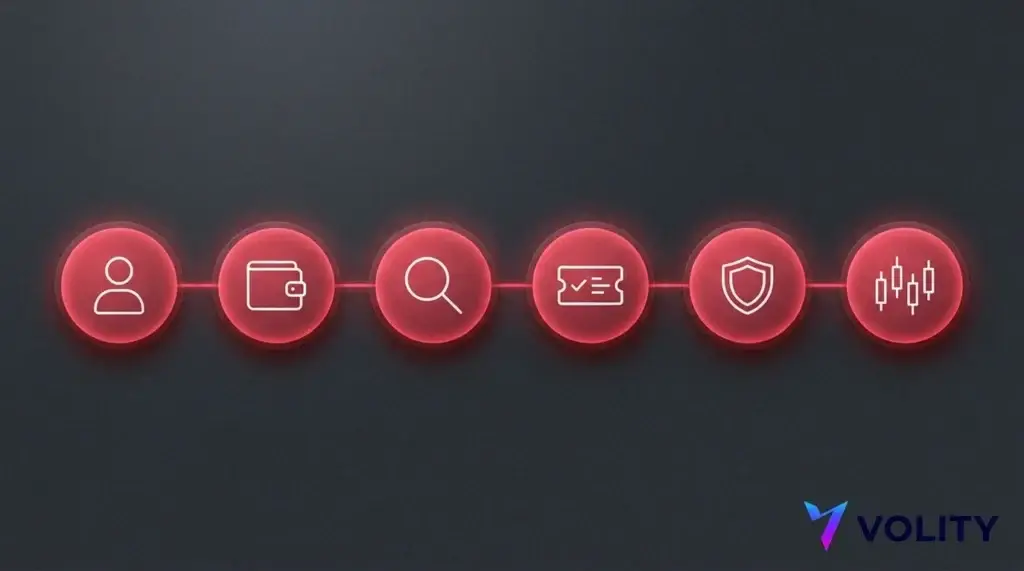
The mechanics are similar whether you buy the share or trade the CFD. Here is how the process runs on a regulated platform such as Volity:
- Open and verify an account. Register and clear the KYC identity checks. Opening a Volity account costs nothing, and you can rehearse on an unlimited demo before you risk real money.
- Fund the account. Add money by card, bank transfer or crypto, and pick the currency you want to trade in. Live funding starts small, from $1 to invest or $1 to start trading.
- Search the ticker. Type NFLX into the instrument search to open the Netflix chart.
- Choose your order type. A market order fills at the current price, while a limit order fills only at a price you set. Netflix can move sharply around results, so a limit order gives you more control.
- Set your size and stop. Decide how much you are willing to lose on the trade, then size the position from your stop-loss distance rather than from a hunch.
- Place the order and manage it. Confirm the trade, then watch it. Trail your stop to protect a profit, and review every position once it closes.
Both are legitimate ways to buy shares in Netflix, and they suit different goals. If you want to hold NFLX for years and ride the long-term story, owning the share makes sense. If you want to trade shorter moves in either direction with leverage, a CFD makes sense. The table sets the two side by side.
| Feature | Owning NFLX shares | Trading a Netflix CFD (Volity) |
| Ownership and voting | Yes | No |
| Go short (profit if price falls) | Hard for retail | Native, one click |
| Leverage | Usually none | Up to 1:500 overall, much lower on single shares |
| Dividends | None (Netflix reinvests profits) | Not applicable |
| Best for | Long-term investors | Active traders, hedgers |
| Held alongside | A separate broker | Forex, crypto, indices in one account |
Working out how to buy shares in Netflix really comes down to matching the route to your time horizon. A five-year holding and a five-day trade are different jobs, and they call for different tools.
Netflix is a US-listed company, so UK buyers reach it in one of two ways. Most platforms show NFLX in US dollars and convert your balance, though a few display a sterling equivalent, so when you check the Netflix share price in the UK you are usually reading a dollar price. Because the share is priced in dollars, the GBP/USD exchange rate affects your return as much as the share price does.
To own the actual share, a UK share-dealing account with access to international markets lets you hold NFLX and, if you want, shelter it in a Stocks and Shares ISA. To trade the price instead, a CFD account lets you go long or short on the Netflix share price in the UK without owning the underlying. If your aim is active trading rather than a decade-long hold, the CFD route on Volity keeps Netflix beside your other markets and settles in the currency you choose.
Nobody can reliably say where NFLX will trade next quarter, and any price target you read online is an opinion, not a fact. What you can do is understand the drivers. Netflix tends to react to subscriber and engagement trends, revenue growth and operating margin, the pace of its ad-supported tier, spending on content and live events, competition from other streamers, and the wider macro backdrop of interest rates and risk appetite. Because a large share of revenue comes from abroad, currency swings feed in too. Netflix’s own investor relations updates are the primary source for those figures.
Netflix is a high-volatility stock, and the price can swing hard around quarterly results. That volatility works in both directions: bigger moves mean bigger potential gains and bigger potential losses, which is exactly why a stop-loss matters more, not less, on a name like this.
How to invest in Netflix for beginners
If you are working out how to invest in Netflix as a beginner, start with process, not prediction. Practise on a demo until your entries and exits are consistent. Risk a small, fixed slice of your account on any single trade. Put a stop-loss on every position. Keep Netflix as one holding in a diversified mix rather than a single concentrated bet, and never trade money you cannot afford to lose. Leverage magnifies whatever happens next, so treat it as a way to size sensibly rather than a licence to over-commit. On single shares like Netflix, retail leverage is capped well below the headline maximum, precisely because regulators such as the FCA and ESMA class leveraged products like CFDs as high-risk for everyday investors. Our stocks trading guide covers the groundwork if any of this is new to you.
Why trade Netflix on Volity?
Volity lets you trade Netflix (NFLX) as a CFD, long or short, on the Volity MT platform with TradingView charting. Execution is quick, with 99.6% of orders filled in under a second and no re-quotes. Netflix sits alongside 10,000+ instruments across stocks, forex, crypto, indices and commodities in one account, so you can move between markets without juggling logins. Volity operates under CySEC licence 186/12 through UBK Markets. You will find exact spreads and overnight costs on the charges and fees page, and you can open a free demo to place your first Netflix trade with virtual funds.
Frequently asked questions
Can I buy Netflix stock with a small amount of money?
Yes. Netflix’s ten-for-one split in 2025 lowered the per-share price, and trading a Netflix CFD lets you open a position with only a fraction of its value as margin, so you can start small. Owning fractional NFLX shares is another low-cost route. Either way, leverage increases risk, so begin on a demo and size your positions carefully.
No. A CFD tracks the Netflix share price without giving you ownership or voting rights. If share ownership matters to you, use a share-dealing account instead of a CFD.
UK buyers reach NFLX through a share-dealing account with international-market access to own the share, or through a CFD account to trade the price. Because Netflix trades in US dollars, factor in the GBP/USD exchange rate as well as the share price itself.
How much does it cost to trade Netflix on Volity?
The cost is the spread plus any overnight financing on leveraged positions held past 22:00 GMT. There is no separate wallet fee. Current spreads and swap details are listed on the charges and fees page.