Crypto is limping through mid-summer with a familiar limp, but a different injury. Bitcoin sits near $60,000. Regulators are tightening the screws. Meanwhile, Wall Street keeps wiring real money into tokenised assets and automated trading systems.
This is not a clean crash. However, it is not a healthy bull market either. It looks more like a market held together by nerves, spreadsheets and compliance manuals.
Thailand’s stablecoin problem
Thailand now offers one of the clearest tests of crypto’s next phase. The country is not banning stablecoins. Instead, it is putting them under brighter lights.
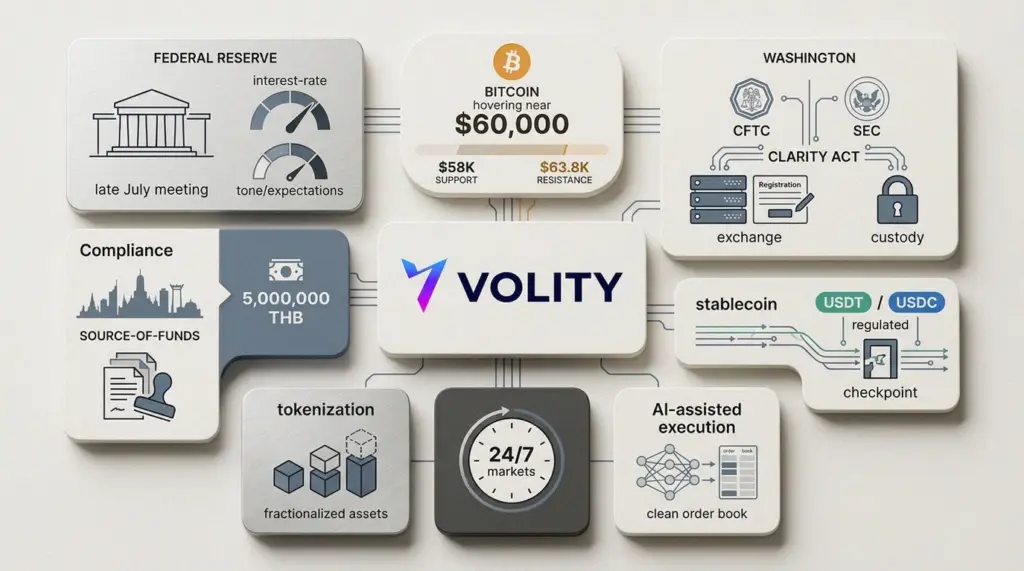
The Bank of Thailand is tightening checks on suspicious capital flows. Anyone depositing at least 5 million baht in cash must verify the source of funds. Earlier rules already applied similar scrutiny to large withdrawals.
Meanwhile, the central bank and Thailand’s Securities and Exchange Commission are examining high-volume stablecoin activity. Their focus falls heavily on Tether’s USDT, the market’s dominant dollar-linked token.
Authorities have found that foreigners account for roughly 40% of USDT sellers on Thai platforms. Therefore, regulators now view stablecoin desks as possible gateways for “grey capital”. That label covers money moving outside normal banking scrutiny.
Thailand has also attacked mule accounts and online scam networks. Investigators have arrested more than 29,000 suspects. Reported online scam cases have fallen by more than 69% after a nine-month crackdown.
Yet the country is not treating crypto as contraband. Thailand’s SEC has approved USDT and USDC for digital asset transactions and some initial coin offerings. Bitcoin, Ether and XRP also sit inside the approved digital asset framework.
That creates a useful paradox for traders. Stablecoins are becoming legitimate market tools. However, large stablecoin flows now resemble bullion trades or big cash deposits. They can move, but they will be watched.
Bitcoin’s macro trap
Bitcoin’s own problem looks less exotic. It is trading like a risk asset waiting for the Federal Reserve.
The token entered July near $60,000 after a bruising first half. It had traded near $93,000 in January. Since then, ETF outflows and higher-for-longer rate expectations have drained momentum.
So far, the weakness has not come from a major exchange failure or a spectacular hack. Instead, old-fashioned macro pressure has done the damage. Tighter real rates still matter, even in a market built to mock central banks.
Traders now treat the July 28-29 Fed meeting as the next serious catalyst. The central bank is expected to hold rates steady. However, the tone may matter more than the decision.
For now, Bitcoin’s map looks narrow. Support sits near $58,000. Resistance stands around $63,800. A sideways range between about $56,000 and $62,000 remains the base case until policy expectations shift.
Still, the downside case has teeth. A break below $58,000 would put the low $50,000s back on trading screens. Meanwhile, a failure to reclaim $60,000 quickly could confirm that dip buyers have lost patience.
Ether adds another warning light. Traders are watching the $1,500 to $1,600 zone. If that area fails, crypto breadth would likely worsen, even if Bitcoin holds its own chart for a while.
Washington’s rulebook fight
While prices drift, Washington is trying to decide who owns the referee’s whistle.
The Digital Asset Clarity Act, known as the CLARITY Act, would divide crypto oversight between two agencies. The Commodity Futures Trading Commission would police most “digital commodities”. The Securities and Exchange Commission would keep authority over fundraising and certain trading issues.
The bill would force crypto exchanges and brokers to register with the CFTC. It would also restrict commingling of customer and company assets. In addition, it would curb proprietary trading and update bankruptcy rules for digital commodity platforms.
The legislation has advanced through the House Financial Services Committee. However, it still faces resistance in the Senate. Senator Elizabeth Warren and other sceptics argue it could create loopholes for large companies issuing tokens.
Another bill would block the Federal Reserve from issuing a central bank digital currency. Together, these measures would shape the next American crypto regime.
For investors, the legal plumbing matters. It will affect listing standards, custody costs and exchange margins. It may also decide whether large tokens trade more like commodities or securities.
Wall street builds quietly
Retail traders are staring at candles. Meanwhile, institutions are building rails.
Tokenisation has moved from conference slides into live products. Platforms now offer tokenised shares, private-market exposures and blockchain-based funds. Some instruments trade around the clock, ignoring the bell that still governs the New York Stock Exchange.
This shift sounds dull until liquidity appears at 2 a.m. A tokenised equity market can absorb information while traditional venues sleep. However, it can also magnify weak price signals during thin trading hours.
AI-driven execution is advancing just as quickly. Exchanges and brokerages are testing assistants that recommend trades, structure portfolios and, within guardrails, place orders. That moves part of the trading decision from a person to a model.
Therefore, the next volatility cycle may feel different. Humans panic, hesitate and overtrade. Machines rebalance, de-risk and chase signals at speed. Both can create ugly charts, but the rhythm changes.
Payments companies are also preparing for machine-to-machine commerce. Mastercard’s Agent Pay for Machines targets a world where software agents and connected devices can settle transactions directly.
Crypto sits naturally beside that idea. Smart contracts and programmable wallets could become settlement tools for automated commerce. However, that also brings fresh model risk, coding risk and compliance risk.
By the numbers
$60,000 – Bitcoin’s current centre of gravity in a nervous summer range.
$58,000 – The support level traders are watching most closely.
5 million baht – Thailand’s cash deposit threshold for source-of-funds checks.
40% – Approximate share of USDT sellers on Thai platforms who are foreigners.
29,000 – Suspects arrested in Thailand’s crackdown on scams and mule accounts.
Key takeaways
Stablecoins face more friction: Thai USDT flows show how regulators may treat large stablecoin transactions elsewhere.
Macro still drives bitcoin: Fed language and ETF flows matter more than halving slogans right now.
Watch the range: A clean break of $58,000 or $63,800 could set the next trade.
Legislation can reprice venues: The CLARITY Act could reshape exchange economics and token listings.
Tokenisation is not cosmetic: Always-on assets and AI execution may change liquidity patterns.
The market is not falling apart. However, it is being rewired while traders argue over chart levels. Stablecoins are starting to look like regulated bank instruments. Bitcoin trades on Fed expectations. Wall Street, quietly but steadily, is testing capital markets that never close.
The next decisive move may not come from a meme coin, a miner or a halving theory. It may come when a central banker, lawmaker or compliance department finally blinks.
Related coverage on Volity
- How to Avoid Crypto Scams: A Beginner Safety Checklist
- How to Choose a Trading Platform: A 10-Point Checklist
- Demo vs Live Trading Account: A 7-Step Checklist Before You Go Live
- How to Size a Trade: Position Sizing and Risk Per Trade for Beginners
- Risk-Reward Ratio Explained: How to Set It and Why It Matters
- ETF vs Index Fund: The Difference and Which to Pick