You can buy AstraZeneca shares two different ways, and it pays to be clear on which one you mean. The first is owning the real shares: AstraZeneca PLC trades on the London Stock Exchange under the ticker AZN, priced in pence, bought through a share-dealing account or a stocks and shares ISA. The second is trading an AstraZeneca CFD, where you take price exposure to AZN without owning any shares. This guide covers both, with a UK reader in mind.
The quick version
- AstraZeneca PLC is one of the largest companies in the FTSE 100. Its primary listing is on the London Stock Exchange, ticker AZN, quoted in pence.
- Own real AstraZeneca shares through a share-dealing account or an ISA and you get voting rights and dividends, plus a 0.5% stamp duty charge on the purchase.
- The same AZN shares also trade on the NYSE and Nasdaq Stockholm under one harmonised listing, a detail rather than the route a UK reader needs.
- On Volity you trade an AstraZeneca CFD instead: price exposure only, no shares and no shareholder rights, with leverage far lower on a single stock than the headline up to 1:500.
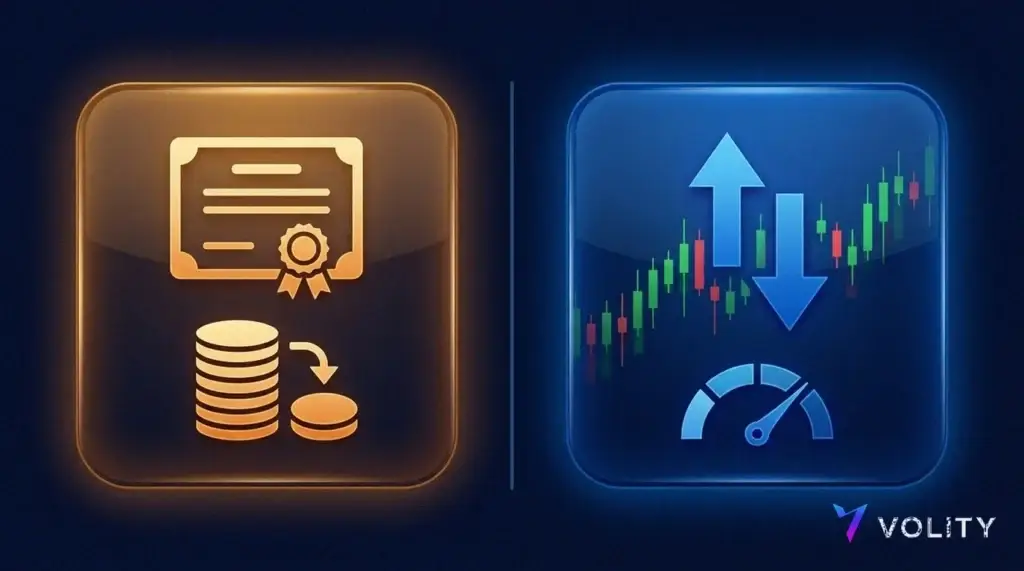
It comes down to one question: do you want to own the shares, or exposure to the price? Owning them means holding AZN in a brokerage or ISA account, collecting dividends and voting at the annual meeting. Exposure through a contract for difference means trading the price movement with leverage, without owning the stock. The table sets the two side by side.
| Feature | Real shares (share-dealing/ISA) | AstraZeneca CFD (Volity) |
| Own the stock? | Yes | No, price exposure only |
| Dividends | Paid to you as a shareholder | Dividend adjustment, not a real payout |
| Voting rights | Yes | No |
| Go short (profit from a fall) | No | Yes |
| Leverage | None (pay the full price) | Yes, capped low on single stocks |
| UK stamp duty on purchase | 0.5% | None (you buy no shares) |
Broadly, a long-term investor who wants a slice of the company and its income holds the real shares, while a short-term trader tends to use a CFD. If buying and selling shares is new to you, our guide on how to start stock trading covers the groundwork first.
Buying the real shares in the UK is short once your account is open.
- Open a share-dealing account, or a stocks and shares ISA, with an FCA-authorised broker and complete the identity checks.
- Fund the account and search the ticker AZN, the AstraZeneca PLC ordinary share listed in London.
- Choose a number of shares or a cash amount, review the dealing commission and live price, and place the order.
- Settle the trade. Your broker collects any tax and the shares appear in your account, usually within two business days.
Two costs are worth knowing first. Buying UK-listed shares carries stamp duty reserve tax at 0.5% of the amount invested, which your broker adds automatically. On a £2,000 purchase of AstraZeneca that is £10, and the charge applies inside an ISA too. The ISA upside is that future gains and dividends sit outside income and capital gains tax, up to the annual ISA allowance, which has been £20,000 in recent years. Since income is a big part of the AstraZeneca case, our explainer on dividend investing for beginners goes deeper.
What is AstraZeneca, and where is it listed?
AstraZeneca PLC is a British-Swedish pharmaceutical and biotechnology company, formed in 1999 by the merger of Astra of Sweden and Zeneca of the UK, and now headquartered in Cambridge. It develops prescription medicines across oncology, respiratory, cardiovascular and rare disease, and much of its value rests on a pipeline still working through clinical trials. In 2024 it set out an ambition to reach $80 billion in total revenue by 2030, up from $45.8 billion in 2023, backed by around 20 new medicines. That is a stated ambition rather than a promise, and pipelines can disappoint.
Its primary listing is on the London Stock Exchange, where AZN is one of the heaviest weights in the FTSE 100 and quoted in pence. Since early 2026 a harmonised listing structure means the same ordinary shares trade in London, on Nasdaq Stockholm and on the New York Stock Exchange under the ticker AZN. That New York direct listing replaced an older Nasdaq programme of American Depositary Shares, where two receipts stood for one London share. For a UK buyer the London line in pence remains the natural one. As a long-established, widely held name, AstraZeneca is a textbook blue-chip stock, though blue-chip status is never a guarantee that the price only rises.
How to invest in AstraZeneca with a Volity CFD
Volity does not sell you real AstraZeneca shares. It offers an AstraZeneca CFD that tracks the AZN price, so you can trade its movement without owning the stock. You post margin rather than the full value, go long if you expect a rise or short if you expect a fall, and settle the difference when you close. There are no shares in your name and no vote at the annual meeting, and open positions receive a dividend adjustment rather than a real dividend when AstraZeneca pays out.
Leverage on a single-stock CFD is lower than some traders expect. Volity offers leverage of up to 1:500, but that ceiling is product-dependent and applies to the most liquid instruments, not to individual shares. For retail clients, European regulators cap single-equity CFD leverage at 5:1. In practice a £1,000 position needs about £200 of margin, and it cuts both ways: a 10% move in the price is a £100 swing on your £200 stake, so a loss builds as fast as a gain. Trades run on Volity MT, with execution under UBK Markets, which holds CySEC licence 186/12.

The steps are simple.
- Open a Volity account and complete the quick checks, or start on a free demo account to practise first.
- Fund your wallet by card, SEPA or crypto. Opening an account costs $0, you can fund from as little as $1, and you can start trading from $1.
- Search the AstraZeneca CFD in Volity MT, study the chart, and decide your direction from your own analysis.
- Set your size from the margin shown on the ticket, attach a stop-loss and a take-profit, and place the order.
The AstraZeneca share price is quoted in pence on the London Stock Exchange and moves second by second in market hours. Rather than chase a figure that is stale the moment it prints, read the live quote on the exchange page or AstraZeneca’s own investor relations site. What matters more is what drives it, and a few forces do most of the work.
- Clinical and regulatory news. Trial read-outs and approval decisions for major drugs can move the share sharply in a single session, in either direction.
- Patents and competition. When a top-selling medicine loses patent protection, cheaper generics and biosimilars can erode its revenue, so the calendar of expiries matters.
- Dividends and growth. AstraZeneca declares its dividend in US dollars, pays twice a year and runs a progressive policy, and its 2030 revenue ambition is a running scorecard the market prices in.
- The wider market. As a large-cap, AstraZeneca also moves with FTSE 100 flows, the pound, and shifting sentiment on healthcare and drug pricing.
Reading those drivers is worth more than watching the ticker alone. Our guide to how to analyse shares sets out a fuller framework for weighing a company before you commit.
Buying any single company concentrates your money in one story, and AstraZeneca has a few specific ones.
- Pipeline risk. A large slice of the value depends on drugs still in trials, and a failed study or a rejected application can knock the share hard.
- Patent cliffs. As key medicines age, loss of exclusivity invites competition and can shrink a once-reliable revenue line.
- Currency. AstraZeneca reports and declares its dividend in dollars, so a UK holder carries some exchange-rate exposure even on a London-listed share.
- Leverage, if you trade the CFD. Margin magnifies losses as much as gains, which is why the FCA classes CFDs as high-risk and most retail accounts lose money on them.
None of this is a reason to avoid AstraZeneca; it is what to weigh when you size a position and choose your route. Check the dealing costs on the charges and fees page, use money you can afford to lose, and treat this as education rather than personal advice. The full range of instruments is on the markets page.
Frequently asked questions
Open a share-dealing account or a stocks and shares ISA with an FCA-authorised broker, fund it, search the ticker AZN and place your order. You pay 0.5% stamp duty on the purchase, added automatically by the broker. If you only want exposure to the price rather than ownership, you can trade an AstraZeneca CFD on Volity instead.
That depends on your goals and your view of the drug pipeline, and no one can answer it for you. AstraZeneca is a large, established dividend payer whose value leans on medicines still in development, so patent and clinical risk sit alongside the income. Weigh those against each other, decide whether you want to own the shares or trade the price, and treat this as general information rather than personal advice.
Does AstraZeneca pay a dividend?
Yes. AstraZeneca declares its dividend in US dollars and pays it twice a year, under a progressive policy that aims to maintain or grow the payout over time. Hold the real shares and you receive that dividend as a shareholder. Trade an AstraZeneca CFD and you do not, though open positions carry a dividend adjustment around the payout date instead.
What is AstraZeneca’s ticker symbol?
AstraZeneca trades as AZN on the London Stock Exchange, quoted in pence, which is the primary listing for a UK buyer. Since early 2026 the same ordinary shares also trade under AZN on the New York Stock Exchange and on Nasdaq Stockholm, part of a single harmonised listing that replaced an older Nasdaq depositary-share programme.