Crypto turns defensive as rules tighten and plumbing gets rebuilt
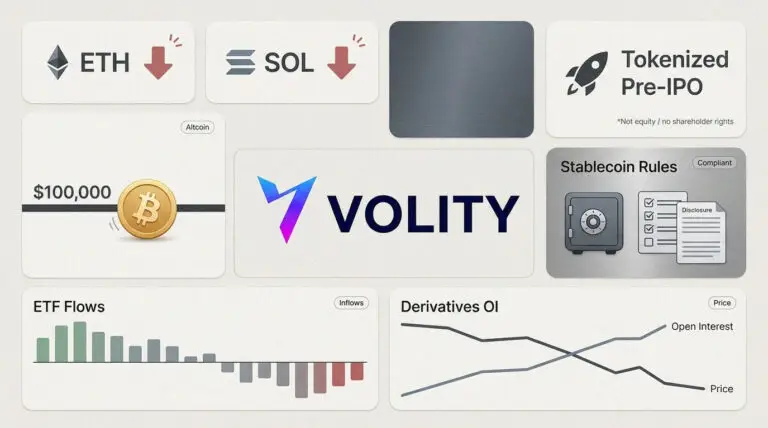
Crypto begins the week in a defensive mood. Bitcoin is holding a key level, traders are watching ETF flows, and regulators are closing in from several directions.
Still, this is not a panic tape. Instead, the market looks tired, selective and increasingly institutional. Money is leaving the flimsy corners and moving towards Bitcoin, Ethereum, stablecoins and tokenised assets with clearer use cases.
Market snapshot: bitcoin steadies near the line
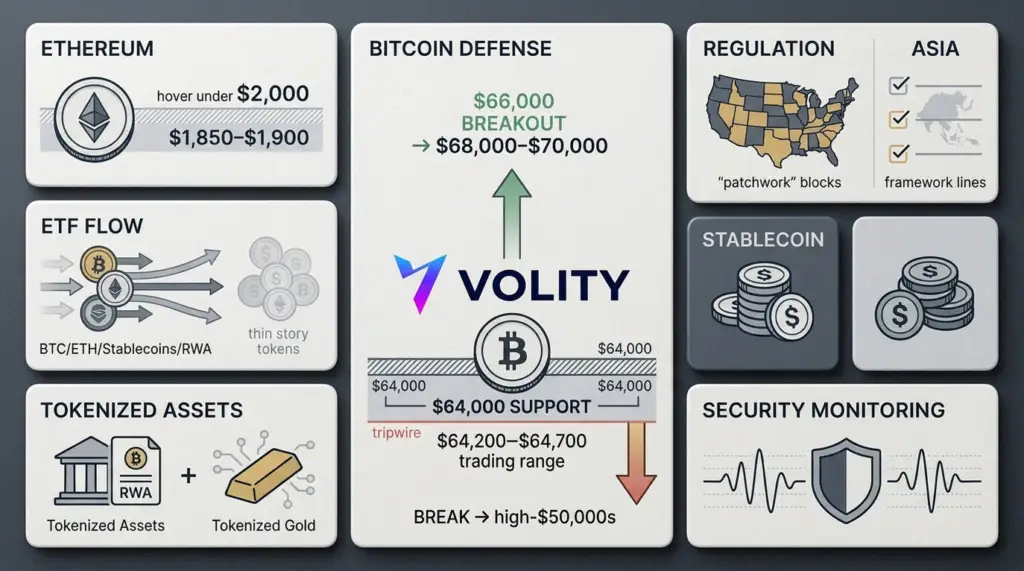
Bitcoin is trading around $64,200 to $64,700, with the $64,000 area acting as the market’s current tripwire.
For now, buyers continue to defend that zone. However, the margin for error has narrowed after a bruising start to July.
- Immediate support: $63,800 to $64,000.
- First resistance: roughly $66,000.
- Upside target: $68,000 to $70,000 if momentum improves.
- Downside risk: a return towards the high-$50,000s if support breaks.
That makes the current range useful for traders, if not comfortable. Above $66,000, momentum accounts can press the long side. Below $63,800, the market will likely turn more defensive quickly.
Meanwhile, options traders are pricing two very different paths. One points to a slow grind higher into late July. The other points to a retest of the early-month lows near $58,000.
ETF flows may decide which path comes first. When demand from spot funds improves, Bitcoin tends to absorb bad headlines. When flows reverse, thin summer liquidity can make small selling waves look much larger.
Ethereum and the majors do the quieter work
Ethereum is trading just below $2,000, with support clustered around $1,850 to $1,900.
That price action looks dull at first glance. However, Ethereum remains central to three of crypto’s bigger structural trades: stablecoins, decentralised finance and tokenisation.
Short-term traders are treating $1,850 as the line to defend. A clean move above $2,000 would change the tone and pull attention back towards infrastructure assets.
Institutional interest has also improved. Ethereum ETFs have started to draw measurable inflows after months of scepticism. That matters because it gives traditional portfolios a cleaner route into the network’s economics.
Elsewhere, capital keeps rotating away from smaller, story-driven tokens. Therefore, liquidity is concentrating in the names that funds can actually trade in size.
Stablecoins face a split-screen regulatory world
Stablecoins now sit at the centre of crypto’s market structure. They grease exchange trading, cross-border transfers, DeFi lending and tokenised settlement.
Yet the rulebook remains uneven. In the United States, regulators have missed a key deadline under the GENIUS Act, leaving issuers without final federal stablecoin rules.
That delay matters for Tether, Circle and smaller dollar-token issuers. Reserve standards, supervision, listings and disclosure requirements remain subject to political timing.
For traders, the risk is not necessarily an outright ban. Instead, the danger lies in abrupt rule changes, enforcement actions or a patchwork of state regimes.
Asia is moving differently. South Korea is developing frameworks for seizing self-custodied crypto and fitting digital assets into state asset-management law. It is also working on won-denominated stablecoins.
Japan has pushed reforms that treat crypto more like a financial product. It has also moved towards a flat 20 per cent tax rate, which could support spot ETFs and cleaner market conduct rules.
Hong Kong, meanwhile, is preparing a new HKDAP stablecoin backed by a Standard Chartered-linked consortium. That project signals the city’s ambition to become a regulated stablecoin hub.
The contrast is stark. In the U.S., policy risk feels jagged and unpredictable. In parts of Asia, crypto is being pulled into the mainstream under stricter supervision.
Tokenised gold shows how fast real-world assets can scale
Tokenised real-world assets are no longer a conference-panel fantasy. Gold-backed tokens alone now represent roughly a $4.4 billion market.
That growth is important because gold attracts a different crowd from meme coins or high-beta altcoins. It brings in commodity investors, treasury desks and buyers looking for on-chain settlement without pure crypto volatility.
However, the rulebook has not kept pace. In the European Union, tokenised gold still operates without a dedicated framework. Oversight remains patchy, while banks, exchanges and fintechs improvise their own standards.
That ambiguity works in calm markets. It becomes more dangerous during stress, especially if investors rush to redeem tokens or question an issuer’s reserves.
Portfolio managers should treat these products as hybrids. They carry on-chain risk, issuer risk, custody risk and commodity risk. They are not simple digital versions of gold bars in a vault.
Security becomes a trading issue, not a footnote
The latest run of exploits and wallet thefts has exposed another weak spot. Old-style crypto audits no longer reassure serious investors.
Several bridge hacks and custody incidents have pushed funds to demand continuous monitoring. They want live risk scoring, incident reporting and automated responses, not just a PDF stamped months earlier.
That shift changes how money moves. Large investors increasingly mark “audit-only” projects as higher risk. Meanwhile, tokens tied to fragile bridges or opaque custody may face higher delisting risk.
Retail traders should watch this closely. Security problems no longer stay buried in developer chats. They now affect liquidity, listings and valuations.
Macro keeps bitcoin on a short leash
The wider backdrop is mixed but manageable. U.S. inflation expectations have cooled, ETF demand has improved, and geopolitical tension remains a live risk.
Recent U.S. spot Bitcoin ETFs snapped an eight-week outflow streak, attracting nearly $200 million. Ethereum ETFs added about $84 million.
Those flows help explain why Bitcoin is holding the mid-$60,000s instead of sliding back towards the $50,000s. They also show how much the market now depends on traditional fund demand.
Still, traders should not ignore the lower bands. If Bitcoin loses $58,000 to $60,000 and ETF demand rolls over, a deeper leg towards the low-$50,000s becomes plausible.
Key takeaways for traders
- Treat $64,000 as active support. A break below $63,800 would argue for tighter stops and smaller risk.
- Watch $66,000 for confirmation. A clean move above that level could reopen $68,000 to $70,000.
- Prefer liquidity over lottery tickets. Bitcoin, Ethereum and credible stablecoin-linked assets remain favoured over thin altcoins.
- Price regulation by region. U.S. uncertainty favours larger compliant issuers, while Asia may attract new products faster.
- Demand live security signals. Bridges, custody tools and DeFi protocols need more than an old audit report.
The market has not abandoned risk. It has become more selective about which risks deserve capital.
Bitcoin still sets the mood. Ethereum and stablecoins still carry much of the workload. Tokenised assets show where the next wave of institutional money may arrive.
For now, crypto is fragile but not broken. It is trading at levels where recovery and renewed stress both remain believable.
Related coverage on Volity
- How to Avoid Crypto Scams: A Beginner Safety Checklist
- How to Choose a Trading Platform: A 10-Point Checklist
- Demo vs Live Trading Account: A 7-Step Checklist Before You Go Live
- How to Size a Trade: Position Sizing and Risk Per Trade for Beginners
- Risk-Reward Ratio Explained: How to Set It and Why It Matters
- ETF vs Index Fund: The Difference and Which to Pick