Crypto markets hold breath as oil climbs and washington argues
Crypto is not falling apart today. It is loitering, which can feel more irritating.
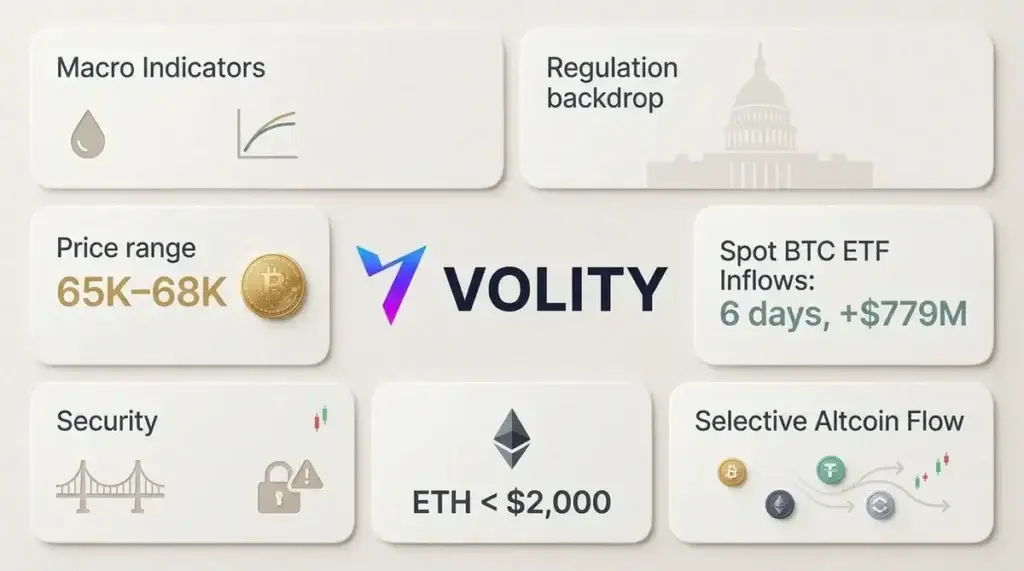
Bitcoin is circling the $65,000-$66,000 area. Ether remains stuck below $2,000. Meanwhile, oil, bond yields and Washington’s crypto fight are doing most of the talking.
The global crypto market is worth about $2.3 trillion, down roughly 0.7% over 24 hours. Trading volume sits near $62.6 billion. Bitcoin dominance remains strong at about 56.8%, while Ether holds just under 10%.
However, the quiet price action hides a busier story. Spot Bitcoin ETFs have logged six straight days of net inflows, adding roughly $779 million since mid-July. Institutions are still buying, but they are not lunging at the tape.
By the numbers
- $2.3 trillion – estimated total crypto market value.
- 56.8% – Bitcoin’s share of total crypto market capitalisation.
- $65,000-$68,000 – Bitcoin’s short-term battle zone.
- $779 million – recent net inflows into U.S. spot Bitcoin ETFs.
- 31 – Crypto Fear & Greed Index, still in “fear”.
Bitcoin holds the line near $65,000
Bitcoin’s chart still leans constructive, though not comfortably. The rally from early-July lows has carried about 13%, then stalled near resistance.
For now, the $65,000-$66,000 band has become the floor traders keep testing. A clean loss of that zone would invite selling toward the mid-$60,000s.
Still, the bulls have a tempting target. A push through $67,000-$68,000 could squeeze short sellers sitting above the range. Analysts estimate that a move beyond $66,738 could pressure roughly $530 million of short positions on major exchanges.
Conversely, a drop below $65,289 could put about $133 million of long positions at risk. This range matters more than today’s small percentage moves suggest.
Ether stays pinned below $2,000
Ether has a different problem. It is trading less like a crypto story and more like a macro asset.
Oil has climbed to six-week highs, reviving inflation worries. Traders are again considering whether central banks stay tight for longer. That is rarely friendly for long-duration risk assets, including crypto.
Ether is hovering around $1,930-$1,950. Buyers keep defending the mid-$1,900s, but sellers keep appearing near $2,000.
That round number is not magic, but markets often treat it like a door. A firm break above $2,000 would suggest risk appetite is returning. However, another rejection there could leave Ether vulnerable to a dull, grinding retreat.
Altcoins split, whales get selective
Altcoins are not moving as one market. Instead, money is rotating hard between specific stories.
Chainlink is finding support above $8.50. On-chain activity points to whales accumulating roughly 14 million LINK. That kind of measured buying can dampen downside volatility, though it does not guarantee a breakout.
Meanwhile, Pi Network looks tired after its recent burst of attention. Open interest in Pi derivatives has dropped sharply. That suggests speculative leverage is leaving, and fast money may already have found a new toy.
Elsewhere, names including Hedera, Lido DAO and Ethena are among stronger performers. By contrast, DeXe and World Liberty Financial are leading the weaker side of the tape.
The message is simple. Capital is not fleeing crypto wholesale. However, it is becoming fussy.
Washington turns crypto into a senate trade
The policy story is becoming harder for traders to ignore.
The CLARITY Act, a major U.S. crypto bill, is moving into a more contentious stage. The bill aims to define how digital assets should be classified and regulated.
Ripple’s chief executive is pushing lawmakers to advance it, arguing that clearer rules would help keep crypto jobs in America. However, Senate Democrats remain sceptical, even after an ethics provision linked to Donald Trump’s crypto interests failed to win them over.
Prediction markets now put the chance of passage well below 50%. Meanwhile, Coinbase shares have slipped about 4%, showing how quickly Washington risk feeds into listed crypto valuations.
The arithmetic is unforgiving. Any serious bill probably needs 60 Senate votes to clear procedural hurdles. Bipartisan support matters more than press conferences.
The industry has scale on its side. U.S. crypto businesses now support roughly 232,000 jobs and add about $55 billion to the economy. That gives the sector lobbying muscle, but not a free pass.
Security remains the market’s grittiest problem. It is also the one most likely to ambush confident traders.
The AFX bridge was hit by an exploit that drained about $24.15 million in USDC. The attacker reportedly used stolen funds to buy more than 12,400 ETH.
Separately, the Verus-Ethereum bridge was hacked again, this time for roughly $7.5 million. Repeated breaches at the same bridge remind traders why cross-chain infrastructure still trades with a shadow discount.
However, not all security risk is technical. CertiK has identified at least 52 confirmed wrench attacks, where holders are threatened or assaulted for their crypto. Estimated exposure tied to those incidents stands near $124 million.
For wealthy holders, custody now means more than seed phrases and hardware wallets. It also means personal safety, travel habits and who knows what.
Meanwhile, a flaw in the Zilliqa Ledger app has raised concerns about exposed private keys. ZIL transfers were halted, unsettling holders who assumed cold storage meant calm sleep.
Traditional finance keeps walking in
The banking side of the story is more constructive.
In Switzerland, BancaStato has launched trading in Bitcoin, Ether and Solana through a partnership with Sygnum. That gives ordinary bank clients direct access to major tokens inside a familiar institution.
In the United States, a Louisiana public pension fund has increased Bitcoin exposure indirectly. It bought more than 21,300 shares of MicroStrategy, one of the largest corporate Bitcoin holders.
Meanwhile, Revolut has reached a private valuation near $115 billion after an employee share sale. The message from investors is clear enough. Payments, brokerage and crypto access are merging into one retail finance bundle.
Asia pushes ahead
Asia is also shaping the next leg of adoption.
In South Korea, Mirae Asset has completed its acquisition of the exchange Korbit. Meanwhile, Circle has partnered with Kakao and Toss to expand stablecoin use in Korea.
Coinbase plans to grow its Singapore workforce to around 200 employees by the end of 2026. Japan is also moving towards its first Bitcoin ETF, potentially by 2028, with possible inflows near ¥3 trillion.
Those dates sound distant to day traders. However, markets often price plumbing before the water starts running.
Key takeaways
- Bitcoin: watch $65,000 for support and $68,000 for breakout confirmation.
- Ether: the $2,000 line remains the key test for risk appetite.
- Policy: the CLARITY Act is now a live input for Coinbase, miners and infrastructure stocks.
- Security: bridge exposure still deserves tighter limits and wider risk discounts.
- Flows: ETF inflows and bank adoption remain a medium-term support for Bitcoin.
The market feels sleepy, but that may be misleading. Under the surface, oil, Senate maths, bridge hacks and ETF flows are all pulling at price. Traders do not need drama today. They need levels, discipline and a close eye on Washington.
Related coverage on Volity
- How to Avoid Crypto Scams: A Beginner Safety Checklist
- How to Choose a Trading Platform: A 10-Point Checklist
- Demo vs Live Trading Account: A 7-Step Checklist Before You Go Live
- How to Size a Trade: Position Sizing and Risk Per Trade for Beginners
- Risk-Reward Ratio Explained: How to Set It and Why It Matters
- ETF vs Index Fund: The Difference and Which to Pick