Crypto weekend: politics, exploits and the battle for clarity
Crypto enters the weekend with one eye on Washington and the other on hot wallets.
Bitcoin is testing important support, hackers are still finding weak doors, and token unlocks are back on the calendar. Meanwhile, regulators from Brussels to Beijing are tightening the perimeter around stablecoins, exchanges and cross-border flows.
For traders, this is not a clean risk-on tape. However, it is not a broken one either. The market looks nervous, selective and unusually sensitive to headlines.
Ark rotates into higher beta
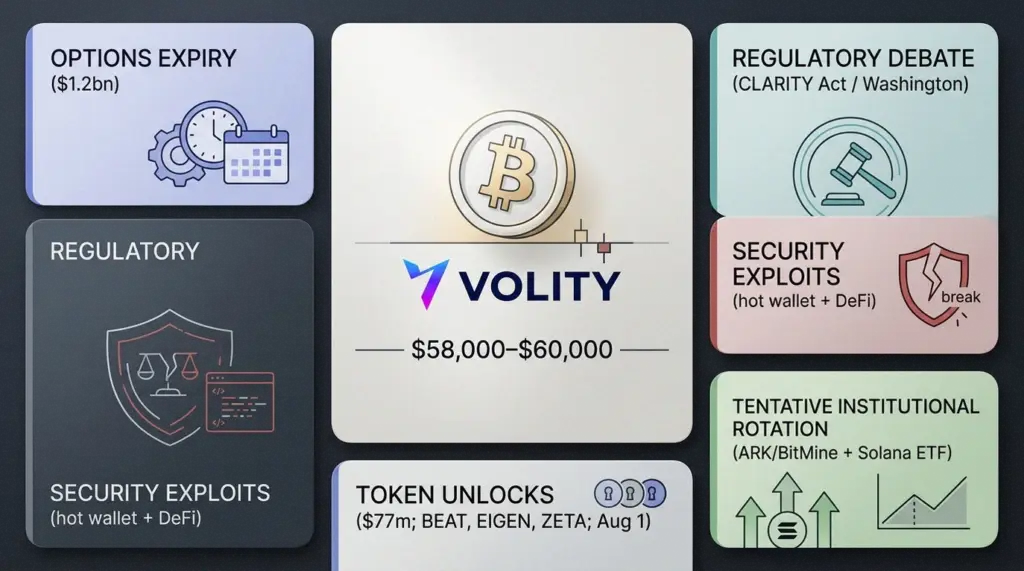
ARK Invest has added modest exposure to BitMine and a new Solana ETF, with purchases worth about $251,000.
The size will not move a desk’s risk model. Still, the signal matters. After months of caution, some institutional money is again probing higher-beta crypto assets.
That rotation has a familiar shape. After sharp drawdowns this year, early buying often returned through Solana-linked products and liquid mining names. Meme coins usually arrived later, when traders felt braver.
The next sustained Bitcoin bounce may not lift everything equally. Solana exposure, listed miners and packaged ETF products could attract the first institutional bid.
Washington turns into a market catalyst
The fight over crypto rules in the United States keeps getting louder.
Donald Trump has reportedly moved about $17 million while the debate around the CLARITY Act and related ethics questions intensifies. At the same time, the bill is still struggling toward a Senate vote, with a large 60-vote hurdle hanging over it.
The bill matters because it would draw a clearer boundary between crypto securities and commodities. In practice, that means a sharper split between the Securities and Exchange Commission and the Commodity Futures Trading Commission.
For investors outside America, the stakes are still high. A durable US framework could keep liquidity centred in New York and Chicago. However, another stalemate may push more activity toward Europe, the Gulf and Asia.
Politics also makes the tape more treacherous. Police unions, industry lobbyists and campaign groups have all shifted positions around the bill. As a result, regulatory risk is no longer background noise. It is a price input.
Bitcoin tests the mood
Bitcoin is balancing near trendline support after profit-taking spread from technology shares into broader risk assets.
The most watched zone sits around $58,000 to $60,000. A brief dip may not matter much. However, a failed reclaim would raise the odds of a deeper flush.
Above that, traders keep watching the $65,000 area and the 200-day region. So far, buyers have defended pullbacks there. A firm daily close beneath that area would likely trigger systematic selling.
Options are also adding noise. About $1.2 billion in Bitcoin options expiry sits over the market, increasing the chance of sharp moves around crowded strikes.
Veteran chartist Peter Brandt has warned against treating the current ascending channel as a bullish bottoming pattern. In plain market English, upside remains possible. Yet the structure does not justify calls for an immediate melt-up.
By the numbers
- $58,000 to $60,000: Bitcoin’s key near-term support band.
- $1.2 billion: approximate Bitcoin options expiry overhang.
- $77 million: scheduled BEAT, EIGEN and ZETA unlocks on August 1.
- $9.7 million: estimated loss from the Triple-A hot wallet exploit.
- $428 million: size of the USDT gambling network targeted in China.
Hackers keep finding soft targets
The week also reminded traders that crypto plumbing still breaks in expensive ways.
Triple-A hot wallets lost roughly $9.7 million in what appears to be a coordinated exploit. The attack vector remains under review. Still, the lesson is blunt. Hosted wallet exposure can turn from convenient to costly very quickly.
Across Protocol also faced trouble on Solana. Attackers forged fake deposits with a nominal value above $40 million. Effective losses are estimated below $4 million, as teams moved to recover funds.
Meanwhile, Lien Finance suffered a roughly $542,000 exploit linked to a logic bug in its bond token design. Once again, complex DeFi machinery proved fragile without constant maintenance.
Active users should shorten the life of large balances in hot wallets. They should also check recent bridge audits before moving funds across chains. Contract upgrades deserve the same attention as earnings releases, too.
Token unlocks return to the tape
August 1 brings a scheduled unlock of about $77 million across BEAT, EIGEN and ZETA.
The headline number is only part of the story. Holder mix matters more. If early investors or ecosystem funds receive large tranches, structured selling can follow.
Liquidity also matters. Thin order books can turn a modest unlock into a violent wick lower. In leveraged perpetual markets, that can quickly become a liquidation event.
This is calendar risk rather than a verdict on the projects. Long-term holders may still like the assets. Short-term traders should size positions around the supply shock.
Regulators tighten the perimeter
Asia and Europe are sending the same message in different accents: crypto access now comes with more conditions.
In China, courts have jailed operators behind a $428 million USDT gambling network. The case reinforces Beijing’s hard line on offshore stablecoin flows tied to gambling or capital flight.
In the European Union, Belarusians have been barred from owning MiCA-regulated crypto firms. The move sits within a wider sanctions push that also touched Russia-linked trading platforms.
India has also ordered GitHub to remove repositories tied to Jack Dorsey’s “Bitchat”. That decision blurs the boundary between content moderation, communications control and financial regulation.
These measures will not stop crypto development. However, they will shape where founders incorporate, where liquidity gathers and which rails remain usable.
Boring rails become important
Behind the louder headlines, the more durable story may be infrastructure.
Samsung Wallet is expanding stablecoin support, pushing crypto closer to a familiar payments interface. That matters because adoption often begins when users no longer notice the rail.
In the Philippines, BPI is testing stablecoin rails for overseas remittances. The country remains one of the world’s largest remittance markets, so even small pilots deserve attention.
China’s digital yuan has completed its first cross-border payment to Singapore. Meanwhile, LayerZero and Keeta are working on tokenised bank deposits across major chains.
These projects lack the drama of a memecoin surge. Yet they show how banks, wallets and state-backed systems are slowly normalising on-chain settlement.
Exchanges chase scale and licences
Market structure is also shifting.
Coinbase is reshuffling senior ranks as it pushes beyond spot crypto into stocks and on-chain prediction markets. The goal looks clear: become a broader trading venue, not just a crypto exchange.
LMAX is exploring a possible $5 billion sale or Nasdaq listing with Morgan Stanley’s help. That suggests regulated institutional venues still command attention, even in choppy markets.
Bitfinex has completed its El Salvador licence set across three markets. Meanwhile, HTX, linked to Justin Sun, has landed on an EU sanctions list over alleged Russia ties.
The background theme is consolidation. Smaller or lightly regulated players are losing room. Better-capitalised venues are locking down banking, licences and distribution.
Key takeaways
- Respect the Bitcoin band: $58,000 to $60,000 is the weekend weather vane.
- Use less leverage around August 1: unlocks can bruise thin books quickly.
- Prefer cleaner venues: sanctions and licensing now affect liquidity access.
- Treat bridges with suspicion: forged deposits and relayer bugs remain live risks.
- Watch Washington: the CLARITY Act may matter more than influencer chatter.
The market is anxious, but not yet broken. Policy is messy, but finally moving. Meanwhile, the rails beneath crypto keep looking more conventional. For traders, that makes this a tape for discipline, not bravado.
Related coverage on Volity
- How to Avoid Crypto Scams: A Beginner Safety Checklist
- How to Choose a Trading Platform: A 10-Point Checklist
- Demo vs Live Trading Account: A 7-Step Checklist Before You Go Live
- How to Size a Trade: Position Sizing and Risk Per Trade for Beginners
- Risk-Reward Ratio Explained: How to Set It and Why It Matters
- ETF vs Index Fund: The Difference and Which to Pick