When a venue says a contract is margined in USDC, it is answering several questions at once: what you must post to open a position, what your profit and loss is paid in, and what you are exposed to while the trade is running. On-chain perpetual venues have converged on a dollar stablecoin for all three. Hyperliquid’s own contract specifications put it plainly for the perpetual futures on its main venue, noting that the oracle price is denominated in USDT, but the collateral is USDC. This guide walks through what that actually changes for a trader, and where the rule stops being universal.
The Crypto Trading Starter Kit
A plain-English PDF: what to check before you trade, how orders and risk really work, and the mistakes to skip. Get it free.
TL;DR / Quick insight: USDC margin means you post a dollar-pegged stablecoin as collateral, one balance backs every market on that venue, and the contract is cash settled so you never receive the underlying asset. That removes a second source of price risk, because your margin is not repricing while your trade is open. It does not remove risk. The position still moves, funding still accrues, and a peg is an assumption backed by an issuer’s reserves rather than a guarantee. It is also not a blanket rule of on-chain trading, so check what collateral the specific venue in front of you actually takes.
Nothing here is personal advice. Leverage amplifies losses as well as gains, a liquidation closes your position at the venue’s discretion, and you can lose the full amount you post as margin.
What margined in USDC actually means
Margin is not a fee and it is not a payment for the asset. It is a good-faith deposit the venue holds against a position that is larger than the deposit. The arithmetic is public on Hyperliquid, where initial margin is calculated as position size multiplied by mark price and divided by leverage, with leverage set to any integer up to the maximum allowed for that asset.
Put numbers on it. Post $2,000 of USDC, choose 5x, and you control $10,000 of notional exposure. A 1% move in your favour is $100, which is 5% of your collateral. A 1% move against you is the same $100 in the other direction. The collateral is the thing that absorbs both, and it is denominated in a unit designed to hold a dollar of value.
The contract itself has no end date. Hyperliquid states that its perpetuals are derivatives products without expiration date and lists delivery and expiration as not applicable, relying instead on funding payments to keep the contract price near spot. So there is no settlement date on which anything is handed over. There is only the day you close, and the balance that goes up or down in the meantime.
One collateral balance across every market you trade
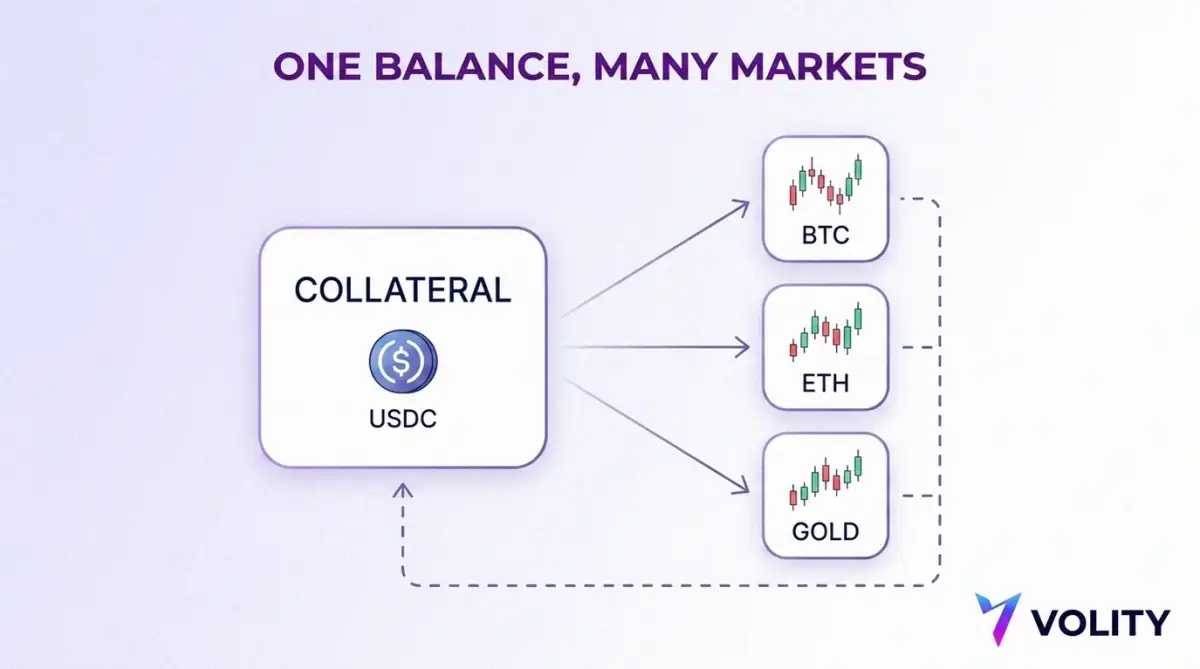
This is the part that changes how an account feels to run. Under cross margin, one stablecoin balance backs everything at once. Hyperliquid describes cross margin as the mode that allows for maximal capital efficiency by sharing collateral between all other cross margin positions, and adds that unrealised profit on cross positions becomes available as initial margin for new ones. Isolated margin does the opposite by constraining an asset’s collateral to that asset alone.
Efficiency cuts both ways, and the trade-off is worth stating before you pick a mode.
| Question | Cross margin | Isolated margin |
|---|---|---|
| What backs the position | The whole account balance | Only the margin assigned to it |
| Most you can lose on one trade | Potentially the account | The margin you assigned |
| Effect of a winning position elsewhere | Supports your other trades | Stays where it is |
| Suits | Hedged or correlated books | A single speculative idea |
How much exposure one balance supports depends on the market and the size. Hyperliquid publishes margin tiers that step maximum leverage down as a position grows, and as of 2 August 2026 the documentation shows Bitcoin at up to 40x below roughly $150m of notional and 20x above it, with Ethereum at 25x and 15x across a $100m boundary. Smaller markets sit far lower.
Why you never take delivery of anything
A cash-settled contract pays the difference in money. A physically settled one hands over the goods. Post USDC on a perpetual venue and you are firmly in the first category: buy a Bitcoin perpetual and no Bitcoin arrives in your account, ever. What arrives is the change in value, credited or debited in the collateral token.
Two practical consequences follow. You do not need a wallet, a custody arrangement or a transfer route for the asset you are trading, which is why one stablecoin balance can carry positions in markets you have no intention of ever holding. And your exposure ends the moment you close, with nothing left to deliver, store or sell afterwards.
The mechanism that keeps a never-expiring contract tethered to spot is funding, and it is charged between traders rather than by the venue. Hyperliquid pays funding every hour at one eighth of the computed eight-hour rate, from longs to shorts when the contract trades above spot and the other way round when it trades below, and states that funding is purely peer-to-peer with no fees collected on the payments. Holding a crowded side for weeks has a running cost even when the price does nothing.
Why a dollar-pegged unit removes a second price risk
Imagine posting Bitcoin as collateral for a long Bitcoin position. The market falls, your position loses value, and the collateral backing it loses value in the same move. Your margin ratio deteriorates from both ends at once, which is why coin-collateralised structures liquidate faster in a sell-off than the raw price move suggests. A dollar-pegged unit breaks that link. The margin sits still while the position does the moving.
Here is the same losing trade with two different collateral assets, using round numbers for clarity.
| Scenario | Collateral posted | Market falls 20% | Collateral after | Equity left |
|---|---|---|---|---|
| Stablecoin margin | $2,000 | Loss of $2,000 on $10,000 notional | $2,000 | $0 |
| Coin margin (same coin as the trade) | $2,000 of the asset | Loss of $2,000, collateral also down 20% | $1,600 | Negative before the move completes |
The stable column is not a safer trade. It is a cleaner one, because only one variable is moving and you can reason about your liquidation level without modelling your own collateral. That single-variable property is the real argument for stablecoin margin, and it is why the on-chain venues settled on it. The wider background on what a stablecoin is and how the different designs differ sits in our explainer on stablecoins in crypto.
What still moves against you when your collateral is stable
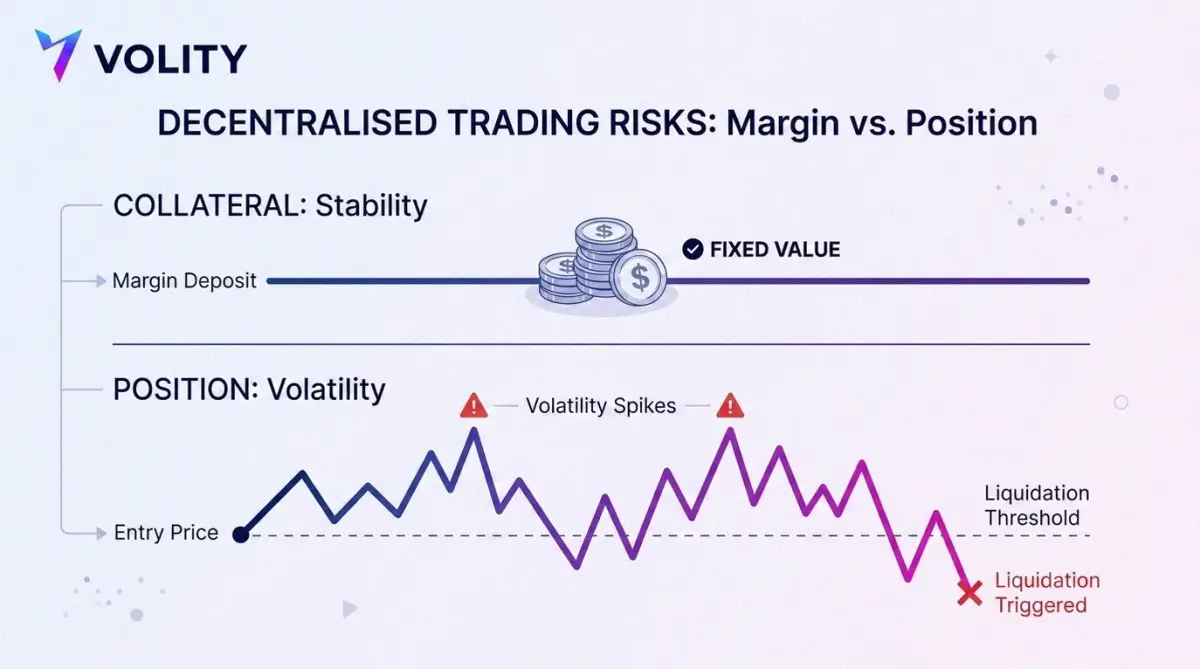
Stable collateral is not a safety net, and this is the section to read twice. Your position is unhedged and fully exposed, and a liquidation event on Hyperliquid occurs when a trader’s positions move against them to the point where the account equity falls below the maintenance margin. That maintenance requirement is half the initial margin at maximum leverage, which the documentation puts at between 1.25% and 16.7% depending on the asset. At the aggressive end, a position can be a few per cent from closure.
Several charges eat the balance while a trade is open. Funding accrues hourly for as long as you hold. Fees are charged per fill, and Hyperliquid’s published base schedule as of 2 August 2026 is 0.045% taker and 0.015% maker on perpetuals at tier 0, falling with fourteen-day volume. On $10,000 of notional a taker fill is $4.50 in and $4.50 out. And the liquidation engine itself works off the mark price, with the documentation warning that during volatility or on highly leveraged positions the mark price may differ significantly from the book price. Reading those numbers on your own panel is covered in our guide to margin health and liquidation price.
The collateral carries its own separate assumption, and it deserves naming rather than glossing. A peg holds because an issuer can honour redemptions, not because the number on the screen says one dollar. USDC traded down to about $0.87 in March 2023 after Circle disclosed that $3.3bn of its reserves were held at the failed Silicon Valley Bank, and it recovered the peg only once regulators confirmed depositors would be made whole. The Bank for International Settlements makes the structural version of the same point, arguing in its 2025 annual report that stablecoins do not deliver singleness of money, elasticity and integrity, with the full chapter setting out why a token can deviate from par. Treat a peg as an assumption you are choosing to carry.
Converting into and out of USDC without friction
The Markets section of your Volity dashboard is titled “Trade and prediction markets” and works the same way for both venues on it: connect or create your account at the platform, deposit from your Volity USD wallet, then trade on the platform and track the balance from the same screen. For Hyperliquid the panel shows available balance, account value, margin used, open positions and unrealised profit and loss, all denominated in USDC and labelled “Held at Hyperliquid” with a refresh timestamp. The step-by-step version lives in our walkthrough on funding a Hyperliquid account.
Balances and positions are held on the external platform rather than by Volity. Trading, availability and withdrawals are subject to each platform’s own terms, and Volity does not place or manage orders on your behalf.
Now the precision that trips people up, because “margined in USDC” is a property of a specific venue rather than a rule of on-chain trading. Hyperliquid’s main perpetuals venue margins in USDC directly. Its permissionless listing framework does not guarantee the same: the HIP-3 specification states that any quote asset can be used as the collateral asset for a dex, with quote-asset status itself subject to an onchain validator vote. So a builder-deployed market can ask you for something other than USDC, and knowing which market you are on is your job, not the interface’s.
Polymarket is different again. Its collateral token is pUSD, described in the venue’s documentation as a standard ERC-20 token on Polygon, backed by USDC, with the smart contract enforcing the backing and no algorithmic peg and no fractional reserve. Wrapping and unwrapping run through named on-chain contracts, and the docs add that day to day nothing changes for the user, who loads funds, sees a balance, trades and withdraws. Volity’s in-product wording for Polymarket funding, that it is funded in USD from your Volity wallet and delivered as USDC, describes the client side of that path accurately. What the venue then settles in is the wrapper.
| Where you are trading | What the collateral actually is | What to check first |
|---|---|---|
| Hyperliquid main perpetuals venue | USDC, with the oracle price quoted in USDT | Your available balance and margin used, both read in USDC |
| A HIP-3 builder-deployed market | Whatever quote asset the deployer chose | The collateral token named on that market before you size anything |
| Polymarket | pUSD, an ERC-20 on Polygon backed by USDC and enforced onchain | That deposits and withdrawals still route through USDC |
Why the venues differ at all comes down to their market structure, which is unpacked in what Hyperliquid is and in our comparison of a perp DEX against a centralised exchange.
What to check about any stablecoin you post as margin
Before your money becomes someone else’s liability, work through the same checks for whatever token a venue asks you to post. This is a due-diligence routine, not a ranking, and none of it says any stablecoin is risk-free.
- Who issues it. Identify the legal entity behind the token and the jurisdiction it answers to. USDC is issued by Circle, which describes it as a digital dollar backed by highly liquid cash and cash-equivalent assets.
- What the reserves hold. Composition decides how a token behaves under stress. Circle states that the majority of the reserve sits in the Circle Reserve Fund, an SEC-registered 2a-7 government money market fund, with the remainder in cash at large banks, and publishes holdings weekly.
- Who checks the numbers, and how often. An attestation from an independent accountant is not the same as an audit of the issuer, but it is a real external check. Circle says a Big Four firm provides monthly third-party assurance that reserves exceed tokens in circulation, and the June 2026 examination report is published in full.
- Whether you can actually redeem. The right that defends a peg is redemption at par. Under the EU’s Markets in Crypto-Assets Regulation, holders of an e-money token may redeem at any time and at par value, with reserve and custody rules supervised through the European Banking Authority and ESMA.
Supervisors are still building the perimeter around all of this, which is another reason to check rather than assume. The Bank of England published a policy statement and draft rules for sterling-denominated systemic stablecoins in June 2026, alongside a paper on how it and the Financial Conduct Authority will jointly regulate systemic issuers. Internationally, the Financial Stability Board’s high-level recommendations for global stablecoin arrangements set the reference standard national regulators work from. Rules differ by jurisdiction, so read the ones that apply where you live, and browse the rest of our crypto guides for the surrounding background.
What does margined in USDC mean?
It means you post USDC as collateral, and your profit, loss, funding and fees are all settled in USDC. On Hyperliquid’s main perpetuals venue the collateral is USDC even though the oracle price for a contract is denominated in USDT. Your account balance, your margin requirement and your realised result are then read in the same dollar-pegged unit. It is a venue property rather than a universal one, so confirm the collateral token on the specific market you are trading, since a permissionlessly deployed market may use a different quote asset.
Do I need to own the asset I trade?
No. A perpetual future is cash settled, so the contract pays the difference in value rather than delivering the asset. You can hold a position in a market without ever holding, storing or transferring the underlying. That is the whole point of the structure, and it is why one stablecoin balance can support positions across markets you have no wallet for.
Can my collateral lose value?
Yes, in two separate ways. Trading losses, funding payments and fees reduce it, which is the ordinary case. Separately, a stablecoin can trade below par if the market doubts the issuer’s ability to redeem, as USDC did in March 2023 during the Silicon Valley Bank failure. A peg is an assumption resting on reserves and redeemability, not a guarantee, and no stablecoin is risk-free.
What is cash settlement?
Cash settlement means a contract closes by paying the difference in money rather than by handing over the underlying asset. Buy a Bitcoin perpetual and profit, and the profit arrives as USDC. There is no delivery date, no asset transfer and nothing to store afterwards. Physically settled contracts do the opposite and require the actual goods or securities to change hands.
Why not margin in bitcoin?
Because it puts two moving prices in one trade. If the asset you post as collateral is also the asset you are trading, a fall in the market shrinks your position value and your margin at the same time, so the liquidation level arrives faster than the price move alone implies. A dollar-pegged unit leaves only the position moving, which makes risk far easier to size and to monitor.