Quick answer
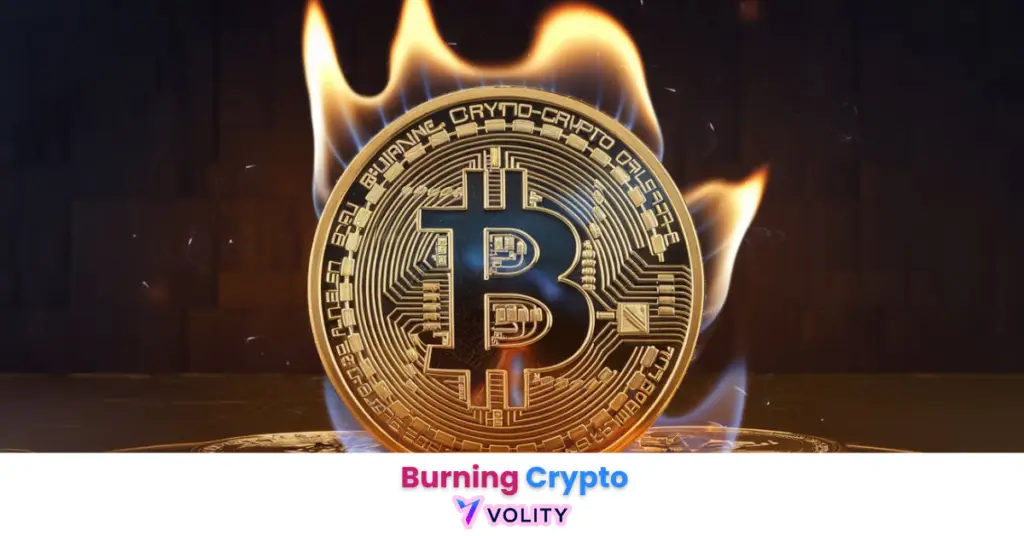
Burning crypto means permanently removing tokens from circulation by sending them to an address no one can access, reducing the total supply. Projects burn tokens to create scarcity, offset inflation or signal commitment. A burn only supports price if demand holds; some burns are mainly marketing, so check the size and purpose before reading it as bullish.
The Crypto Trading Starter Kit
A plain-English PDF: what to check before you trade, how orders and risk really work, and the mistakes to skip. Get it free.
Burning crypto involves permanently removing tokens from circulation through irreversible transfers to inaccessible addresses. This article explains the mechanism but does not constitute financial advice.
Token burning does not guarantee price appreciation, scarcity without utility fails to sustain value. Always evaluate a project’s use case and network demand before making investment decisions based on burn mechanics.
Past performance is not indicative of future results. Capital at risk.
While understanding Burning Crypto is important, applying that knowledge is where the real growth happens. Create Your Free Forex Trading Account to practice with a free demo account and put your strategy to the test.
Burning crypto identifies the intentional destruction of digital assets to permanently reduce their circulating supply. This process reveals how projects manage their economic models to support long-term market capitalization. In the 2026 regulatory environment, these mechanisms must meet strict transparency standards.
Token destruction correlates with network utilization in modern ecosystems. For example, Ethereum and BNB Chain utilize automated systems to destroy fees, indicating a shift toward deflationary pressure. These burns are no longer just marketing tools but core components of sustainable blockchain architecture.
What Is the Purpose of Burning Crypto?
Burning crypto is a strategic mechanism used by blockchain protocols to manage token supply, counteract inflation, and align incentive structures for long-term holders. Digital scarcity created through burning operates as the economic foundation of tokenomics. Proof-of-Destruction, the immutable record that tokens are gone forever, distinguishes burns from temporary lockups that retain recovery potential.
The difference between burning and bitcoin halving events illustrates the distinction between programmatic and mechanical supply reduction. Bitcoin halving cuts mining rewards automatically; burning actively destroys existing supply. Both mechanisms reduce dilution and create scarcity, but burning achieves immediate circulation reduction while halving distributes supply reduction across mining epochs.
Role in DeFi governance and staking rewards reveals how burns align community incentives. Protocols that burn governance token fees reward non-participating holders with scarcity gains while paying active participants directly.
Ready to Elevate Your Trading?
You have the information. Now, get the platform. Join thousands of successful traders who use Volity for its powerful tools, fast execution, and dedicated support.
Create Your Account in Under 3 MinutesHow Does Crypto Burning Work Step-by-Step?
The crypto burning process identifies the transfer of tokens to a “null address” or “dead wallet” that lacks a private key, rendering the assets permanently inaccessible. Sending 1 million tokens to address 0x000…dead (the standard Ethereum null address) destroys them irreversibly because no one possesses the private key to recover them.
Role of smart contracts in automating burns enables projects to execute deflationary policies without manual intervention. Ethereum’s EIP-1559 burns a portion of every transaction fee automatically. BNB Chain’s burn mechanism runs a quarterly auto-burn set by a published formula. Automation ensures consistency and transparency that manual burns cannot provide.
Verification of “non-recoverable” status on blockchain explorers confirms that burned tokens are truly destroyed. Searching the null address on Etherscan reveals all incoming transactions and, critically, zero outgoing transfers.
This immutable record proves the tokens are unreachable. Contrast between manual community burns and protocol-level burn rate triggers shows that programmatic burns build stronger confidence than volunteer-based destruction.
Ethereum’s EIP-1559 has cumulatively burned more than 4.6 million ETH, a running total published on the ultrasound.money burn tracker.
Why Is On-Chain Verification Essential for Token Burns?
On-chain verification identifies the use of public transaction hashes to prove that tokens were successfully destroyed and are not hidden in accessible developer wallets. The 2026 MiCA framework mandates that all token burns must be verifiable on-chain, eliminating claims about burns that lack cryptographic proof.
Identifying “fake burns” and honeypot scams requires understanding the difference between inaccessible addresses and developer-controlled wallets. Projects claiming to burn tokens while retaining recovery access represent fraud. Using crypto nodes to validate the integrity of the burn ledger provides independent verification rather than trusting project claims.
Real trading example:
Shiba Inu burn transactions are published on-chain, so a claimed burn surge can be checked against the ledger rather than taken from a social-media post. Blockchain explorers confirmed each burn transaction irreversibly. Past performance is not indicative of future results.
How Do Major Protocols Implement Token Burning?
Major protocols implement token burning through automated fee destruction or scheduled revenue-based buybacks to maintain economic equilibrium. Ethereum’s gas fee burn mechanism destroys 100% of base fees, creating perpetual deflationary pressure. BNB Chain’s quarterly auto-burn runs against a published formula and continues until total supply reaches 100 million BNB.
Stablecoin supply management reveals how burns prevent inflation spirals. When stablecoin demand declines, protocols burn excess supply to maintain the 1:1 peg. This mechanism creates a feedback loop, declining demand triggers burns that reduce supply, stabilizing the price floor. gas fees impact determines burn velocity: high network activity drives high gas destruction; network lulls reduce burn rate.
The 35th quarterly BNB burn removed 1,569,307 BNB, worth roughly $1.02 billion at completion, in April 2026, per BNB Chain’s own burn announcement.
How to Avoid Accidental Crypto Burning?
Avoiding accidental crypto burning requires the rigorous verification of recipient addresses and the utilization of trusted wallet interfaces to prevent irreversible fund loss. Dangers of “copy-paste” errors in wallet addresses account for hundreds of millions in inadvertent burns annually. Confirming the first and last 4 characters of an address eliminates 99.9% of copy errors.
Identifying phishing scams disguised as “burn rewards” requires skepticism toward promises of compensation for “joining burn events.” Legitimate burns occur automatically on-chain; fraudulent burns solicit transfers to the scammer’s address under false pretenses. Importance of “test transactions” for large transfers protects against catastrophic address errors, sending 0.1 tokens first confirms proper destination before committing the full amount.
Turn Knowledge into Profit
You have done the reading, now it is time to act. The best way to learn is by doing. Open a free, no-risk demo account and practice your strategy with virtual funds today.
Open a Free Demo AccountKey Takeaways
- Burning crypto identifies the permanent destruction of tokens via inaccessible null addresses.
- Ethereum has removed more than 4.6 million ETH from circulation through its EIP-1559 mechanism.
- BNB Chain’s quarterly burn events target a final supply equilibrium of 100 million tokens.
- MiCA 2026 standards mandate on-chain transparency for all protocol-level burn transactions.
- Token burning creates scarcity but requires sustained network demand to impact asset value.
- Burn addresses are verifiable on public ledgers but lack private keys for asset recovery.
Frequently Asked Questions
This article contains references to Burning Crypto and Volity, a regulated CFD trading platform. This content is produced for educational purposes only and does not constitute financial advice or a recommendation to buy or sell any financial instrument. Always verify current regulatory status and platform details before using any trading service. Some links in this article may be affiliate links.
What our analysts watch: Three signals separate a real deflationary thesis from a marketing burn. Net issuance after burn (Ethereum can swing positive or negative depending on validator emissions versus base-fee destruction).
Burn-rate stability across cycles (one-off ceremonial burns rarely move price; programmatic burns tied to network activity do). Wallet provenance of burned tokens (treasury burns from foundation wallets carry a different signal than user-fee burns).
When all three line up, supply mechanics start to matter for valuation.
Volity operates a trading platform and also publishes educational and analytical content about trading. The content on this page is for educational purposes only and should not be considered financial advice. Volity may benefit commercially when readers open trading accounts through links on this site.
Our content is produced and reviewed under documented editorial standards; see our comparison and review methodology.