Volity crypto morning brief: taxes, exploits and a flash-crash stress test
Sunday’s crypto market offers three familiar pressures in sharper form: tax policy, protocol security and exchange capacity.
Illinois is testing a new tax model. Meanwhile, Term Labs faces a costly governance exploit.
In South Korea, Upbit processed nearly $830 million during one violent hour of trading.
Illinois taxes crypto, and the industry pushes back
Illinois has become an early battleground for state-level crypto taxation.
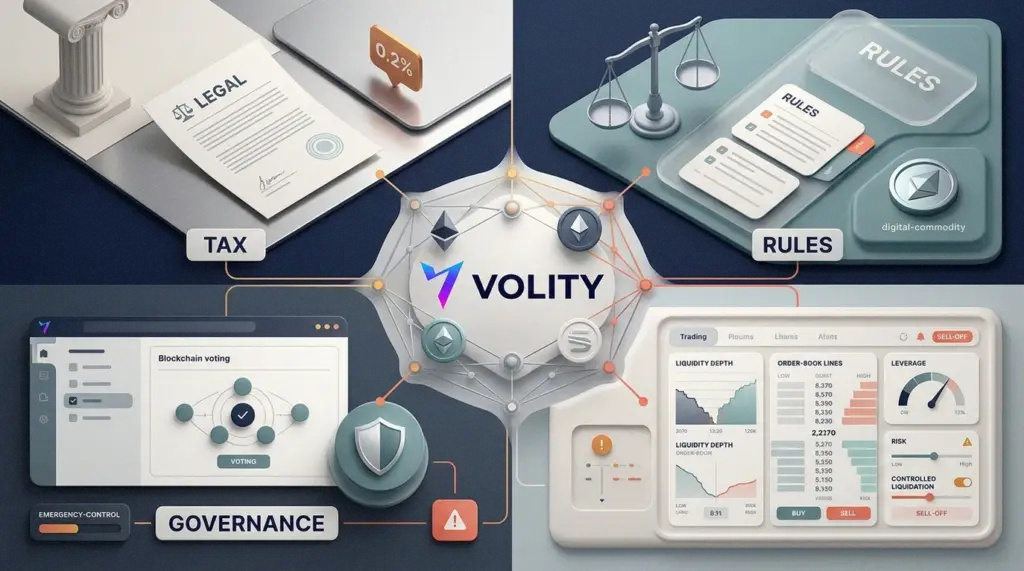
The state’s Digital Asset Tax Act imposes a 0.2% levy on certain digital-asset transactions.
The charge applies when qualifying brokers trade or hold assets for Illinois customers.
The levy does not depend on whether customers made money, so losing trades are taxed too.
Brokers with more than $100,000 in Illinois-linked receipts could fall within its scope.
Several industry groups have now challenged the measure in court.
They argue that Illinois singled out blockchain-based assets for treatment unavailable to stocks, bonds and cash.
The plaintiffs also cite the Dormant Commerce Clause, which limits state burdens on interstate trade.
They also point to the federal Internet Tax Freedom Act.
That law restricts discriminatory taxes on online activity and electronic commerce.
The lawsuit matters beyond Illinois. Cash-strapped states will watch the case closely.
If Illinois wins, similar transaction taxes could spread across the country.
However, a defeat would limit states’ ability to isolate crypto for special fiscal treatment.
For exchanges and brokers, regulatory risk has become a measurable operating cost.
Armstrong presses Congress for clearer rules
Coinbase chief executive Brian Armstrong continues to press senators over the proposed CLARITY Act.
His argument is straightforward: companies need rules before enforcement begins.
Armstrong says today’s framework leaves firms and retail customers guessing about legal boundaries.
That uncertainty can push activity towards weaker venues and opaque products.
The proposed legislation seeks to define categories including “digital commodities” and “network tokens”.
It would also divide responsibilities between the Securities and Exchange Commission and Commodity Futures Trading Commission.
Oversight would depend on an asset’s features and the nature of each transaction.
In addition, the bill proposes registration requirements for exchanges, brokers and dealers handling digital commodities.
That structure would resemble licensing systems already used in conventional financial markets.
Traders may dislike tighter rules. Yet predictable rules can reduce sudden enforcement shocks.
A settled statute could help institutions approve larger allocations to digital assets.
The trade-off is plain. Firms would have less room to interpret vague rules creatively.
Term Labs exposes governance risk
Term Labs confirmed that attackers exploited governance controls within some of its lending vaults.
Security analysts estimate losses near $8.5 million, although the protocol still assesses the final figure.
The attacker allegedly took about 2,843 ETH and $1.6 million in dollar-pegged assets.
Those stablecoins moved through USDC before landing in DAI, according to on-chain tracking.
The attack did not appear to rely on a conventional coding mistake.
Instead, the attacker gained effective control over vault governance and used authorised permissions to drain funds.
That distinction matters. Governance contracts increasingly offer the richest targets in decentralised finance.
Direct smart-contract flaws may attract scrutiny. Governance settings often receive less attention.
Seemingly cautious parameters can also become dangerous when volatility and flash-loan liquidity collide.
The affected vaults reportedly held only modestly more than the stolen amount.
As a result, the exploit nearly stripped their lending capacity in one sweep.
- Control matters: Investors should identify who can change collateral, borrowing and withdrawal rules.
- Delays matter: Timelocks and emergency pauses can limit damage when governance fails.
- Concentration matters: A small group of voters can turn decentralisation into a fragile label.
Yield always carries a price. In DeFi, that price includes code, custody, liquidity and governance risks.
Upbit handles a billion-dollar hour
South Korea delivered a separate test of crypto market infrastructure.
Upbit processed an estimated 1.15 trillion won, or roughly $830 million, within one hour.
The burst came during a sharp market decline and pushed rolling 24-hour volume to about $3.8 billion.
Traders rushed to exit positions. Others were forced out through leveraged liquidations.
South Korea’s retail-heavy crypto market often magnifies momentum in widely held tokens.
Recent enthusiasm around XRP and Trump-linked tokens added fuel to that tendency.
When prices fall quickly, leverage can transform a fast move into a liquidation chain.
Still, Upbit’s operational performance offered some reassurance.
The exchange handled intense order flow without a full system failure or prolonged outage.
That marks real progress from the infrastructure strains seen during earlier crypto booms.
However, traders should not mistake high volume for reliable exit liquidity.
Liquidity often appears when prices already move violently, and spreads can widen without warning.
What traders should watch
- Track the Illinois case closely. A successful tax could become a template for other states.
- Inspect governance before chasing yield. TVL and APY reveal little about emergency powers and voting concentration.
- Test exchange assumptions. Venue resilience matters most when liquidations flood the order book.
- Expect regulation to shape valuations. Clear federal rules could favour compliant exchanges and established token issuers.
Crypto markets are gaining structure in law, governance and trading systems.
Yet each improvement reveals another weak point. Traders should watch the tape and the small print together.
Related coverage on Volity
- How to Avoid Crypto Scams: A Beginner Safety Checklist
- How to Choose a Trading Platform: A 10-Point Checklist
- Demo vs Live Trading Account: A 7-Step Checklist Before You Go Live
- How to Size a Trade: Position Sizing and Risk Per Trade for Beginners
- Risk-Reward Ratio Explained: How to Set It and Why It Matters
- ETF vs Index Fund: The Difference and Which to Pick