Which AI trading app can you trust with your money? Most of the “AI” inside trading apps is research help that explains, summarises and filters information, and an app’s safety depends far more on the licensed company holding your money than on its AI. The checks below take you from the app store page to your first real trade: name what the AI does, spot the scam signs regulators warn about, confirm who holds your funds and test every AI feature on a demo first.
TL;DR: Most AI in trading apps explains, summarises or alerts, and only automation can move your money. No app can reliably predict markets, so treat win rates and “guaranteed” returns as warning signs. Check the licence number of the company that holds your money on the regulator’s own register, then test any AI feature on a demo you open yourself.
On 7 July 2026 eToro launched a rebuilt “AI-first” app built around Tori, an AI agent that explains price moves, as FinTech Global reported. eToro’s own announcement says Tori does not provide investment advice, and our eToro alternatives guide compares it with other apps. A survey by the UK’s Financial Conduct Authority (FCA) of 666 people aged 18 to 40 who invest or plan to, run in July 2026, found that 56% trust AI tools, yet 44% wrongly believe AI-generated financial information is regulated. That gap between trust and protection is where people lose money.
Know what “AI” means inside a trading app
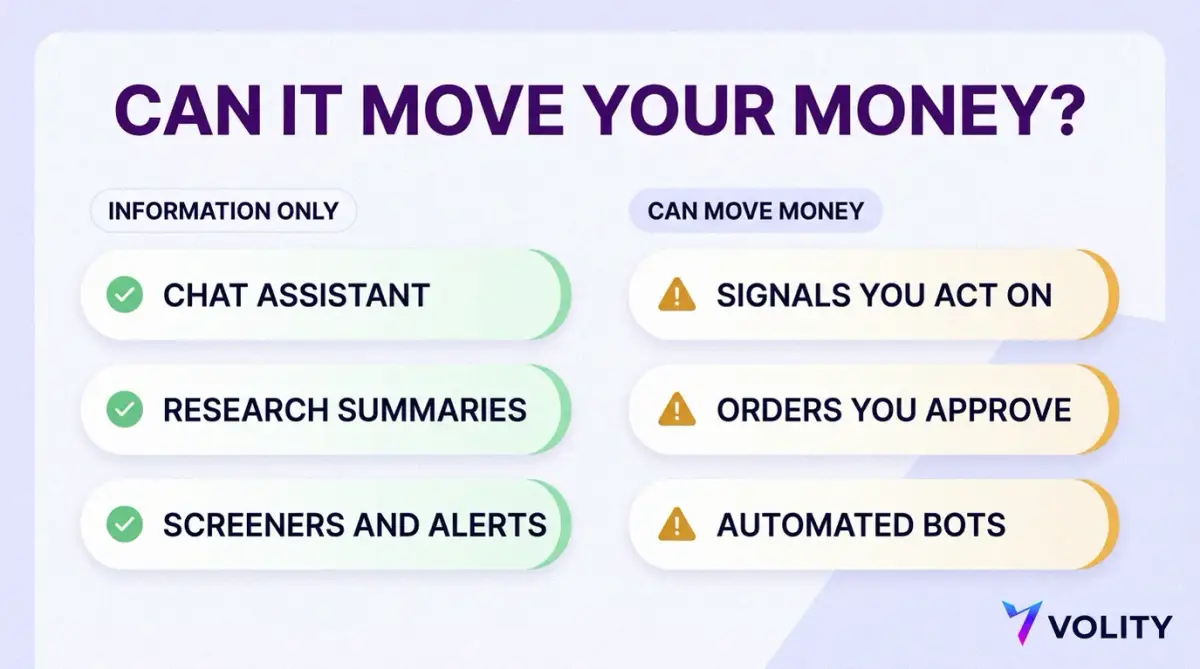
On an app store page, “AI” can mean anything from a chat window to a bot that trades while you sleep. What matters most is whether the feature can move your money or only gives you information. Canada’s Ontario Securities Commission groups retail uses of AI into decision support, automation, and scams and fraud. The table covers the first two, and scams get their own section below.
| Feature | What it does | Can it move money? |
|---|---|---|
| Chat assistant | Answers questions and explains terms | No |
| Research summaries | Condenses news, company results and filings | No |
| Screeners and alerts | Filters markets by your rules and flags price levels | No |
| Signals and pattern calls | Suggests trades, often for a subscription fee | No, but you may act on them |
| Order staging | Prepares orders for you to approve | Yes, after your approval |
| Automated strategies and AI agents | Trades by itself within limits | Yes, without asking you |
The last two rows need the most care. Most bots reach your account through an API, a digital doorway that lets one program send instructions to another, and whoever holds its password, the API key, can do whatever the key allows.
Before you download anything, write one line: what does this app’s AI do, and can it move my money? For the wider picture, see our explainer on AI trading tools and strategies.
Separate useful AI features from marketing
Useful AI saves time on work you would otherwise do by hand: summaries that lead you to the original news and filings, plain-language explanations of jargon, screeners and alerts built on your own rules, and a journal of your trades so you can review your decisions.
Marketing is anything that promises an outcome, and regulators are blunt about prediction. ESMA, the EU’s securities markets regulator, warns that “no one and nothing, including AI tools, can accurately predict financial markets”. The FCA’s InvestSmart guide calls AI “analytical not psychic”, because it works from past data and cannot foresee sudden events. AI can also be wrong while sounding certain, which the industry calls a hallucination.
Treat these as red lights: a win rate in the headline, “up to X% a year”, “guaranteed”, or a “sure thing”, which the FCA names as a red flag. A win rate is the share of trades that close in profit. It says nothing about the size of the losses, so a bot can win most of its trades and still lose money. Ask for dated, complete results that include losing trades and costs, and walk away if the seller cannot show them.
Spot the red flags of an AI trading scam
Some of the loudest “AI trading apps” are not trading apps at all. Australia’s regulator, ASIC, warns about scammers who claim their trading bots use AI to generate passive income, and says: “It is very unlikely that these trading bots exist.” Australians lost A$837.7 million to investment scams in 2025, according to the National Anti-Scam Centre. In an Ontario Securities Commission experiment, people put 22% more money into AI-enhanced scams than into ordinary ones.
The bait is often a deepfake: a video or voice clip made with AI to show a real person saying things they never said. The Central Bank of Ireland has warned about deepfake ads that steer people to fake investment platforms, and it named “Quantum AI” as an unregistered firm that claims to trade crypto with AI. New Zealand’s regulator, the FMA, describes the pattern: a first deposit of around US$250, fake profits on screen, then invented “fees” at withdrawal.
Warning signs from the FCA, the EU supervisors’ AI fraud factsheet and the regulators above:
- guaranteed or “passive” income from a bot
- a news-style ad or a celebrity promoting a trading app
- pressure to act now, flattery or contact you did not expect
- payment only by crypto, gift cards or bank wire
- a request to install software or take control of your device
- a polished website with no company registration details
- small early payouts meant to build trust
- profits you cannot withdraw, or a fee to release them
- a “recovery” service offering to win back lost money for a fee
If two or more appear, stop and send nothing. Our checklist on how to avoid crypto scams covers the same tricks.
Check who holds your money and who regulates the app
An AI feature is software, but your money sits with a company, and that company is what you need to check. The AI itself carries no protection: the FCA does not regulate advice from general-purpose AI tools, so a chatbot’s tip comes with no safety net.
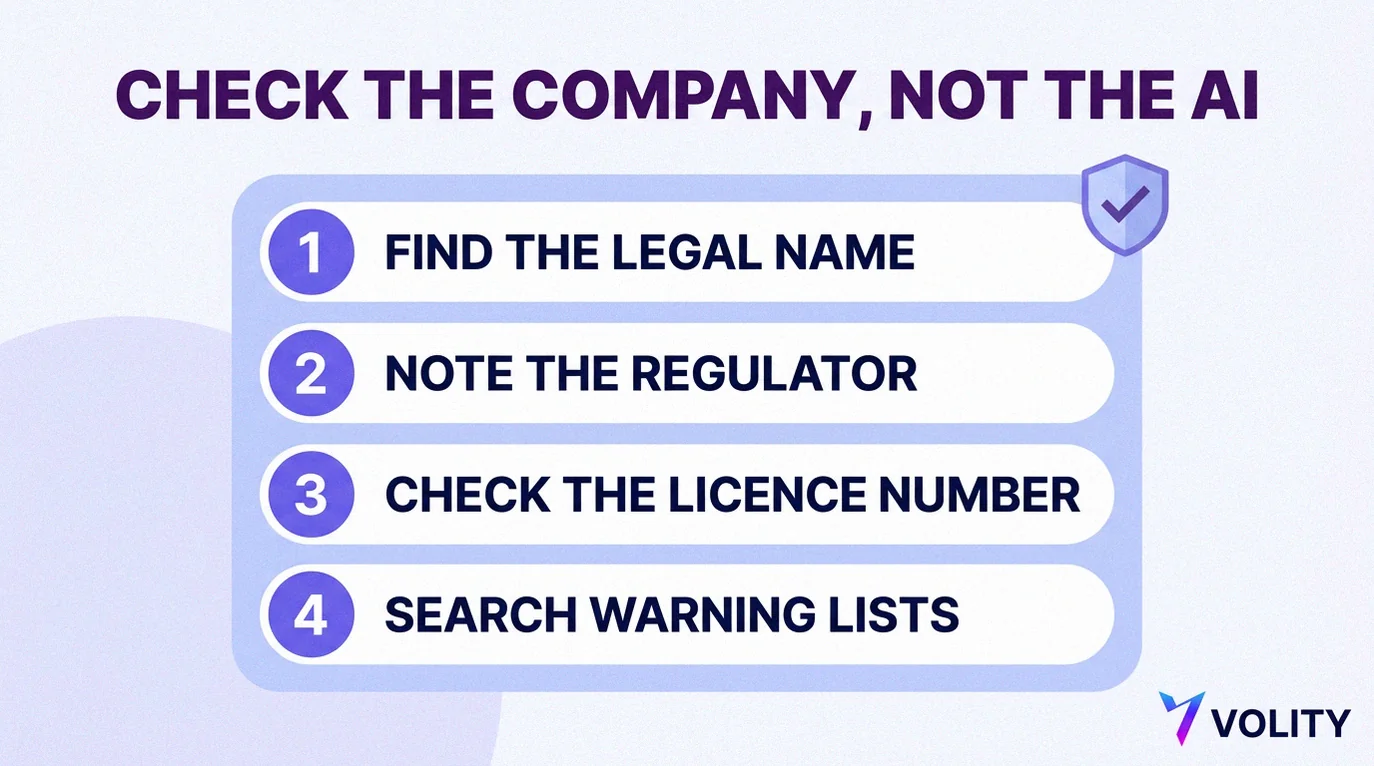
Find the company behind the app
- Find the legal name of the company that holds your money in the app’s terms or website footer. It often differs from the brand name.
- Note which regulator licenses that company and write down the licence number.
- Look the number up yourself on the regulator’s public register, the official list of firms it licenses. Type the regulator’s web address rather than clicking a link, and check that the name and number match.
- Search the app and company names on warning lists, such as IOSCO’s I-SCAN and your national regulator’s list.
Search results are not proof. ASIC, which took down 7,051 fake investment platforms in its 2025-26 financial year, up 151%, warns that “a simple online search is not enough to verify whether an opportunity is legitimate”. A Google UK search for “are AI trading apps safe” on 28 September 2026 proved the point: several top results were “review” videos hosted on an unrelated business’s website.
Volity answers these questions in public. It operates under CySEC licence 186/12 via UBK Markets, and Is Volity legit? shows how to check that licence on the register of CySEC, the Cyprus Securities and Exchange Commission.
Lock down what the AI can touch
Good designs keep you in the loop, with every order waiting for your approval. Never give an AI tool withdrawal rights or remote access to your device, make any API key trade-only and, as ESMA advises, keep personal details out of public chatbots.
Test any AI feature on a demo before real money
A demo account trades virtual money at real market prices, so you can test an AI feature without risking your own. Run it as a written experiment:
- Open the demo yourself at a licensed provider, from its official website or app store listing.
- Fix the length of the test in advance, in weeks or in trades.
- Write a pass rule, for example “beat my own plan after costs, with no loss above my limit”.
- Log every AI suggestion, what you did and what happened next.
- Count every cost: spreads, commissions and overnight fees.
- Run your own plan alongside the AI for comparison.
- Judge the losers as well as the winners, then go live small with a loss limit you review monthly.
Scammers show fake balances too, so trust only a demo you opened yourself, never a seller’s dashboard or screenshot. On Volity, a free demo comes with every account tier: open a free Volity demo and run this test before you fund anything.
How Volity uses AI to help you trade and invest
On Volity, AI has a clear job: helping you understand the platform. Avy, Volity’s AI assistant on volity.io, works by chat or by voice and answers in your own language. Ask how to open an account, what a fee covers or how an order type works. Avy searches Volity’s published guides to answer, and you can read those guides in full on the site.
Avy does not trade, give personal investment advice, predict prices or manage money. It answers your questions, and the trading decisions stay with you, in line with the FCA’s first tip for investing with AI: stay in the driving seat. The rest of the platform keeps you in charge too:
- a free demo on every account tier
- copy trading and curated trading signals, which are tools rather than AI: copy trading mirrors a trader you choose, and signals are ideas you review before acting
- a commission-free Markets account, free crypto deposits and free withdrawals
- one account for real shares, fractional shares, crypto and CFDs, plus a $0 multi-currency wallet
Copy trading and signals carry the full risk of the strategy you follow, and CFDs (contracts for difference) use leverage, which magnifies losses as well as gains. Find both tools in the Volity tools hub, read how to choose a copy trading platform, then open a Volity account and ask Avy anything before your first trade.
Choose the AI trading app that fits you
Match the AI feature to your goal, then check the one thing that matters most.
| Your goal | Look for | Check first |
|---|---|---|
| Learn the basics | An assistant that cites its sources | A free demo to practise on |
| Research faster | Summaries and screeners | Links back to the original documents |
| Trade actively | Alerts and orders you approve | No order runs without your approval |
| Stay hands-off | Automated strategies or AI agents | You carry the full risk and can stop it at any time |
Whatever you choose, keep permissions tight, test on a demo first and keep the final decision yours. If you trade mostly from your phone, see what to look for in a mobile trading platform, a crypto trading app or a CFD trading app, or browse all our trading platform guides. Then pick one AI feature and test it on a demo this week. For market insights, education and platform updates, subscribe to Volity’s “Start Your Days Smarter” at the foot of this page.
Fact check: Figures and quotes were checked against the original sources on 28 September 2026: the FCA, ESMA and the EU supervisors’ joint factsheet, ASIC releases 26-063MR and 26-195MR, the Central Bank of Ireland, New Zealand’s FMA, the Ontario Securities Commission, eToro’s 7 July 2026 announcement and Fidelity International’s study via International Adviser. Volity facts come from Volity’s own pages. General information, not personal investment advice.
Frequently asked questions
Is AI trading legit?
Yes, as a research aid. A Fidelity International study of 13,000 investors in Europe and Asia Pacific, reported in June 2026, found that 23% of UK retail investors use generative AI to support investment decisions. Bots that promise guaranteed or passive income are the scam version, and ASIC says they very likely do not exist.
Can an AI app trade for me automatically?
Some can, through AI agents that trade in a separate sub-account (a walled-off part of your account) or bots linked to a broker by API. Automated trades can magnify losses, and the risk stays yours, so approve each order or set firm limits, and never grant withdrawal rights.
Are AI trading apps safe?
An app is as safe as the licensed company holding your money, so check its licence number on the regulator’s own register. The AI adds no protection of its own. Test on a demo first and walk away at the first red flag.
What is the best AI trading app for beginners?
Choose one whose provider you can verify, whose AI explains instead of promising, and which offers a free demo. Start with an assistant and research summaries, leave automation for later, and make every trading decision yourself while you learn.
Can AI predict the stock market?
No. ESMA says no one and nothing, including AI tools, can accurately predict financial markets, and the FCA calls AI “analytical not psychic”. At best, research finds narrow edges on specific tasks, so decide before each trade how much you are prepared to lose.
How much money do I need to start with an AI trading app?
Nothing, if you start on a free demo. On Volity, a Markets account starts from $1, with funding from 10 EUR. Crypto deposits and all withdrawals are free, card deposits carry a 2.99% fee, and every charge is listed on the fees page. Add real money only after your demo test has passed.